
What Moisture Variation Actually Changes
Recovered wood fibre almost never arrives at one moisture level. A load that has been stacked outdoors in a rainy week, a batch from a different dismantling yard, and a pallet of freshly planed offcuts are three different materials even when they look the same on a conveyor. Treating them as one input is the point where a molding line starts producing variation rather than parts.
The difficulty is not that wet fibre is unpleasant to handle. It is that moisture is an input to three separate decisions downstream, and a change in it moves all three at once.
Binder is dosed against dry fibre
Glue dosing is set as a ratio to the fibre charge. If a weighed charge carries more water than the recipe assumes, the actual binder-to-dry-fibre ratio falls below what was specified. The mix then cures differently, and the part that leaves the mould is not the part the process settings were written for. Isocyanate binders also react with water, so excess moisture consumes part of the addition before it can do its intended job in the bond.
Water becomes steam inside a closed mould
A molded pallet is formed in a heated steel mould held closed under pressure. Water that was not removed earlier turns to steam inside that closed volume. The result shows up as density variation across the part, local voids or blistering, release problems and surface defects. Extending the dwell time is not a general remedy: it changes the cure state of the whole charge and slows the line’s rhythm without restoring the missing control upstream.
Weighed spreading assumes a stable bulk density
An automatic spreading unit weighs the charge before distributing it across the mould. Wet fibre packs differently from dry fibre, so the same weight occupies a different volume and levels differently. The operator sees a correct number on the scale and still gets an uneven fill. This is why moisture control is a precondition for the weighing stage rather than a refinement of it.
Where the Drying Stage Sits in the Line
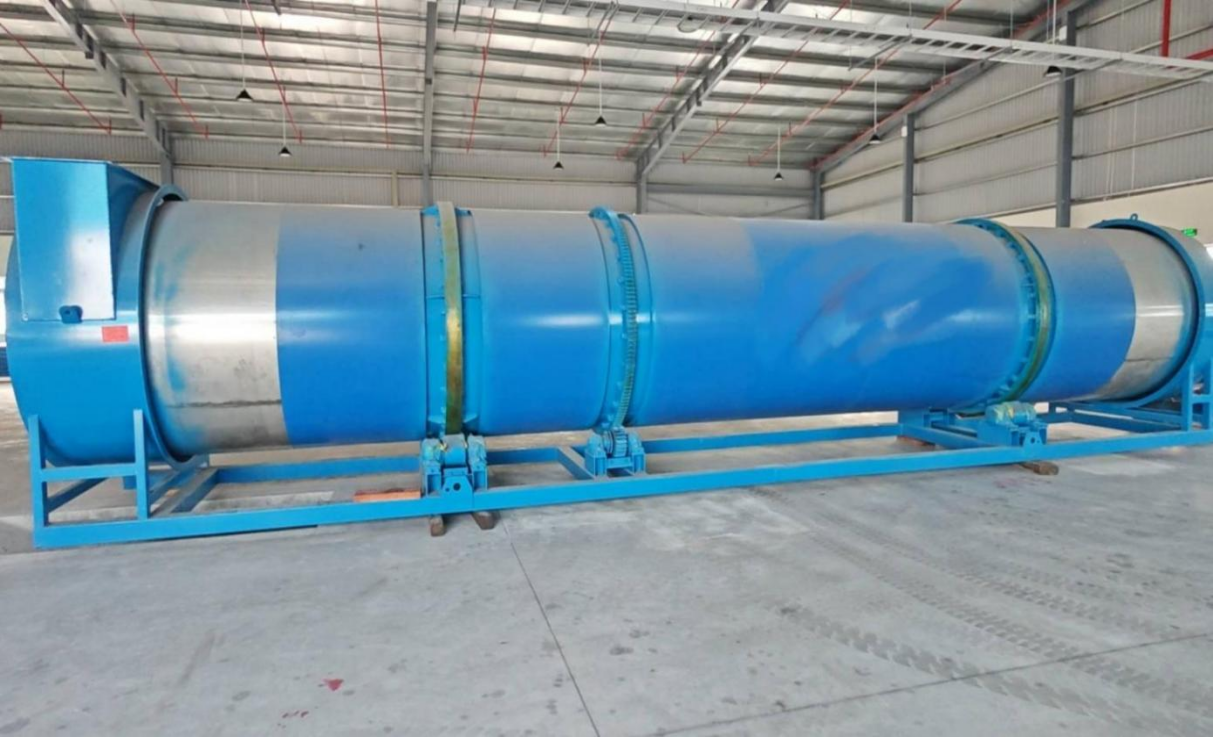
AutoML is configured as a chain: size reduction and tramp-metal removal, drying, buffering, metered glue blending, weighed spreading, hot pressing, then demoulding and stacking. Drying sits where it does because every stage after it assumes a furnish inside a defined moisture band. Its job is not simply to remove water; it is to give the blending and pressing stages a controlled input so their settings continue to mean the same thing from one batch to the next.
In practical terms that means the drying unit is specified together with the furnace or heat source, the temperature sensing and the material handling into and out of it. A rotary dryer that holds a target on a steady infeed can still drift when the infeed swings; the control arrangement and the buffering ahead of the dryer are part of the same decision. See the sawdust dryer machine and glue mixer machine pages for how these stages are described as equipment.
What to Measure Before a Dryer Is Sized
A dryer is sized against the worst case the site will actually see, not against an average. These are the facts worth putting on the table before any configuration is discussed:
- The moisture range across a representative period, including the wet-season peak, not a single measured figure.
- How many different supply sources the yard draws from, and how much their moisture differs.
- Fibre geometry after size reduction, because particle size changes how quickly water leaves the material.
- Contamination load: metal, stone, plastic, paint and treated timber all affect the front end.
- The target moisture band at mould entry, which depends on the furnish and the binder system chosen.
- Available heat source, dust extraction, fire protection and the floor space a closed drying stage needs.
The line selection guide is a useful starting point for matching the configuration to those constraints, including whether the front end is supplied at all.
Where the Scope Has to Be Confirmed
The target moisture content and the drying configuration are determined by the raw material and the agreed project solution; they are not fixed values that apply to every line. Our AutoML process documentation uses a narrow window at mould entry as its reference band (6-10%), but the setting for a specific project has to be confirmed against the actual furnish, the chosen binder and the mould in question. Treat that number as a reference point for the technical discussion, not as a specification you can order against.
Existing drying equipment can sometimes be kept, provided its output is sampled across a full range of infeed conditions rather than on one good day. Projects with a reliable supply of already-dried fibre may legitimately leave the drying stage out of scope and start downstream of it. Final equipment scope, control arrangements and acceptance conditions are confirmed during technical review and set out in the agreed proposal and contract.
Next Step
If moisture variation is what currently limits your line or your plan for one, the useful conversation starts with your own measurements: the range, the sources and the point in the process where the material is sampled. Bring those together with the target pallet specification, and the drying stage can be discussed as a defined requirement rather than a catalogue item.
FAQ
Can a longer press cycle compensate for wet fibre?
Only within narrow limits, and not as a general fix. Extra dwell changes the cure state of the whole charge, reduces output and does not restore the binder ratio that was set against dry fibre. Moisture control belongs upstream of the mould.
What target moisture should we specify?
It is set during technical review for your furnish and binder system. Our process documentation works with a narrow reference band at mould entry, but the project value has to be confirmed by sampling and trial runs. A number copied from another plant is not a valid setting.
We already own a dryer. Can it stay?
Often yes. The question is whether its output stays inside the required band when the infeed changes, so ask for output records across a wet period rather than a single test. Its capacity and its control arrangement both have to match the line’s rhythm.
How should outdoor stockpiles be handled?
Cover and segregate by source and delivery date, and measure moisture at the point where material enters the line rather than at delivery. Blending wet and dry batches ahead of the dryer is usually more controllable than trying to correct the mix at the press.
Is a drying stage always included?
No. AutoML is modular. Where prepared, dried fibre can be bought locally on a reliable basis, a semi-automatic configuration can begin at the blending and pressing stages and leave the front end out. That shifts the moisture responsibility to the supplier and should be written into the scope explicitly.