
A sawdust pallet making machine turns wood waste into hot-pressed molded pallets with ±1mm dimensional tolerance—no nails, no warping, no splinters—so robot forklifts, ASRS cranes, and high-speed sorters run without sensor trips or repair backlogs.
When Automation Outruns Pallet Consistency
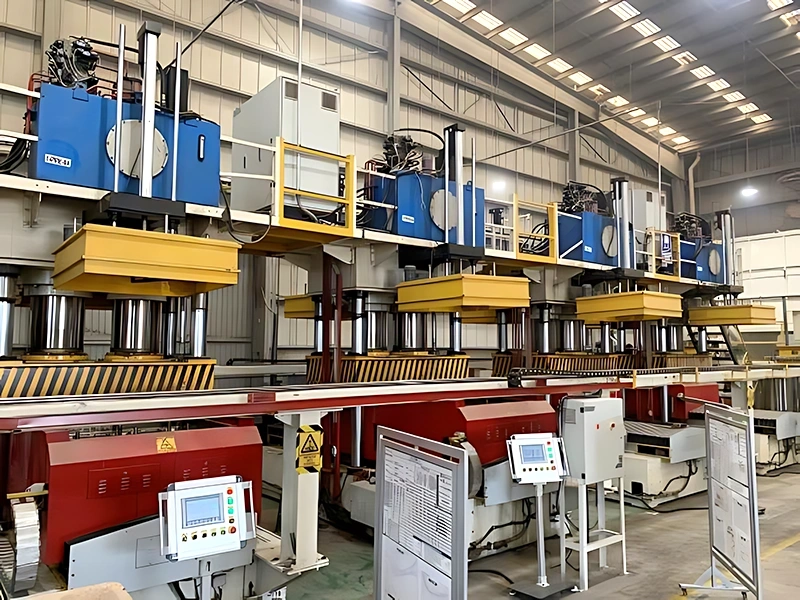
Downstream facilities are automating fast. Automated storage and retrieval systems (ASRS), robot forklifts, and high-speed sortation lines are now standard in modern distribution centers. But there is a catch these systems all share: they assume the pallet underneath the load is geometrically predictable.
The moment a pallet shows even slight warping, a protruding wood splinter, or a missing corner block, the sensors trigger an alarm and the line stops. One bad pallet can halt a whole sorting lane. As automation rates climb, the tolerance for pallet inconsistency drops toward zero.
Why Traditional Wood Pallets Break the Automation Promise
Conventional nailed wood pallets are built from loose lumber components fastened with nails. Wood is a natural material: its moisture content shifts with temperature and humidity, so every board expands, contracts, and bows a little differently. Over weeks of cycling through a warehouse, that means:
- Dimensional drift — pallet length, width, and load height vary from one unit to the next.
- Nail pull-out and protrusion — fasteners loosen, lift, and snag sensors or conveyor guides.
- Splinters and broken components — cracked stringers and missing blocks create uneven bearing surfaces.
- Warped decks — bowed top boards prevent robot forks from seating cleanly.
None of this is a quality failure in the traditional sense—it is the natural behavior of nailed timber. But on an automated line, it becomes a reliability failure. Pool operators are forced to raise inspection standards, which drives up the number of repair parts per pallet. Repair capacity and labor both get stretched. In 2026, one major pool operator saw roughly USD 60 million in quarterly profit pressure from the combination of constrained repair capacity and tightening quality demands, and had to emergency-purchase 2 million new pallets just to keep downstream customers supplied.
How a Sawdust Pallet Making Machine Fits the Automation Equation
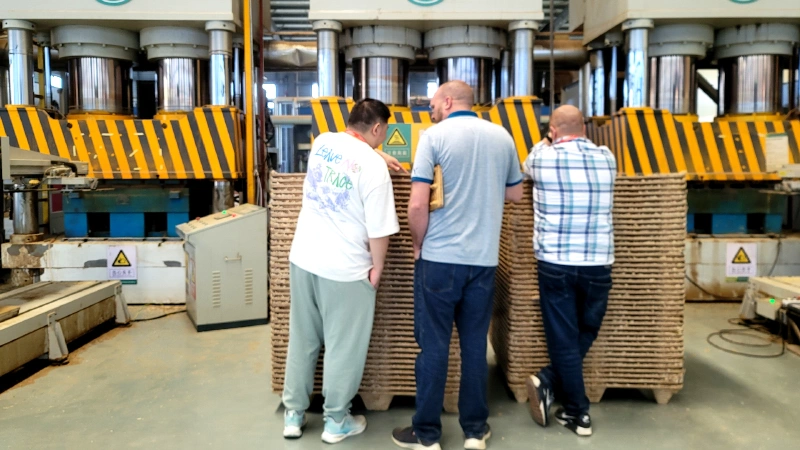
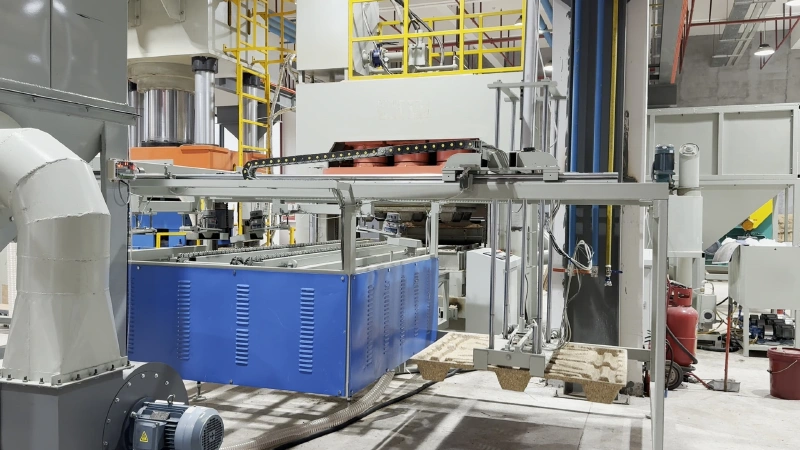
A sawdust pallet making machine solves the consistency problem at the source. Instead of assembling loose lumber with nails, it takes sawdust and wood fiber—material that would otherwise be waste—mixes it with a thermosetting resin, and presses it into a single solid pallet under high temperature and pressure. The key equipment chain is:
- GEO automatic spreading machine — meters and spreads the sawdust-resin mix evenly into the mold cavity, so density is uniform across every pallet.
- 1600T dual-cylinder hydraulic press — applies 1,600 tons of force in a single hot-press stroke, bonding the fibers into one monolithic block with no nails.
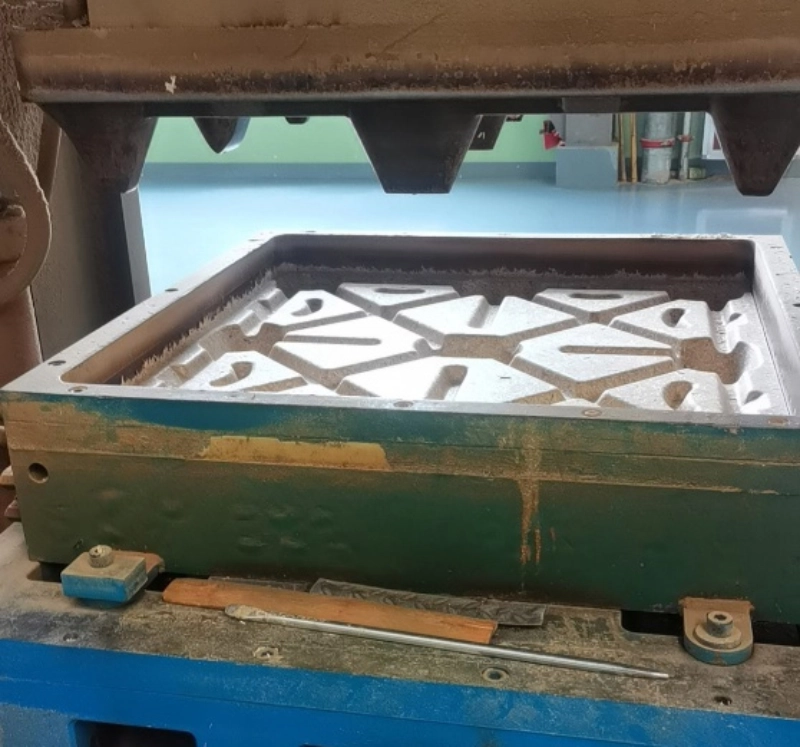
- Precision steel mold — every pallet is formed in the same cavity, so dimensions repeat to within ±1mm.
Because the pallet is molded as one piece, there are no joints to loosen, no nails to protrude, and no boards to warp independently. The result is a pallet that is dimensionally stable, structurally consistent, and—critically for automation—born automation-friendly.
Structure, Parameters, and Evidence
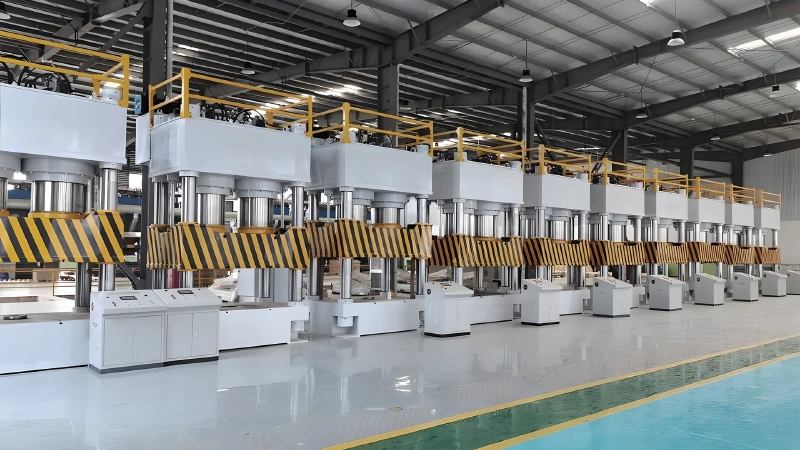
The press frame is a three-beam four-column high-rigidity steel structure. This design keeps the platens parallel under full load, which is what allows the molded pallet to come out flat and uniform rather than tapered or skewed. Key parameters:
- Pressing force: 1,600 tons (dual-cylinder)
- Pressing speed: up to 180 mm/s for efficient cycle times
- Dimensional tolerance: ±1mm on length, width, and load height
- Fastening method: none—single-piece molded, zero nails
- Surface quality: smooth, no splinters, no protruding fasteners
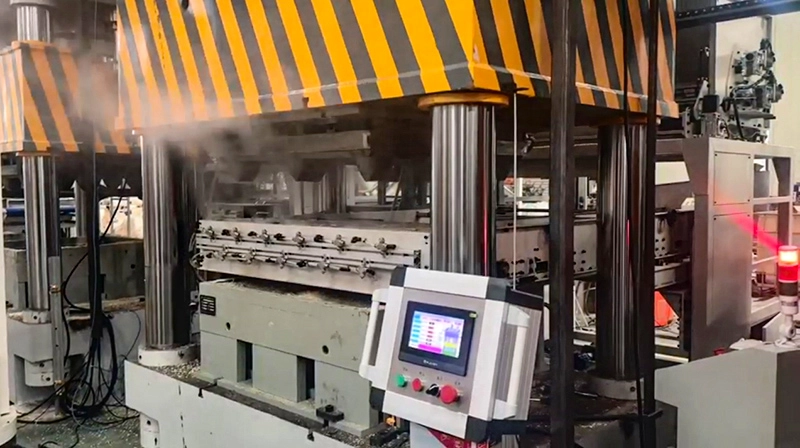
The PLC touch controller manages temperature, pressing force, and holding time. Once a recipe is locked in, every pallet in the run is pressed under identical conditions. That repeatability is exactly what automated warehouses need: the 10,000th pallet comes out to the same dimensions as the first.
The Result: Automation-Friendly Pallets That Cut Repair Costs
For pallet pool operators and manufacturers serving automated facilities, switching to output from a sawdust pallet making machine changes the economics:
- No more sensor-trip stoppages from warped decks or protruding nails—the pallets are smooth, flat, and dimensionally uniform.
- No rising repair bills driven by stricter inspection standards—there are no nails to pull, no boards to replace, and no loose joints to re-fasten.
- Higher automation throughput — robot forklifts seat cleanly every time, ASRS cranes handle loads without misalignment, and sortation lanes run uninterrupted.
- Lower raw-material cost — the machine runs on sawdust and wood fiber that would otherwise be discarded or sold cheap.
In short, a sawdust pallet making machine does not just make pallets—it makes pallets that survive the automated warehouse. When every pallet shares the same ±1mm geometry, no nails, and no splinters, the downstream automation works the way it was designed to. The repair backlog shrinks, the emergency re-purchase budget disappears, and the operator stops paying for pallet inconsistency twice—once in the purchase price and again in the repair line.
Ready to stop fighting pallet inconsistency on your automated lines? A sawdust pallet making machine turns wood waste into ±1mm molded pallets that robot forklifts and ASRS systems can rely on. Contact us for line sizing, mold design, and a tailored production plan.