
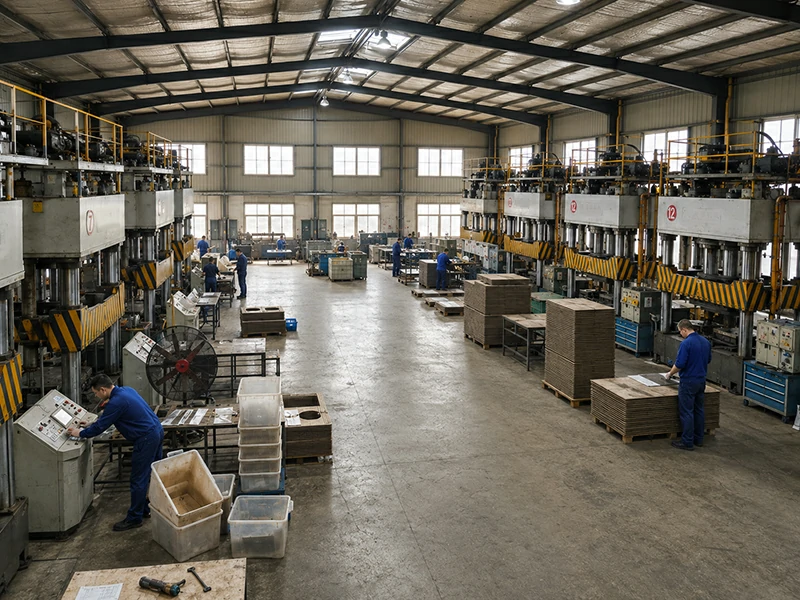
The Scenario: Recyclers With Rising Capacity and Shrinking Outlets
A wood recycler in the United Kingdom screens, crushes and dries tonnes of wood waste every day — pallets no one will return, off-cuts from joinery shops, sawdust and wood shavings swept off factory floors, demolition timber pulled from site clearances. The processing line keeps getting bigger: a heavier crusher / grinder, a longer dryer, a wider conveyor. Throughput climbs month on month.
But the three outlets that have always absorbed that volume are not climbing with it. Biomass fuel pellets depend on energy prices; panel-board furnish is squeezed by imported chip; animal bedding is a thin, price-sensitive trade. Across all three, the last two years have delivered flat or falling demand while the recycler’s own capacity has expanded. The gap between what a yard can process and what the market will take keeps widening — a scissors gap that eats margin from both sides.
The Problem: Per-Tonne Economics Cap the Business at “Commodity Supplier”
As long as the end destination is fuel, board or bedding, recycled wood fiber is priced by the tonne. The recycler earns a gate fee plus a tonnage spread, and nothing more. When fuel prices dip, the spread compresses instantly; when a board mill shuts a line, a whole category of furnish stops moving. There is no buffer, because the product is interchangeable with any other low-grade wood chip stream.
Adding another screening deck or a second grinder does not fix this — it only pushes more volume into the same capped channels. What the recycler needs is an outlet that is incremental, one that does not overlap with biomass, board or bedding and that is not priced as a bulk commodity.
Why Molded Pallets Are That Incremental Market
Molded wood pallets are a finished good, not a raw material. They are sold by the piece to logistics users who need a warehouse pallet, a shipping pallet or an export pallet every single day. Global molded pallet demand ran to roughly USD 630 million in 2025 and is expanding at about 5.5% compound annual growth, driven by two structural forces that have nothing to do with biomass pricing:
- ISPM-15 exemption. Molded pallets are pressed under heat, so they carry no live pests and need no fumigation — making them the default fumigation-free pallet for export shipping.
- EU packaging regulation. Tightening reuse and recyclability rules push brand owners toward molded pallets that are themselves made from recycled wood and agricultural residue.
That means a recycler who redirects part of the same wood waste stream into molded pallets is not competing with his own fuel or board customers — he is entering a logistics supply market that grows independently of energy cycles. The value of a tonne of waste jumps from “fuel-grade chip, priced in pence” to “finished pallet, priced per piece.”
The Machine: A Turnkey three-beam four-column hydraulic press Line
The press at the centre of that line is the three-beam four-column hydraulic press. Its top beam / slide / worktable structure gives a single, rigid platen that applies uniform tonnage across the mold, so a one-piece pallet forms in a single compression molding cycle. The solid column design of the four columns resists the off-centre loads that come from asymmetrical pallet cavities, which is exactly why this architecture — not a frame press — is the industry standard for pallet forming.
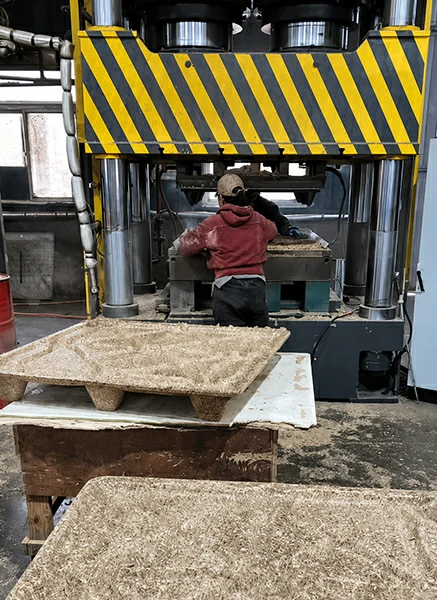
EMP ships the line as a true turnkey package. From the crusher / grinder and dryer at the front, through the glue mixer (where MDI adhesive is dosed into the fiber), the preheater, the molding die / mold and the hydraulic cylinder with its ejector (top eject), every stage is specified, matched and commissioned by one supplier. The recycler does not need in-house woodworking know-how to start; the line is delivered ready to press pallets.
Structure and Parameters: Evidence the Pallet Meets Logistics Standards
Because the press is built on the Y32 three-beam four-column hydraulic press platform, it is available across the tonnage range a pallet plant actually needs:
- Y-1250 hydraulic press — entry single-cavity molding for standard 1200×1000 export pallets.
- Y-1600 hydraulic press and Y-2000 hydraulic press — mid-range tonnage for heavier dynamic-load pallets.
- Y-2500 hydraulic press — high tonnage for double-cavity or oversized mold tools.
Pressed at a hot press molding density of about 900 kg/m³, the finished pallet meets real logistics thresholds: dynamic load of 1.5–2 tonnes and static load of 5–8 tonnes, fully comparable with a conventional wooden forklift pallet or racking pallet. The molding cycle is short enough to sustain an automatic molding rhythm, and the platen size and motor power are matched to the chosen mold so the recycler is not buying over- or under-spec machinery.
Crucially for a UK site, the Y32 column structure is a bolted assembly that can be broken down for container shipping and re-erected on a standard factory slab — no special foundation, no on-site welding. A turnkey pallet plant lands, bolts down and runs.
The Result: From Raw-Material Supplier to Pallet Manufacturer
Once the line is running, the same tonne of wood waste that used to leave the yard as low-value wood chip now leaves as finished stackable pallet and nestable pallet units, invoiced per piece to logistics customers. The recycler has not abandoned fuel, board or bedding — those channels still take the overflow — but the marginal tonne now flows into the highest-value outlet, and the business model shifts from “gate-fee-plus-spread” to “manufacturer with a product line.”
That is the growth curve the three-beam four-column hydraulic press unlocks: incremental demand, decoupled from energy prices, served by a turnkey line a recycler can actually install and operate. For yards watching the scissors gap widen, it is the one addition that turns surplus capacity into a new category of revenue.