
The Scenario: Wood Waste That Piles Up Faster Than It Leaves
Every sawmill, pallet plant, furniture workshop, and packaging factory generates the same daily surplus: offcuts, trim ends, broken pallets, and sawmill residue. Left in place, that pile eats yard space, raises the fire load, and leaves the plant paying for disposal trips that carry raw material out of the gate. The straightforward answer is wood waste recycling on site — crush the waste into sawdust and feed it straight back into the production line as raw material.
Yet many plants that install a crusher discover a second problem the salesman never mentioned: dust. When wood is ground at high speed in an open machine, fine particles escape with every discharge. They settle on electrical cabinets, drift across the workshop, and force operators to work in a haze. And every gram of dust that floats away is feedstock the plant already paid to produce.
The Old Way: Open-Discharge Crushing That Fills the Shop with Dust
The usual culprit is an old single-roll crusher or an open-discharge hammer mill with no collection system. Three costs stack up. First, dust: without a separator, the finest fraction of the sawdust blows out with the airflow — lost material, dirty equipment, and a workshop that fails its own housekeeping walks. Second, particle size: worn or missing screens let the output swing between coarse chips and over-ground flour, so the downstream press, dryer, or boiler receives an input it cannot hold steady. Third, tramp metal: nails and brackets from broken pallets go straight into the chamber, chipping hammers and tearing screens.
The alternative — buying ready-made sawdust — moves the same problems outside the gate. Prices move with the local fiber market, moisture and cleanliness vary by supplier, and the plant stays dependent on deliveries it cannot control.
Why the Pulvz Wood Powder Machine Fits
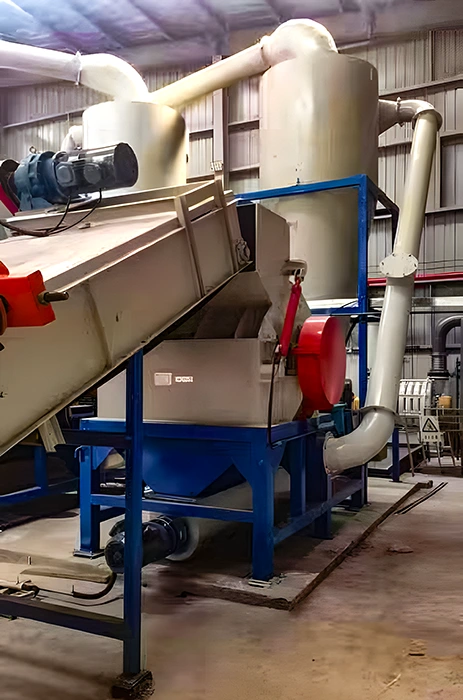
The Pulvz wood powder machine is built as a closed crushing circuit. The grinding chamber discharges pneumatically into a cyclone separator, which spins the sawdust out of the airstream and drops it into collection — so the dust stays inside the system instead of inside the workshop. Cyclone dust collection turns an open, hazy operation into a dust-controlled step the plant can place next to the production line without rebuilding the whole workshop.
Particle size is set by replaceable high-hardness alloy screens: swap the mesh, and the same machine shifts between coarser fiber and uniform fine sawdust down to the ≤5 mm range that molded pallet lines and similar front-end applications feed on. A magnetic separator ahead of the chamber pulls nails and iron scrap out of the waste stream before they reach the hammers, and belt conveyor feeding keeps the hopper loaded for continuous running instead of batch-by-batch manual drops.
Structure, Specs, and Evidence from the Floor
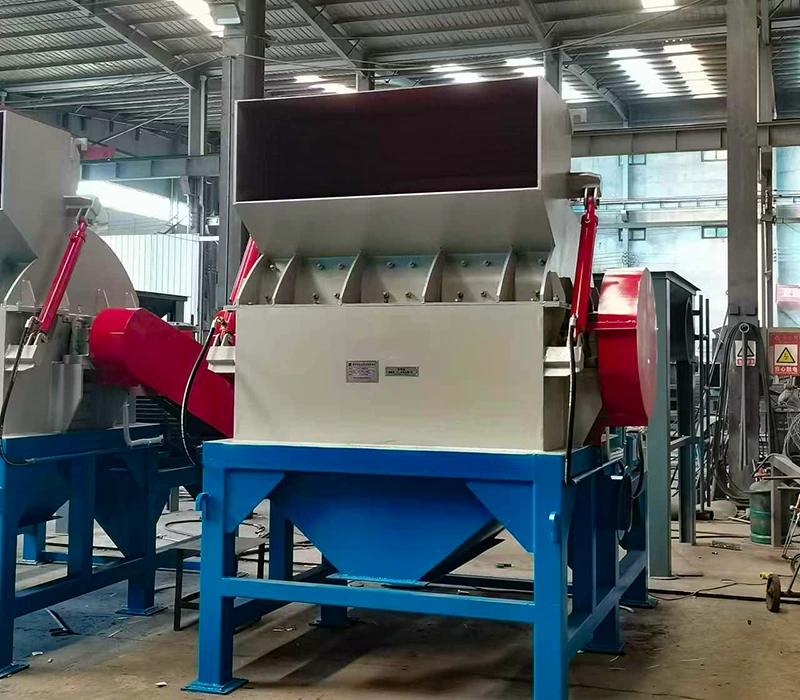
The machine is a hammer mill crusher at its core: manganese steel hammer plates on a dynamically balanced rotor, working against one-piece manganese steel liners. The F-series covers four sizes — F-800, F-1000, F-1200, and F-1500 — spanning 45 to 110 kW of installed power and 1-8 t/h of continuous output, with screen widths from 780 to 1480 mm. For most wood waste recycling lines, that range means one correctly sized machine instead of an undersized unit running flat out or an oversized one burning power.
Maintenance is engineered for the floor, not the office: a hydraulic open cover system lifts the top shell for screen changes and hammer inspection, so the wear parts that actually need attention are reachable without a full strip-down.
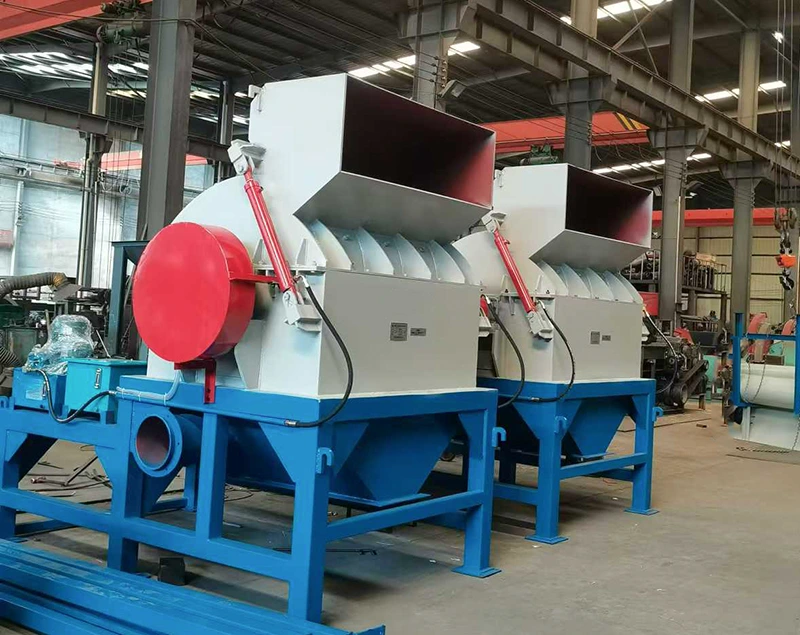
Where one machine cannot cover the waste stream, the units are built to run in parallel — two F-series crushers sharing the feeding conveyor and collection side by side, doubling throughput while keeping a single screen grade and a single dust-controlled discharge point.
The Result: Clean, Uniform Sawdust Where the Waste Pile Used to Be
Run the numbers the plant actually feels: the waste pile shrinks by volume reduction of eighty percent and more, so yard space and disposal trips drop with it. Dust losses that used to drift out of an open discharge are captured in the cyclone and sold as product instead. The output grade holds steady because the screen — not the operator’s eye — decides particle size, and the downstream line receives the same feed every shift.
The wood powder machine with cyclone separator is, in the end, a simple trade: stop paying to export wood waste and to import sawdust, and start converting one into the other inside a closed, dust-controlled circuit on your own floor.