CHARCOAL BRIQUETTE PRODUCTION | AFRICA | DRYR
When Rain Stops Open-Air Drying
For Char Briq-type charcoal briquette operations in Africa, natural sun drying can turn the rainy season into a production bottleneck. A Dryr industrial sawdust dryer combines roofed storage with continuous hot-air rotary drying to reduce moisture below 10% as a reference target, helping create a more predictable feed stream for capacity expansion.
Why a Rotary Sawdust Dryer Fits the Feed Preparation Step
Dryr is a continuous rotary sawdust dryer designed to place moisture reduction before charcoal briquette forming. A hot air furnace sends heated air through the rotating drum while the drum lifts, disperses, and advances the sawdust. This arrangement separates feed preparation from daylight and weather, so a covered storage area can buffer incoming material and the sawdust drying machine can process it on a planned schedule in both seasons. The same biomass sawdust dryer approach can be assessed for wood chips, wood shavings, straw, pellet production, MDF or particleboard, and other biomass material, but the correct configuration still depends on initial moisture, particle size, target moisture, fuel, and required throughput.
What the Dryr System Shows in Structure and Parameters
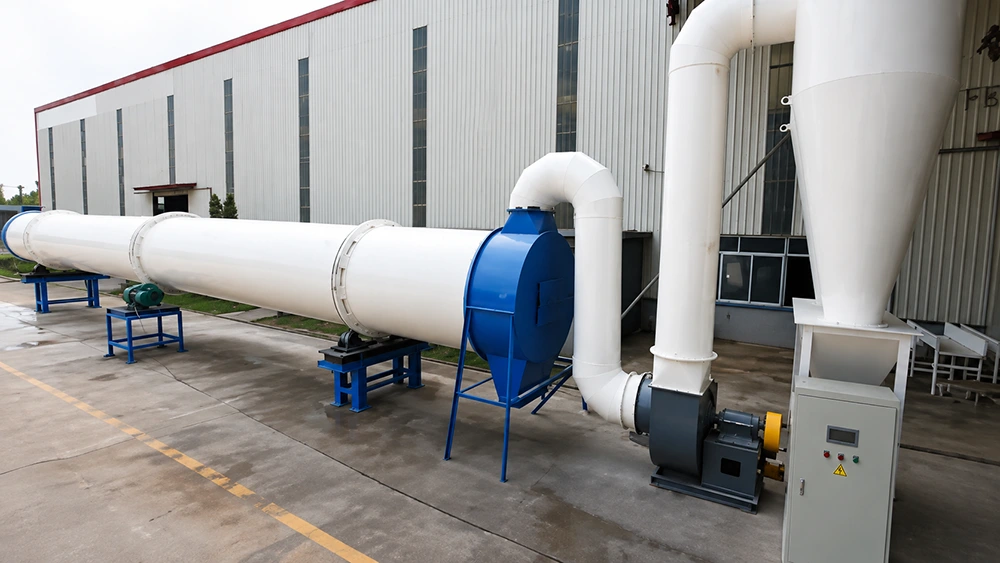
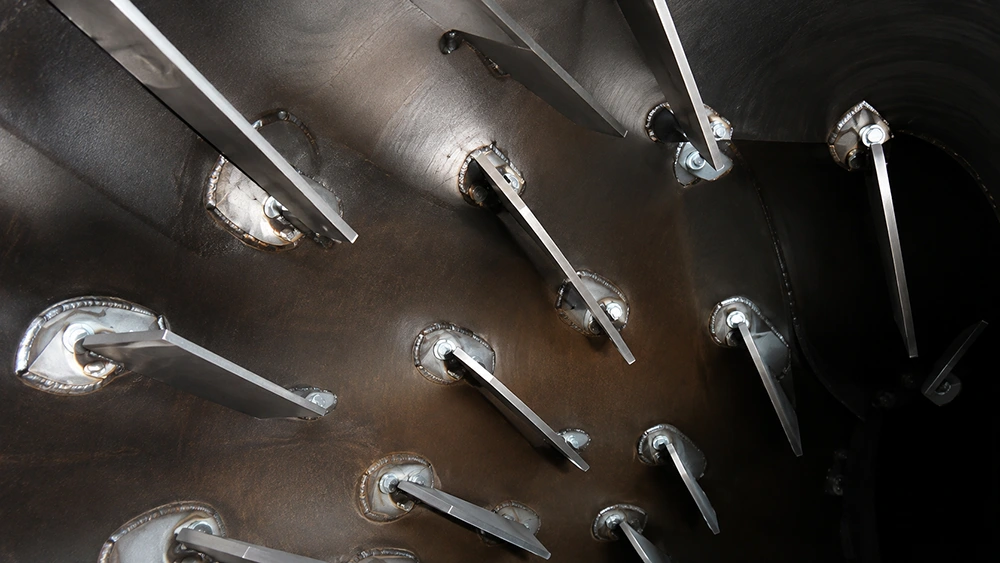
The Dryr structure combines a feed section, rotating drum, lifting flights, roller supports, external gear and pinion drive, gearbox, motor, induced-draft air path, and a dust-control section. The system view shows a long drum connected to process ducting, a cyclone separator, blower, and control cabinet. The chamber detail shows staggered metal paddle bars, welded mounting plates, bolted hubs, and continuous welds that support repeated lifting and scattering of the feed. Reference model data covers H-1010 at 1000 mm, 4 kW main motor, 7.5 kW induced-draft fan, and 0.8–1 t/h; H-1212 at 1200 mm, 5.5 kW, 7.5 kW, and 1–1.2 t/h; H-1512 at 1500 mm, 7.5 kW, 11 kW, and 1.2–1.5 t/h; and H-1815 at 1800 mm, 11 kW, 15 kW, and 1.5–2 t/h. Product material gives below 10% as a reference dried-output moisture, while final values must be confirmed against the actual feedstock and process.
From Weather-Dependent Supply to Planned Capacity
For a Char Briq capacity expansion plan, the practical change is from waiting for a clear day to managing a feed-preparation sequence. Covered storage protects collected sawdust from renewed wetting; a screw conveyor or other metered feed arrangement can move material into continuous drying; and cyclone or baghouse filtration can be selected with the local dust-control requirements. The multi-fuel arrangement can be evaluated around available coal, oil, natural gas, or biomass fuel, while the stated self-insulation design and thermal-efficiency reference above 80% still require confirmation for the project conditions. For a 17–18 m drum, split shipment, field assembly, installation, and commissioning should be included in the engineering plan. The expected production benefit is a more stable moisture condition for briquetting, less dependence on manual sun drying, lower weather-driven stoppage risk, and a clearer basis for scaling output. A project inquiry should include seasonal moisture, particle size, desired capacity, target moisture, fuel, site layout, and emission-control requirements.
- Continuous rotary drying through dry and rainy seasons
- Reference output moisture below 10% for downstream process planning
- Four models covering approximately 0.8–2 t/h for charcoal briquette and biomass lines
- Roofed storage plus mechanical drying for a more predictable year-round feed supply


