Processed-wood exemption capacity
The customer: an export pallet maker whose buyers already buy inside one exemption category
Export demand for fumigation free, mark free, no residue pallets keeps rising, and a pallet maker can only book the orders its ISPM-15 exempt capacity can ship. This page follows a wood pallet hydraulic press line added inside an existing pallet plant, so the new output lands in the same processed wood exemption category its buyers already accept: hot press molding at 150 to 180 C, MDI adhesive with no added formaldehyde, formed density around 900 kg per cubic metre and low formed moisture, on a Y32 three beam four column platform from 1250 to 2500 ton with platens up to 2500 x 1700 mm. The upstream boundary is stated plainly: crush to about 5 mm, dry to 8 to 12 percent moisture and mix the MDI evenly before the press forms anything, and the machine is not sold as a stand alone unit.
Why the pallet lands in the processed wood category: one heated pressing instead of a treatment schedule
A molded pallet hydraulic press machine is a hydraulic press built around pallet tooling and heat. The wood pallet hydraulic press is the forming stage of a molded pallet production line: recovered wood fiber, wood shavings, sawdust, wood chips and recycled wood are crushed to about 5 mm, dried down to 8 to 12 percent moisture, mixed with MDI adhesive and laid into the lower mould; the slide brings the upper mould down; heat and pressure cure the mat; pressure releases and the ejector pushes out one finished pallet per cycle. Deep processing at high temperature and pressure inside the mould is what separates this product from solid wood packaging. The finished presswood pallet needs no heat treatment schedule, no fumigation and no IPPC mark stencil, and it leaves no treatment record to audit, so it holds its place as fumigation free, ISPM-15 exempt and phytosanitary compliant processed wood. The MDI system carries no added formaldehyde, which is what the no chemical residue clause in a food or pharmaceutical packaging specification is actually reading for. Formed density around 900 kg per cubic metre gives a dense one piece molded shape with a uniform load surface, so boards do not loosen under a load and cargo does not shift. Low formed moisture keeps the pallet from taking on mould in a humid container, and there are no nails and no splinters on the deck. A lightweight, reusable molded pallet with a nestable design also cuts the return leg, because empty pallets nest rather than travelling back at full volume.
The structure, the parameters and the pictures behind the claim
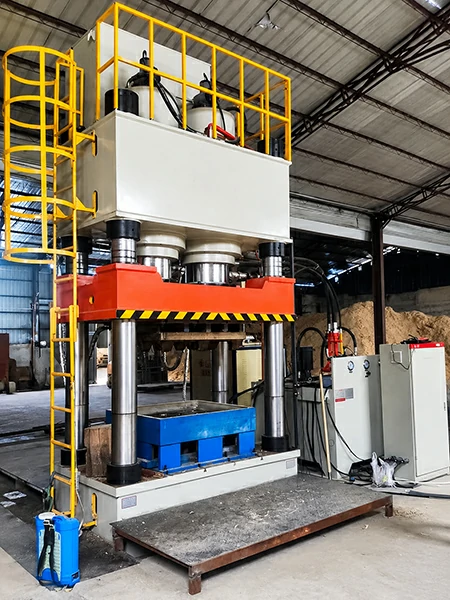
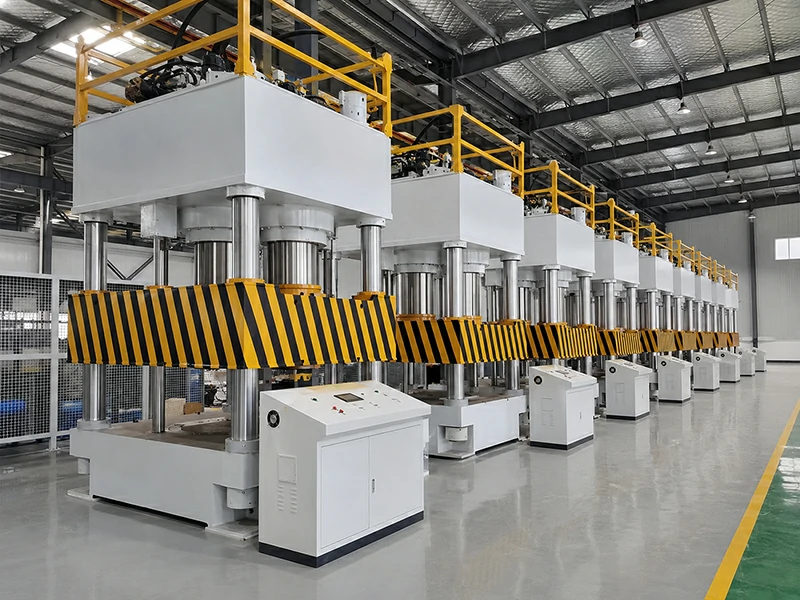
The forming platform is a Y32 three beam four column hydraulic press: top beam, slide and worktable clamped onto four solid smooth columns that both guide the slide and lock the frame into one closed rigid body, with the hydraulic power unit carried on the back of the top beam and a control console that can be floor standing or mounted on the machine. Published tiers run from the 1250 ton hydraulic press at 12500 kN with a 1700 x 1400 mm platen and a 55 kW servo motor, through the Y-1600 hydraulic press and the Y-2000 hydraulic press, to the 2500 ton hydraulic press at 25000 kN with a platen up to 2500 x 1700 mm, a 900 mm slide stroke and a 75 kW servo motor, all at 25 MPa system working pressure with a 150 to 180 C hot press molding window and a short molding cycle. Because the tooling is interchangeable, one machine covers nine leg, grid base, Japanese and chu shaped pallets, and a larger platen can press any format below its own size. The frame is split shippable, with columns, beams, slide and cylinder separated for container loading and re assembled on site during factory installation, which is what keeps an added pallet manufacturing plant line inside a normal cargo budget. The photographs on this page document the machine rather than the site: one shows the four column press body with guide pillars, safety railing, side ladder and a separate hydraulic power unit, and the other shows presses standing in a line with safety guards and independent control cabinets, the arrangement a plant uses when it adds capacity in stages. What travels with the machine matters as much as the machine. The buyer's packaging engineer reviews the new pallets against the exemption claim and the no residue clause, so the delivery pack carries the process parameters and the compliance support file: raw material path, the no added formaldehyde MDI adhesive system, the exemption basis and the forming record, which is what shortens the cycle for the new line's pallets to pass the customer's own approval.
The result: capacity inside the exemption category, and the orders that follow it
Once the line runs, the plant's supply of fumigation free export pallets stops being limited by how many heat treated units it can buy in and store, and starts being limited by the cycle it owns. Fewer manual hours per unit, no nailing stage and no manual board sorting move the plant toward high output per shift with less manual labor, while the nestable, lightweight, reusable molded pallet pulls freight and storage cost out of the return leg at the same time. The boundary stays on the page. The press forms pallets; it does not make the input ready. Crushing to about 5 mm, drying at 150 to 180 C to 8 to 12 percent moisture and even MDI mixing have to be in place upstream, which is why the machine is not sold as a stand alone unit and why a line is quoted with semi automatic and automatic tiers sitting on the same process platform. Plants whose annual need sits under roughly 10000 pallets are told to keep buying pallets instead, and a plant without a steady waste wood or sawdust intake, without about 600 square metres of floor and 6 metres of headroom, or without about 200 kW of available power is told the same before an order. For a pallet maker already selling into an exemption category, an added line is not a new market entry: it is the same accepted product, more of it, offered to buyers who already take it. Send the daily output target, the wood waste type and the available floor area, and the exemption category capacity question becomes a number rather than a ceiling.
- Title, slug, H1 and first screen carry the exact phrase wood pallet hydraulic press, and no previously published title or slug is reused.
- Both selected images come from the resolved canonical product designer gallery for MldP, with index ALT text carried into the body and the media library.
- Compliance wording stays inside the processed wood exemption category and the no added formaldehyde MDI system; no third party certificate or competitor equivalence is claimed.
- The upstream boundary is stated in the first screen and the close: crush to about 5 mm, dry to 8 to 12 percent moisture, even MDI mixing, and the press is not sold as a stand alone unit.


