BX215 wood chipper for biomass pellet plants: cutting dryer heat load at the chipping stage
Why drying heat load is set at the chipper, not the dryer
Most pellet plant audits name the rotary drum dryer as the biggest thermal load on the line, but the load is shaped upstream. A drum dryer sized to push wet sawdust or wood chips from an undefined moisture content down to a stable 10% or lower inlet window has to be oversized; a drum dryer fed with a defined chip geometry from a calibrated chipper can be sized to the real heat-and-mass transfer curve. The chipper stage therefore sets three numbers that the dryer has to live with: the upper limit of particle dimension entering the hammer mill, the bulk density of the chip pile that feeds the dryer conveyor, and the surface-to-volume ratio that controls evaporation rate. When the chipper is a BX215 wood chipper or equivalent 45 kW drum machine with a 400 × 180 mm feed opening and a 600 mm rotor running at 590 rpm, those three numbers become a specification instead of a guess. Pellet producers who treat the chipper as part of the drying scope, rather than a stand-alone grinder, recover that scope every month on the energy bill.
For biomass pellet producers, the dryer is the single largest energy cost on the line, and the chipper sitting in front of it decides how hard that dryer has to work. A BX215 wood chipper sized at 45 kW with a 600 mm knife roller and a 4–5 t/h throughput gives a pellet plant a predictable feedstock of about 35 mm chips, which is the practical upper bound for downstream hammer-mill, dryer and ring-die performance. This page walks a buyer through why drying heat load belongs to the chipping conversation, what an X-215 / BX215 class drum chipper actually delivers at the chip stage, and which structural features protect the dryer window when wet agricultural residue and wood waste arrive at the same time.
What a BX215 class drum chipper actually does in a pellet line
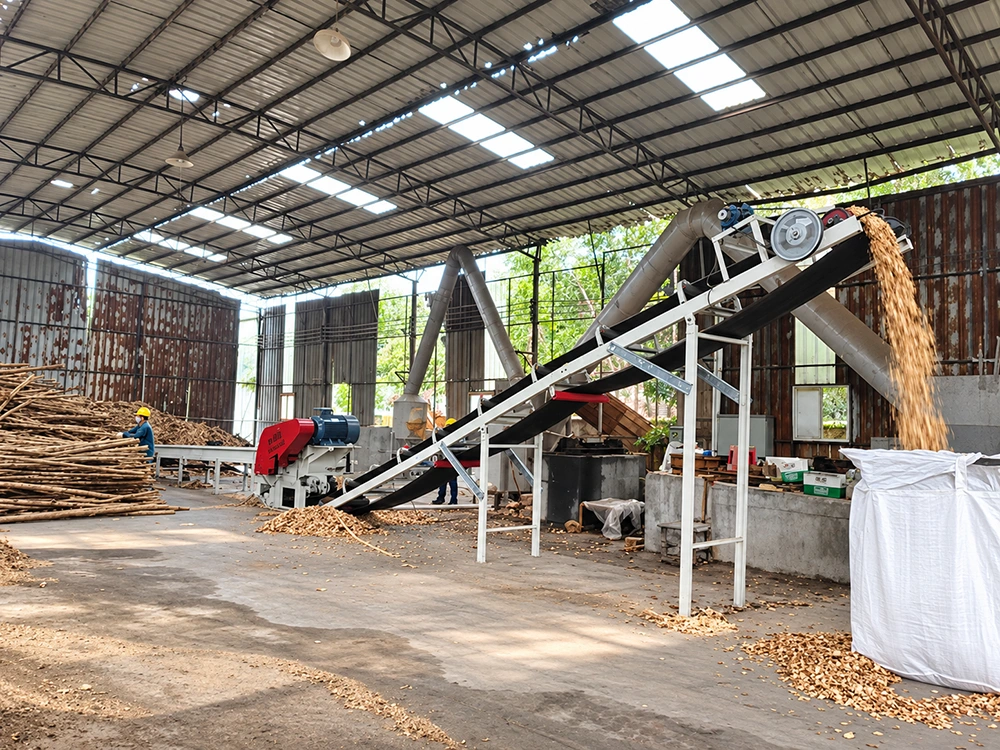
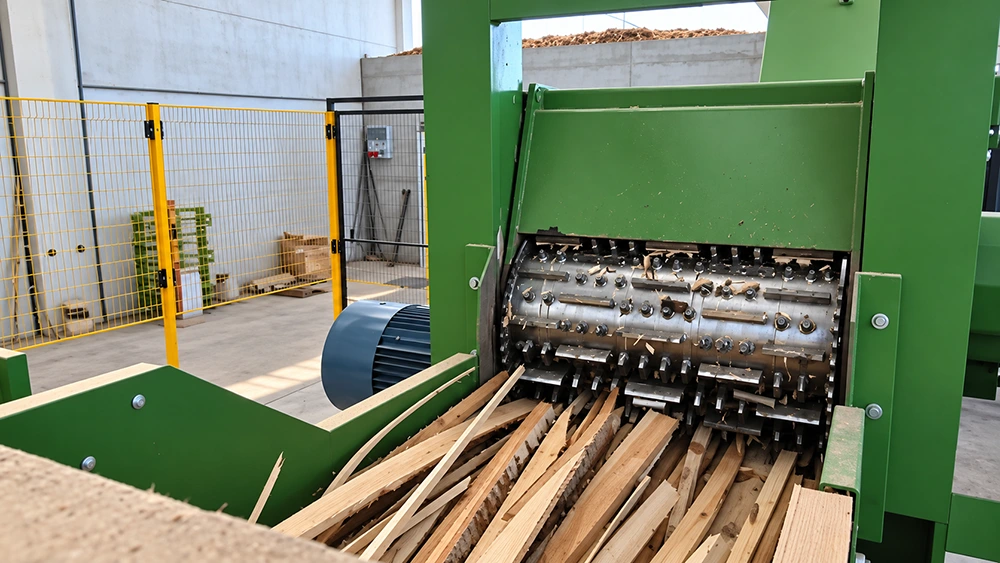
The BX215 designation refers to the 45 kW drum chipper class that has become the de facto entry point for serious pellet plants and is shared across Chinese BX-platform suppliers and the EMP X-215. On the EMP X-215 datasheet the published numbers are: knife roller diameter 600 mm, feed opening 400 × 180 mm, maximum log diameter 160 mm, 2 fly knives as standard with 2–5 fly knives available on the rotor, rotor speed 590 rpm, two 2.2 kW feed motors, one 45 kW main motor, total installed power 49.4 kW, and rated throughput 4–5 t/h against a target chip length of 35 mm. The structural logic of the class is consistent across suppliers: a welded high-strength steel housing, a horizontal drum rotor with replaceable alloy fly knives, an upper and lower feed roller pair synchronized by chain and sprocket, hydraulic lift on the upper roller so it can float over irregular feedstock, and a sizing screen inside the housing that recirculates oversize until it passes. The chipper is fed by an infeed conveyor and discharges through a screen and discharge belt; downstream it hands 35 mm chips to a hammer mill, then to a rotary drum dryer, then to a pellet press.
From branches and slabs to a 35 mm chip that the dryer can handle
A pellet plant rarely gets clean, dry sawdust. The realistic feedstock mix is small-diameter logs, branches, slab offcuts, veneer waste, broken pallets, and agricultural residue such as straw, bagasse, corn stover or grass, all arriving with moisture contents that vary by season and supplier. The BX215 wood chipper is sized for this mixed upstream because the drum geometry is forgiving on irregular geometry: the feed opening admits pieces up to 160 mm in diameter, the upper feed roller floats on hydraulics so it can clamp a thin slab or a thick log without the operator having to re-set the machine, and the screen below the rotor rejects oversize so the chipper cannot push a 60 mm chunk downstream by mistake. The hammer mill that follows sees a narrow size distribution and can run at a steady power draw, the rotary drum dryer sees a consistent bulk density on the conveyor and a known surface-to-volume ratio on the chip, and the pellet press sees feed that has been dried to the binder window. The chipper is therefore the upstream guard for the dryer's tightest tolerance.
Structural features that protect the dryer window
The dryer window is the moisture band the pellet press needs, typically inside roughly 8% to 12% on a wet basis, and a dryer holds that band only if the upstream does not pulse-feed it with wet, oversized material. Three structural features on a BX215 class drum chipper protect that window. First, the screen inside the housing acts as a sizing check: anything that does not pass through the screen stays on the rotor and is re-cut, so the chipper cannot discharge an oversized chip that would survive the hammer mill and arrive wet in the dryer. Second, the hydraulic upper feed roller applies a steady clamping force across varying thickness, so the rotor is fed at a constant linear rate and the chipper does not starve or flood the downstream conveyor that feeds the dryer. Third, the V-belt drive between the main motor and the rotor acts as a mechanical fuse: a hard inclusion or a wet slug will stall the belt rather than break a coupling, and the dryer does not see a slug of un-chipped material that would dump its moisture into the drying chamber. Each of these features is mechanical and visible on the machine, not a software claim, which is what a process engineer wants when sizing the dryer.
Matching the chipper to the dryer, not the other way around
The right sizing exercise starts from the dryer. A 1 t/h pellet line needs roughly 2 to 2.5 t/h of dry chips at the press, which means the chipper has to feed a hammer mill and dryer train at about 2.5 to 3 t/h of wet chips; a BX215 wood chipper rated 4–5 t/h covers that with margin for moisture variation and screen recirculation. A 2 t/h pellet line needs about 5 to 6 t/h of wet chips at the chipper, which is at the top end of the BX215 envelope and a better fit for a 55 kW BX216 class machine. A 4 t/h pellet line is outside the BX215 class and belongs on a BX218 or larger drum chipper. Sizing the chipper from the dryer, instead of from the chipper catalog, also clarifies what the buyer should ask the supplier for: the rotor diameter, the rotor speed, the feed opening, the fly knife count and material, the screen aperture, and the test condition behind the throughput number. The Shred drum wood chipper line publishes the first five; the test condition is a known industry-wide disclosure gap and should be requested in writing before order.
What the chipper cannot solve on its own
A chipper has limits a buyer should name in the inquiry, not discover at commissioning. The BX215 class is built for clean to moderately clean lignocellulosic feedstock; material contaminated with nails, wire, or large metal inclusions is a different machine and a different risk profile. Wood waste from demolition formwork or used pallets with fasteners belongs on a primary crusher with metal removal upstream of the drum chipper, not on the chipper itself. The X-215 datasheet does not list a magnetic separator or metal detector, and feeding contaminated feedstock into a drum chipper risks blade fracture, secondary ejection, and a hot spark that a downstream dryer cannot tolerate. The other limit is moisture: a drum chipper will chip wet wood, but the wetter the feedstock the more thermal load shifts downstream onto the dryer and the tighter the dryer's tolerance becomes. The chipper is the upstream guard for the dryer, not a substitute for feedstock sorting or for the dryer's own control loop. Buyers who put these limits in writing in the inquiry get a chipper sized to the real feedstock and a dryer sized to a real upstream, instead of a chipper sized to a catalog and a dryer chasing a moving target.
- Confirm rotor diameter (600 mm), feed opening (400 × 180 mm), maximum log diameter (160 mm), rotor speed (590 rpm), main motor (45 kW), total installed power (49.4 kW), throughput (4–5 t/h) and target chip length (35 mm) match the supplier datasheet for the BX215 / X-215 class machine being offered.
- Request the test condition behind the throughput number: feedstock species, moisture content on a wet basis, bulk density, chip length definition, and whether the figure is sustained or peak. Do not accept a t/h number without a written condition.
- Confirm the fly knife count and material as ordered, since 2 fly knives is the standard configuration and 2–5 fly knives is available on the rotor.
- Confirm the sizing screen aperture in mm and whether it is field-replaceable, because the screen sets the upper size limit that the hammer mill and dryer will see.
- Confirm the feed opening protection, emergency stop wiring, and the control interface (the EMP configuration uses 380 V with a soft-starter cabinet, inverter-controlled feed speed, and a wireless remote for start and stop; an equivalent configuration should be specified in writing).
- Confirm the chipper is fed by a matched infeed conveyor and discharges onto a matched discharge conveyor with the correct inclination and guard, since a chipper starved or flooded at the conveyors will pulse the dryer downstream.
- Confirm feedstock scope in writing: clean to moderately clean lignocellulosic material is in scope; demolition formwork, used pallets with fasteners, or other metal-contaminated feedstock must be processed through a metal-removal primary crusher upstream, not through the drum chipper.
- Confirm the chipper's total installed power including any hydraulic pump motor and the lower feed roller power, and size the plant transformer and cable to the higher of the two numbers rather than the published total.
- Confirm whether the proposed configuration holds a current CE declaration under Machinery Directive 2006/42/EC and the migration path to Regulation (EU) 2023/1230 before the directive expires on 2027-01-20, if the plant is in the European Union or exports into it.