Sawmill Residue to Sellable Chips
Why sawmill residue is a structural problem, not a side issue
Sawmilling is, by mass balance, a residue-generating process. FAO references put conversion to sawn wood at roughly 40–52% of the input log volume, with the remaining balance split across slabs/edgings/trims (around 34%), sawdust (around 12%), and bark (around 12%) — the exact share varies by species, log diameter, and kerf, but the directional finding holds across hardwood and softwood programs. For a mill running 100,000 m³ of log per year, that is tens of thousands of cubic metres of material that must leave the mill every year, one way or another. Leaving it on the yard is not a free option: wet bark and slabs carry fire load, surface-water runoff risk, and neighbor complaints; paying it away as biomass or landfill tipping carries a recurring per-tonne cost; and any premium claim on the sawn timber (FSC, PEFC, legality due diligence) is weakened when the upstream residue handling is undocumented.
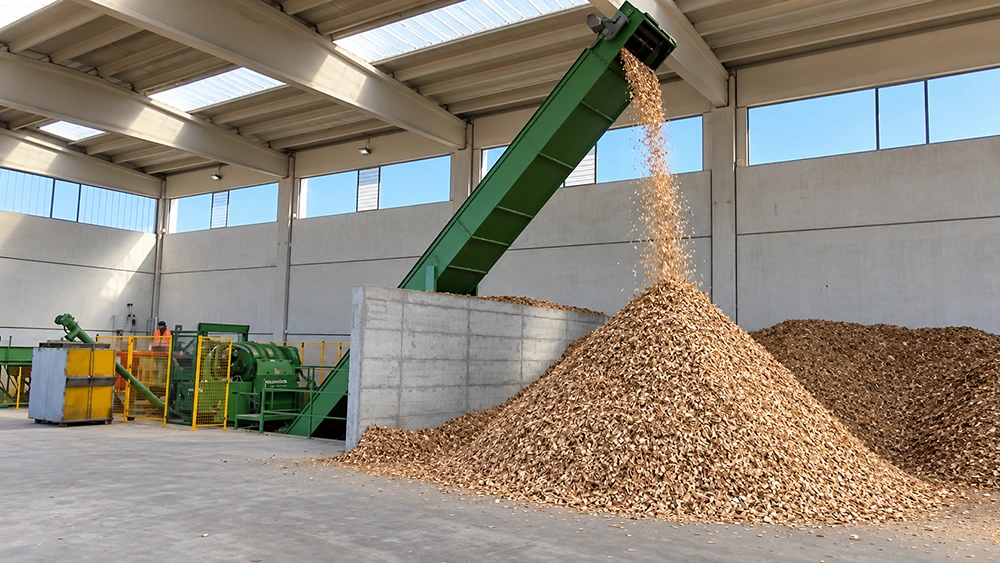
A sawmill converts only part of every log into sawn timber. The rest leaves the headrig as slabs, edgings, trims, sawdust, and bark — a continuous stream of residue that has to be moved, stored, or paid away. A drum-style wood chip making machine turns that stream into a uniform 30–35 mm chip that downstream lines can actually use, so the residue line becomes an outlet instead of a cost center.
The old answer — saw, split, sell, or pay — runs out of room
Most small and mid-size sawmills still handle residue through a patchwork: a stationary log splitter for oversize slabs, manual handling into chip trucks for the medium fraction, a separate fines screen for sawdust, and a paid hauler for anything that does not fit a truck neatly. The pain points are predictable: (1) labor hours per cubic metre of residue rise as forklift operators and loaders move the same material three or four times; (2) chip buyers discount mixed, contaminated, or wet loads heavily, and a mill has no leverage to push back; (3) when the chip truck does not show up, residue piles grow into the loading bay; (4) any change in end-market — a pellet plant closure, a pulp mill downtime, a regional biomass subsidy shift — instantly removes the offtake and the cost line flips from negative (tipping fee paid) to worse (storage emergency). In short: the mill is price-taker for an output it cannot stop producing.
Where a drum wood chip making machine fits the residue flow
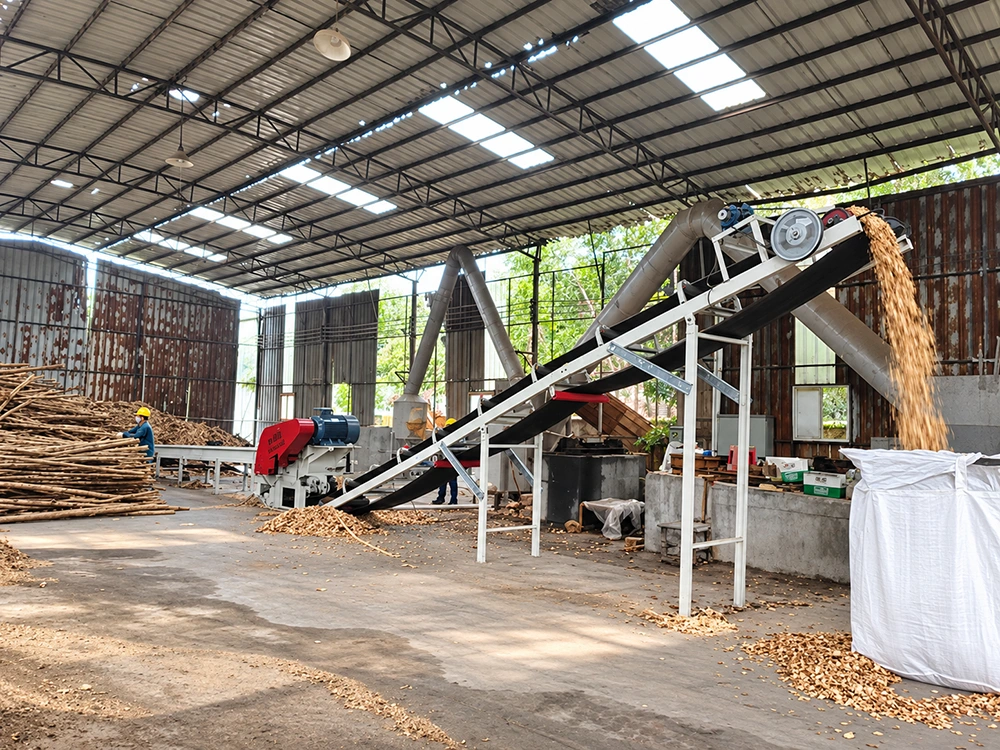
The Shred drum wood chip making machine sits between the green-chain and the residue truck. The feedstock it accepts — small-diameter logs, branches, slab wood, veneer offcuts, broken boards, irregular off-cuts — is exactly the fraction a sawmill already separates at the green chain, and the EMP configuration handles a 160 mm (X-215), 200 mm (X-216), or 300 mm (X-218) maximum feed diameter depending on the model. The discharge is a uniform 30–35 mm chip, which is the specification accepted by particleboard lines, MDF preparation, pellet plants, and biomass boiler operators. The right comparison is not "chipper vs. nothing" but "chipper vs. the current cost of moving this material out of the yard every week." The unit is electric and stationary, which matches a fixed electrical room in a sawmill and avoids the diesel handling that complicates indoor installation.
What the EMP configuration actually delivers on the residue line
Three configurations cover the typical sawmill residue band. The X-215 runs on a 45 kW main motor with a 49.4 kW site total, takes material up to 160 mm in diameter through a 400 × 180 mm feed opening, and is rated at 4–5 t/h — a fit for a band-saw or small-capacity line running softwood or plantation hardwood. The X-216 is the workhorse: 55 kW main motor, 61 kW site total, 540 × 240 mm feed opening, 200 mm max diameter, 6–8 t/h. For a hardwood mill or a site with rubberwood, eucalyptus, or mixed tropical feedstock, the X-218 is the relevant step: 110 kW main motor, 118 kW site total, 680 × 310 mm feed opening, 300 mm max diameter, 8–12 t/h. Each unit ships with a hydraulic upper feed roller that floats to accommodate inconsistent slab thickness, a chain-and-sprocket synchronized feed pair, a V-belt drive to the knife roller, and an internal sizing screen so undersize material recirculates until it passes. The sawmill operator controls start, stop, and feed rate from a wireless remote, and a soft-starter cabinet limits inrush on the 380 V supply.
Evidence boundaries the buyer should keep in mind
The headline capacities above are taken from the EMP product page and need to be read with the usual caveats for this product class: across the Chinese BX-series market the same 55 kW class is published anywhere from 5 t/h to 15 t/h depending on the supplier, and t/h figures are rarely quoted against a stated moisture content, wood density, or chip length baseline. EMP's own spec table is also incomplete on items a residue buyer will want — overall weight, footprint L×W×H, conveyor length and motor, hydraulic pump motor, full noise figure, and chip thickness — so any quotation should request those before the sawmill commits to a foundation design, transformer sizing, or bagging line layout. Finally, residue that contains nails, screws, or stone (demolition timber, used pallets, construction formwork) should not be routed through a drum wood chip making machine without confirming a magnetic or metal-detection stage; for that stream, the EMP Wood Crusher product line is the configured path.
What to ask before signing the residue-chipper line
Before a sawmill commits, four checks keep the project honest. First, ask the supplier for a capacity figure stated against a named moisture content, a named wood density, and a fixed chip length — anyone who can only give a single t/h range is not in a position to guarantee performance. Second, request overall weight, overall dimensions, and a 20 ft / 40 HQ container loading plan; without these, freight, foundation, and indoor layout all become guesswork. Third, confirm the electrical package: main motor kW, total installed kW (including hydraulic pump and conveyor drives), voltage, phase, and frequency, plus whether a soft-starter is included for the main motor. Fourth, walk the residue stream end to end: where does slabwood accumulate on the green chain, how does it reach the chipper feed, where do chips discharge to, and is the existing dust collector sized to handle the additional air volume from a chipping stage? A drum wood chip making machine is a single link in that chain — its value shows up only when the chain on both sides is sized correctly.
From residue line to chip revenue line
The shift is small in equipment terms and large in operating terms: the sawmill stops paying to move residue and starts producing a defined-spec chip product at a defined hourly rate, with the chipper as the gate between the green chain and the offtake. That is the working logic behind positioning the Shred drum wood chip making machine as the first stage of a residue-to-product line — it gives the mill a uniform, accepted chip specification on its own site, which is the prerequisite for selling into particleboard preparation, pellet plants, biomass boiler fuel, or the next presswood pallet line in the same group. The numbers (45 / 55 / 110 kW, 4–12 t/h, 160 / 200 / 300 mm feed) are the tool; the underlying change is moving from "residue as a cost line" to "residue as a controlled output."
- FAO references for sawmill residue shares are industry baselines, not mill-specific measurements; treat them as directional.
- Capacities on the EMP page are quoted as t/h without a stated moisture, density, or chip-length baseline — request a baseline before committing to a production guarantee.
- The Shred product page does not publish overall weight, footprint L×W×H, conveyor lengths, hydraulic pump motor, or full noise figure — request these before foundation, transformer, and container-loading design.
- Residue containing nails, screws, or stone (demolition timber, used pallets, formwork) requires a magnetic or metal-detection stage or should be routed through the EMP Wood Crusher line instead of the Shred drum wood chip making machine.
- Do not assume the headline kW figure covers the whole machine: confirm total installed power including hydraulic pump and conveyors against the mill's electrical room capacity.
- The drum configuration is selected for residue-stream tolerance (mixed sizes, irregular slabs, bark), not because it is universally "most efficient"; chip-quality comparisons to disc chippers in this article are limited to feedstock fit.