Sawmill Residue → Sellable Wood Chips
What a Sawmill Actually Produces Per Log
Sawmills don't sell logs — they sell lumber, and the gap between the two is the entire business case for a wood chip making machine. FAO data on log breakdown shows that for every cubic meter of roundwood that enters a sawmill, the usable sawnwood output is roughly 40–52% of the original log volume. The other ~46% is residue, split roughly into slabs and edgings (~20%), trimmings and ends (~14%), sawdust (~12%) and bark (~12%). For a mill sawing 100,000 m³ of roundwood per year, that is on the order of 45,000–46,000 m³ of wood by-products that have to go somewhere every year. Left in a yard, that volume is a fire load, a leachate source and a recurring disposal invoice. Run through a drum chipper, the same volume becomes a uniform chip that a particleboard line, pellet press, MDF refiner or biomass boiler will accept. The shift is from a cost line to a revenue line, and it starts at the chipper infeed.
A sawmill takes only the usable lumber out of a log and leaves the rest as slabs, edgings, trimmings, sawdust and bark. That remainder is roughly 46% of the original log volume and is either a disposal cost or a marketable feedstock, depending on whether it gets chipped. A drum-style wood chip making machine turns those offcuts into uniform 30–35 mm chips that downstream lines can accept for particleboard, pellets, MDF, pulp or boiler fuel. This guide walks through the physical loop, why the drum geometry fits sawmill residue, and what to verify before buying.
Why a Drum Chipper Fits Slabs, Edgings and Irregular Offcuts
Sawmill residue is not clean, uniform, debarked small-diameter roundwood. It includes curved slab edges, split edgings with nails-free bark patches, occasional short round sections, and offcuts carrying surface grit from the log yard. That is the feedstock profile a drum wood chipper is designed for, and the geometry of the machine is what does the work. The horizontal knife rotor accepts material across its full width through a top-and-bottom feed roller pair, so a curved slab edge enters the same way a straight strip does. The fly knives are mounted on the rotor circumference with bolt-and-wedge clamps, which lets the operator index or rotate a knife rather than scrap it when an edge dulls. The lower bed screen re-circulates oversize pieces back into the cutting zone, so the discharge is graded by the screen aperture rather than by the operator's eye. For sawmill residue specifically, the advantage over a disc chipper is feedstock tolerance: a drum rotor keeps cutting through irregular geometry, mixed moisture and bark patches without the disc-chipper sensitivity to grit and off-axis loading. The cost of that tolerance is a heavier rotor and a larger main motor, which is why drum chippers in this class start at 45 kW.
Matching the Chipper to the Residue Stream
Sizing a drum wood chipper to a sawmill is a feed-opening problem before it is a tonnage problem. The maximum log diameter or slab thickness that the machine will accept is set by the infeed opening, not by the motor nameplate. For a small sawmill cutting rubberwood, pine or similar softwood with offcuts generally under 160 mm thick, the X-215 class (45 kW main motor, 400×180 mm feed opening, 160 mm max feed diameter, 4–5 t/h throughput) covers the residue stream without overcapitalizing. For a mid-size mill with mixed hardwood and softwood and slabs up to ~200 mm, the X-216 class (55 kW, 540×240 mm feed opening, 200 mm max feed diameter, 6–8 t/h) is the common fit. For mills processing larger-diameter logs or running heavy hardwood slabs, the X-218 class (110 kW, 680×310 mm feed opening, 300 mm max feed diameter, 8–12 t/h) provides the rotor mass and motor reserve to keep cutting through dense material without stalling. All three units share the same 30–35 mm target chip length, so downstream screens, dryers and hammer mills see one chip spec regardless of which model feeds them. Sawmill buyers should request the throughput figure with its test basis stated — moisture content, wood species and bulk density — because chipper capacity numbers across the industry are quoted on incompatible bases and direct comparison without those conditions is unreliable.
From Chipper Discharge to a Usable Chip Pile
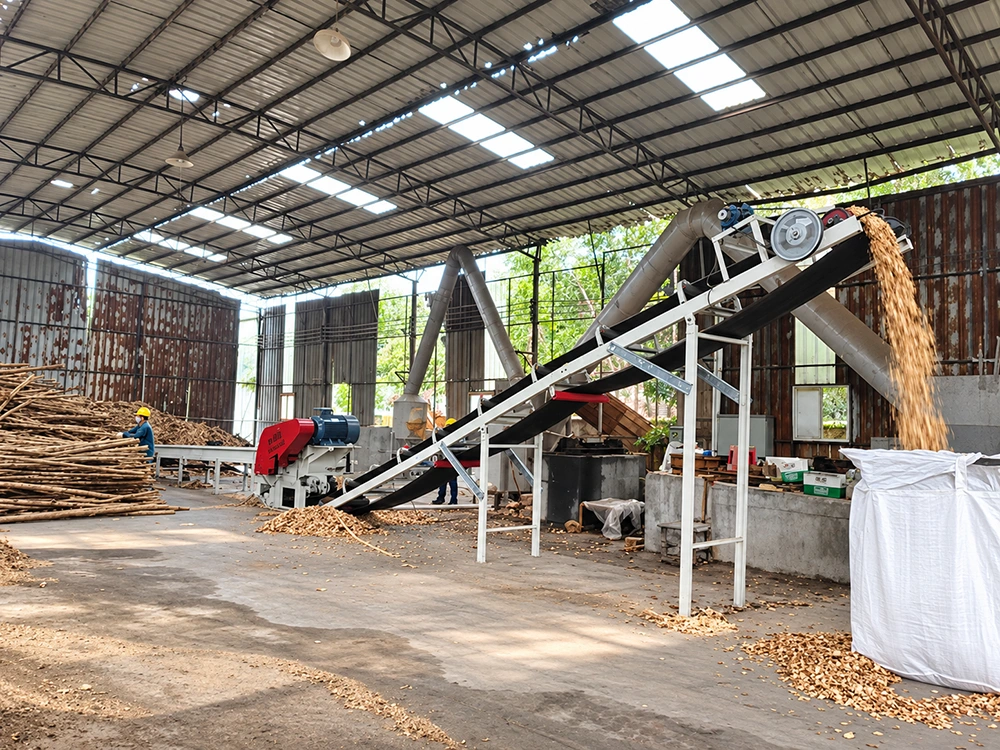
The chipper's job ends at the discharge conveyor, but the chip's commercial life starts there. Chips leave the machine at roughly 35 mm length and at the moisture content of the incoming log (commonly 40–60% wet basis for fresh sawmill residue). Three downstream routes are common: drying and pelletizing for biomass fuel; direct sale or transfer to a particleboard or MDF line that re-hammers the chips into furnish; or boiler fuel for the sawmill's own kiln heating plant. In every case, the value the drum wood chipper adds is uniformity — a screened chip of consistent length feeds a hammer mill or pellet die more predictably than a mixed-size yard load. The same screen that grades the chip inside the drum chipper also protects the downstream hammer mill from oversize pieces, which is why the screen aperture is matched to the next machine, not chosen at the chipper alone. For a sawmill planning an in-house chipping line, the practical layout is infeed conveyor → drum chipper → discharge conveyor → chip bin or bulk bag, with a dust duct to a baghouse or cyclone to keep the working area visible and the wood dust below combustible-dust thresholds.
What to Verify Before You Buy
Sawmill buyers should treat the spec sheet as a starting point, not a contract. Five items are worth confirming in writing before a drum wood chipper is ordered. First, the throughput figure with its test conditions: moisture content (wet basis %), wood species, bulk density and chip length. Without these, two competing 55 kW machines quoted at 6 t/h and 10 t/h are not comparable. Second, the actual total connected power: main motor plus both feed motors plus hydraulic pump motor, since several published spec tables omit the hydraulic pump from the headline figure. Third, whether the machine is configured for the feedstock in question — a drum chipper is appropriate for slabs, edgings and round offcuts, but if the residue stream includes nail-bearing demolition timber, a metal-detection or magnetic-separation stage must be added upstream, because the published parameter list for this chipper class does not include built-in tramp-metal rejection. Fourth, overall dimensions, weight and container loading, which are needed for the mill's electrical supply, foundation and shipping quotation. Fifth, the supply scope of the quote: whether it includes the infeed conveyor, discharge conveyor and electrical control cabinet, or only the chipper body, since most competing quotes bundle these differently.
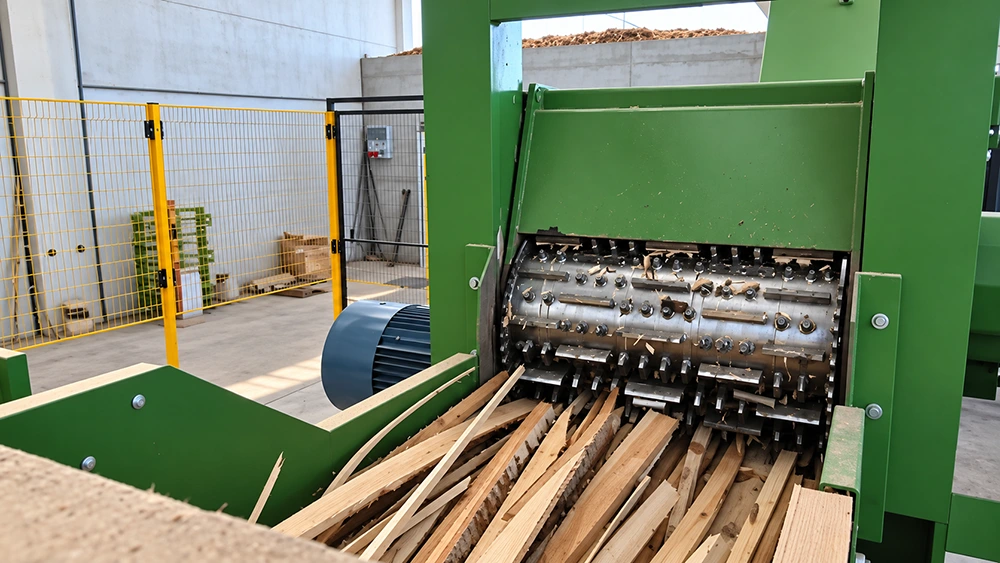
- FAO log-breakdown figures are an industry-wide reference, not a customer-published number; the ~46% residue share applies to general sawmill practice and should be presented as such, not as a customer-specific claim.
- Chipper capacity numbers across competing suppliers are quoted on incompatible bases (wet vs bone-dry, mixed species, undisclosed chip length); direct tonnage comparison without stated test conditions is unreliable.
- The published parameter set for this chipper class does not include a built-in tramp-metal rejection device; sawmill buyers handling demolition timber or pallet scrap with residual nails must add magnetic separation upstream.
- Total connected power should be reconfirmed against main motor + 2 feed motors + hydraulic pump motor, as some published headline figures exclude the hydraulic pump.
- Overall dimensions, weight and container-loading data are not in the published spec and must be requested before electrical, foundation and shipping decisions are finalized.