Wood Waste to Pallet Conversion
The Scenario: Recovery Already Runs, and the Loop Still Leaks
For manufacturers and 3PLs that already run pallet recovery or pooling, the remaining problem is not collection, it is the tail. Repaired pallets are downgraded, rejected units and broken boards still leave the gate as waste, and under ESG scrutiny a recycling statement with no measured physical outlet is easy to challenge. A presswood pallet machine changes the structure of that argument: recovered fiber goes in as feedstock, a one-piece nail-free pallet comes out, and a retired pallet is crushed and re-fed instead of written off.
Where the Traditional Pallet Nailing Machine Runs Out of Road
The incumbent setup is familiar: hardwood stringer pallets assembled on a traditional pallet nailing machine, topped up with bought-in used pallets. It works until it does not. Nailed construction is a repair-based life cycle with a hard ceiling, because stringers split at the nail line, board ends pull free, and once a unit is downgraded twice it is scrap. That scrap has a market, but not a short one, and it is not a pallet. Export adds another layer, since solid wood needs heat treatment or fumigation under ISPM 15, which is exactly the paperwork a fumigation-free pallet machine removes. Many operators who already own a wood waste recycling machine stop at chips, because chips are an output rather than a product with a unit price and a customer list.
Why the Fit Is an Automated Pallet Manufacturing Line, Not a Better Repair Bench
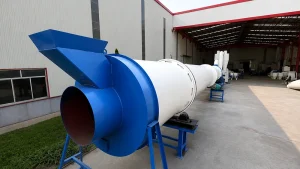
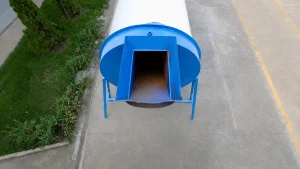
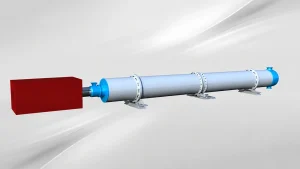
The mismatch is structural, not a matter of buying finer nailing equipment. AutoML is a molded pallet production line that takes the recovered fraction as raw material instead of treating it as waste. Crushing and hammer milling bring sawdust, shavings, wood chips, straw, bamboo powder or bagasse down to a defined particle size; a rotary drum dryer conditions moisture ahead of gluing; adhesive blenders feed dosing belt spreaders; a 1600T class hot press cures the mat; a servo take-out arm demolds the pallet and a powered roller conveyor stacks it. Because each pallet is pressed as one piece with no nails, staples or loose boards, there is nothing to repair and nothing to pull apart at end of life. A retired pallet can be crushed and re-fed into the same front end, so the pallet becomes feedstock again rather than a handling cost, and because the pallet is one-piece, nestable pallet manufacturing also cuts the empty-trip volume. That is the difference between recycling a pallet and closing a loop on it.
The Evidence: Parameters, Tonnage and an Input Record You Can Hand to an Auditor
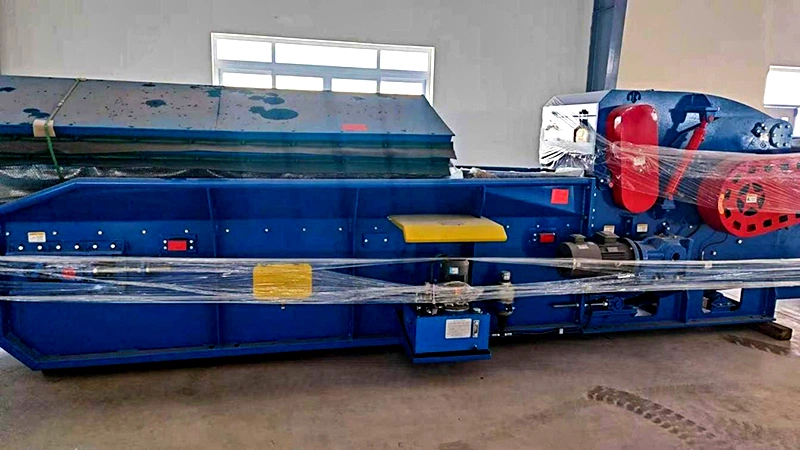
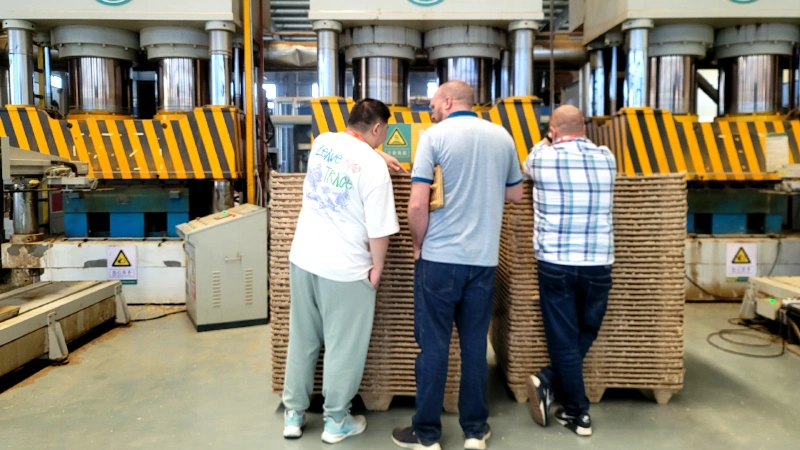
What a buyer can put in front of a technical reviewer is the pressing window, the frame and the intake record. The line runs a 150 to 180 C mold temperature at 15 to 20 MPa, on a cycle of roughly 180 to 240 seconds, pressing a mat built from 5 to 30 mm long and 2 to 5 mm thick particles to a finished density of about 0.8 to 1.2 grams per cubic centimetre. Moisture and glue ratio are set to the adhesive system and confirmed in trial data rather than taken as a global constant, because UF, PF and MDI behave differently inside the mold. The press frame is a three-beam four-column welded steel structure verified by finite element analysis, and the servo hydraulic circuit is what lets a row of presses hold cycle time without holding full pump pressure between strokes. The regulatory argument follows from the feedstock rather than from marketing copy: the input is documented recovered and residue fiber, so the due diligence position rests on intake records at the buyer's own gate, which is a far firmer footing than a sentence in a sustainability report. The two images here show the two ends of that chain, a heavy-duty hammer mill preparing recovered timber at the front, and finished nail-free pallets inspected in stacks before dispatch at the back. At that point the environmental claim stops being a statement of intent and becomes a material path with a start point, a process window and a product.
- All tonnage, temperature, pressure, cycle, density and particle figures are file or project-scope references and must be confirmed against the signed technical agreement for the specific project.
- Moisture window and glue dosage are adhesive-system dependent and must be set from trial data, not treated as a universal fixed value.
- Any EUDR due diligence position depends on the documented recovered-fiber intake at the buyer's own gate, not on a generic product claim.
- Both images are drawn from the resolved AutoML designer gallery, carry the indexed ALT text, and no image from another EMP product is used.