Pallet Recycling Networks / EUDR Due Diligence
The scenario: a network that already recycles still leaks at the end of the loop
Most responsible logistics networks already recycle and pool pallets, so the claim is not new. What ESG and EUDR reviewers now challenge is the tail end of that loop, where pallets are repaired, downgraded and finally scrapped. A wood waste recycling machine changes what can be proven: recovered fibre enters the moulded pallet production line, finished nail-free pallets leave it, and retired pallets are crushed and re-fed into the same press. The circularity statement stops being a promise and becomes a material route with recorded inputs, parameters and outputs.
Why a wood waste recycling machine moves the boundary instead of the wording
AutoML is not a single press bolted to a factory floor. It is a moulded pallet production line built as one chain: crushing, drying, glue mixing, metered dosing and spreading, hot pressing, demoulding and stacking. Because the feedstock is fibre rather than cut timber, the input side can be sawdust, wood chips, shavings, offcuts, crop straw, bamboo powder or bagasse, and the output side is a one-piece nail-free pallet formed in a steel mould. The important part for an ESG or EUDR file is the return leg. A scrapped moulded pallet has no nails, no staples and no mixed-material joints to strip out, so it can be crushed and fed back into the same preparation stage as fresh residue. Wood waste to pallet conversion becomes a loop rather than a one-way upgrade, and the network is no longer limited by how many times a sawn board can be re-nailed. That is the difference between a circularity narrative and a circularity route that can be walked through on site.
What the line records: structure and parameters a reviewer can actually read
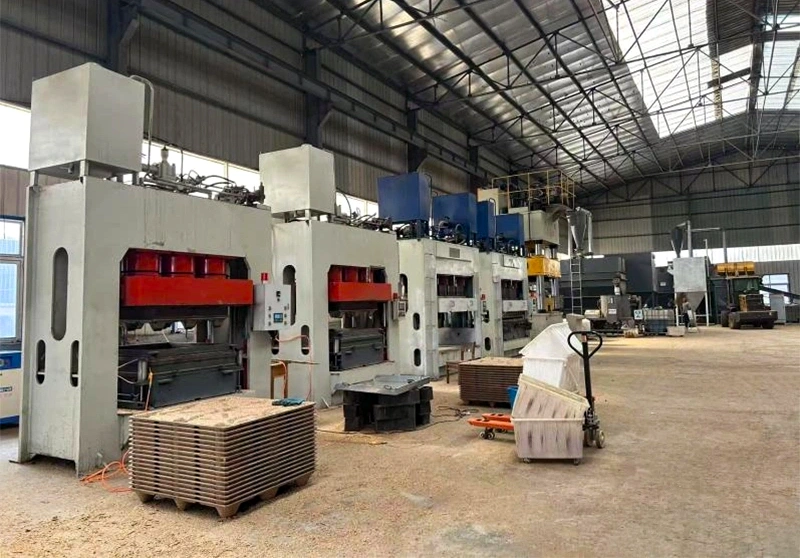
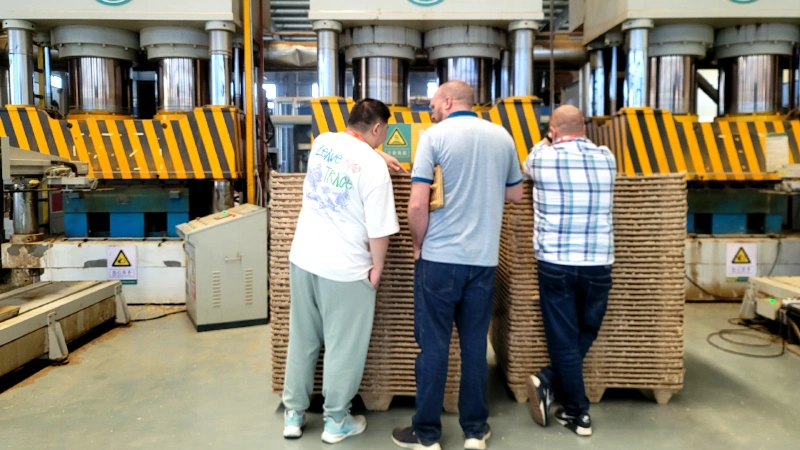
A defensible claim needs numbers attached to it. The AutoML line is generally built around 1200T to 2200T hydraulic presses, with 1600T three-beam four-column machines repeatedly used as the reference configuration, and product density in the 0.8 to 1.2 g per cubic centimetre range. Typical pressing conditions sit at 150 to 180 degrees Celsius, 15 to 20 MPa and a cycle of roughly 180 to 240 seconds, with fast clamp-up in the region of 10 seconds. Feedstock is prepared to a length of 5 to 30 mm and a thickness of 2 to 5 mm, and moisture is matched to the adhesive system rather than fixed by habit: UF systems commonly run drier, MDI systems tolerate a wider window, and the working set point belongs in the technical agreement and the trial report. Adhesive dosage follows the same logic, with MDI commonly referenced near 8 to 10 percent and UF or PF near 10 to 12 percent. On the shop floor these variables are not manual guesswork. Rail-mounted automatic dosing and spreading machines meter each charge, PLC stations log temperature and displacement, servo take-out arms pull the cured pallet from the tooling, and finished stacks are inspected before dispatch. For an audit trail, the useful artefacts are the raw material intake records at your own gate, the dosing and pressing parameter logs, and the final dimensional and load checks on the stacked output. The photo of parallel heavy-duty hydraulic hot presses with marked walkways shows the production footprint that generates those records, and the inspection photo of two stacked pallet columns shows the point where the finished article is verified rather than assumed.
The result: a due-diligence position that does not depend on a slogan
Two outcomes follow from running the loop this way. First, the environmental statement is anchored to a documented input stream. Because the pallet body is made from recovered fibre, the material argument under the EU Deforestation Regulation can rest on recycled content and intake documentation instead of a virgin-timber chain of custody, which is a far more durable answer in a due diligence review than a general commitment to recycling. Conditions and documentation still have to be met, and the specifics belong in your compliance file, but the substance exists rather than being asserted. Second, the output is a moulded, one-piece, nail-free pallet, which keeps it outside the solid wood packaging treatment path and supports a fumigation-free, ISPM-15 exempt logistics article that does not queue for heat treatment. For a network that already recycles, that combination is what turns a vulnerable claim into a checkable one: waste wood in, pallets out, retired pallets back to the crusher, and a paper trail at every step. If you want to see how the metering, pressing and take-out stages would be configured around your own waste stream and pallet specification, send the pallet size, target output and available feedstock and we will map the line against them. Talk to our engineers through the contact page.
- Body text is plain text with no HTML tags, attributes or markdown; the fixed renderer owns the paragraph markup.
- Image source paths are taken from the resolved AutoML designer gallery and both ALT strings come from the same index entries.
- Traffic keywords are used naturally in the eyebrow, intro, section headings and body, covering wood waste recycling machine, moulded pallet production line and wood waste to pallet conversion.
- The contact call to action points at the site contact page and the article keeps the subscriber scenario, legacy problem, product fit, parameter evidence and result sequence.