Automated Pallet Manufacturing Line
Where a Wooden Pallet Stops Being Packaging and Becomes Line Infrastructure
An automated storage and retrieval system, a robotic forklift and a high-speed sorter do not fail on a pallet first lift. They fail on the second pass, when a 2 mm warp, a proud splinter or a missing corner block reaches a photo-eye. A presswood pallet machine that runs as a molded pallet production line presses recovered fibre into a single piece at 1600T, 150 to 180 C and 15 to 20 MPa, so every unit leaves the mold on the same dimension, the same mass and the same deck height, with no nails, no warp and no splinters left for the sensor to catch.
Why a Tighter Repair Standard Cannot Buy Back Consistency
The first answer from most operations is to inspect harder. Repair benches get stricter pass criteria, so a pallet that used to go straight back into the pool now goes to the bench. That works until the arithmetic catches up: tighter criteria raise the number of parts replaced per repair, the number of repairs per pallet and the labour minutes per pallet, while repair capacity and skilled hands stay where they are. The public number that framed this for the whole industry came in 2026, when CHEP reported quarterly profit pressure of roughly USD 60 million from repair capacity limits combined with automation-driven quality demands, and had to buy about 2 million new pallets as an emergency bridge. That is the ceiling of a repair-based quality strategy: a traditional pallet nailing machine, a wooden stringer pallet equipment bench and an automatic pallet nailing robot can all rebuild a pallet, but none of them can remove the joints, the nails or the moisture movement that created the fault in the first place. If the automation rate keeps rising, the repair route is not a solution, it is a growing cost line sitting between the press and the customer.
Why a Molded One-Piece Pallet Matches an Automated Flow
The presswood route changes the object instead of the inspection standard. A nail-free wooden pallet process presses wood fibre, sawdust, shavings or agricultural residue with resin into one continuous body, so the pallet has no stringer joint to loosen, no nail to back out, no board edge to chip and no block corner to break off. Because it is one piece, geometry is set by the mold and the recipe, not by a nailing jig and a timber lot. The AutoML line is built as a one-piece pallet press solution: a GEO automatic spreader with weighing-based dosing fills each mold cavity by mass, a 1600T dual-cylinder hydraulic press closes and holds the cure, and a servo take-out arm removes the finished pallet while it is still on the same dimensions the mold defines. Repeatability of size, mass and deck height reaches the plus or minus 1 mm class, and because the process is automated from dosing through demolding, that repeatability does not depend on how experienced the operator on shift happens to be. The same line also gives you nestable pallet manufacturing for compact return loads and, being a heat-pressed processed wood product, an ISPM-15 exempt pallet equipment position that removes fumigation from the export lane. The practical result is a pallet whose geometry is a process output rather than an inspection outcome.
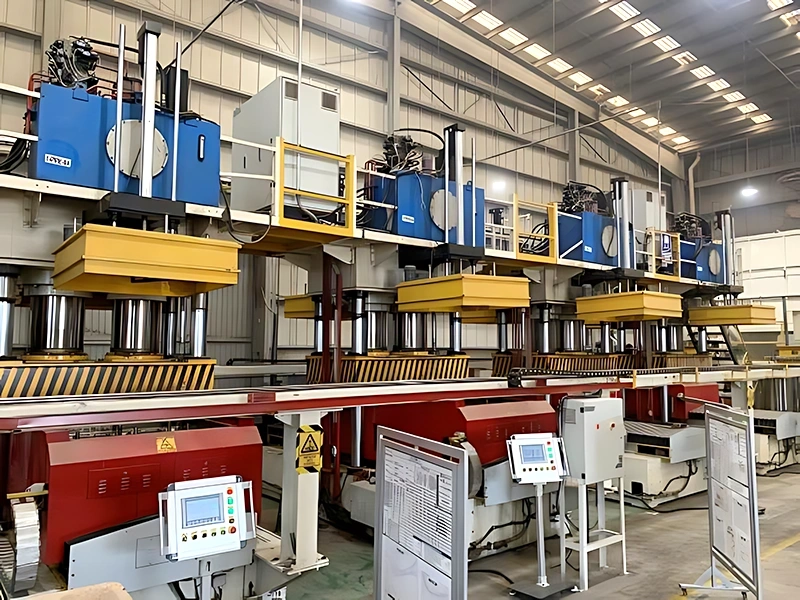
What the Line Holds at the Sensor: Structure, Parameters and Evidence
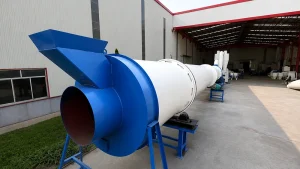
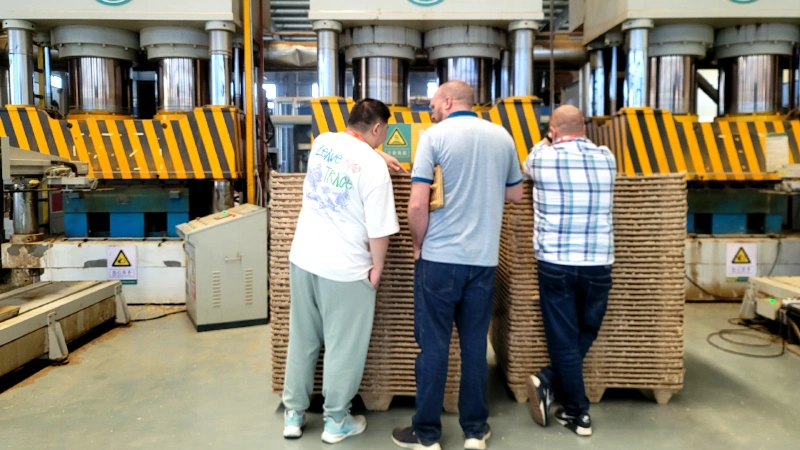
The evidence sits in the equipment, not in a brochure claim. A molded pallet production line for automated logistics is normally specified with 1600T class three-beam four-column hydraulic hot presses, rail-mounted spreading stations with central PLC control, oil-heated molds and a servo or pneumatic demolding arm feeding a powered roller conveyor, which is what the plant photography in this AutoML set shows: the press array, the spreading segment with its dosing belt feeders, and finished pallets stacked for a dimensional and finish check before they leave the shop. Molds cover the usual logistics formats, from 1000 by 1000 and 1100 by 1000 to 1200 by 1000, 1219 by 1016 and custom sizes for special loads. Pressing parameters are commonly set at 150 to 180 C and 15 to 20 MPa with a cycle of about 180 to 240 seconds; board density lands in the 0.8 to 1.2 g per cm3 range; raw material is prepared to roughly 5 to 30 mm in length and 2 to 5 mm in thickness, with moisture and glue dosage matched to the glue system in use, typically around 8 to 10 percent MDI or 10 to 12 percent UF or PF. Final power, layout, moisture window and cycle time are confirmed in the technical agreement for the specific project, because those values follow the mold and the glue rather than a universal datasheet. Take the result at the point where it matters: when deck height, footprint and mass repeat from unit to unit, a robotic forklift and an ASRS stop logging pallet-induced faults, the repair standard no longer has to be tightened every time the automation rate goes up, and the repair bench stops growing with volume. The high-automation flow you already paid for finally gets fed pallets it can handle.
- Every section body is plain text with no HTML tags, attributes, Markdown or angle brackets, so the fixed renderer owns all paragraph markup.
- Both images are selected from the resolved AutoML designer gallery and were imported once with their indexed English ALT text.
- Traffic-profile vocabulary is used naturally: presswood pallet machine, molded pallet production line, automated pallet manufacturing line, one-piece pallet press solution, nail-free wooden pallet process, nestable pallet manufacturing, ISPM-15 exempt pallet equipment, plus the traditional pallet nailing machine and wooden stringer pallet equipment comparison words.
- The rendered fragment keeps the route contract root section.emp-section.emp-blog-p0 with emp-section markers, an emp-btn-primary CTA and an href pointing to /contact/.