Return-Leg Economics for Pallet Pools and Network Shippers
Where the Money Leaks: Paying Freight to Move Air on the Return Leg
A rented or pooled pallet earns its keep on the outbound leg and burns margin on the way back. Traditional block and stringer units weigh 27 to 34 kg and do not interlock, so a returned stack grows a full pallet height at every unit and a trailer ends up hauling air. A presswood pallet machine presses recovered fibre into a one-piece, nail-free pallet whose underside accepts the next unit: nestable pallet manufacturing runs about four to one, cuts return volume by 60 to 70 percent, and each molded pallet is roughly 60 percent lighter than the same-spec wooden pallet. Same trailer, several times the returned quantity, and the empty kilometres stop being a line item you argue about every quarter.
Why a Traditional Stringer or Block Pallet Cannot Fix the Empty Run
The standard wooden pallet is an assembly: deck boards, stringers or blocks, and nails. The frame it creates is rigid but hollow, and it does not interlock. Set one unit on another and the second sits on the top deck, so a returned stack grows a full pallet height every time. A 1200 by 800 block or stringer unit also weighs roughly 27 to 34 kg. At the loading dock the outcome is predictable: fixed trailer volume, low unit count and a load that is heavy before anything is loaded on it. Repair is a second leak. Nailed joints loosen under automated handling, board ends splinter, and units that fail inspection leave the pool as scrap instead of returning as revenue. When a site moves to automatic storage and retrieval lanes, robotic forklifts and high-speed sorters, the same unit must repeat its dimensions and mass pass after pass, and a nailed unit with a proud fastener stops the lane rather than slowing it.
Why the Molded Pallet Fits This Specific Route
A presswood pallet machine changes the geometry of the returned load instead of the outbound load. A molded pallet production line presses recovered wood fibre, sawdust or agricultural residue together with binder into a one-piece, nail-free pallet inside a heated hydraulic press. The underside of the molded unit is profiled so that one pallet drops into the one beneath it. That is what nestable pallet manufacturing means in practice: about four units occupy the height of one. On a return trip the trailer volume consumed by a given number of units falls by roughly 60 to 70 percent, and each unit is about 60 percent lighter than a same-spec wooden pallet. The same consolidation a pool operator tries to buy with a return surcharge is produced here by pallet geometry. For the shipper the saving is freight and handling on the empty leg; for the pool operator it is more fleet turns per year at a fixed trailer count, and for a compressed wood machine owner it is a return leg that no longer needs its own budget.
Structure, Parameters and the Result on the Return Lane
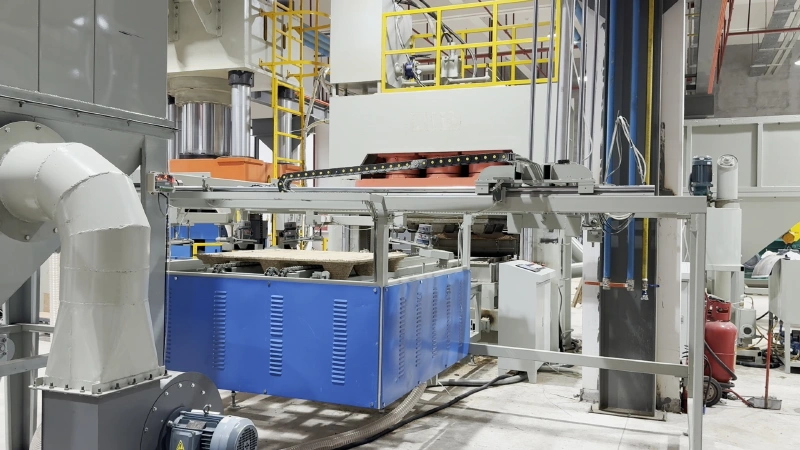
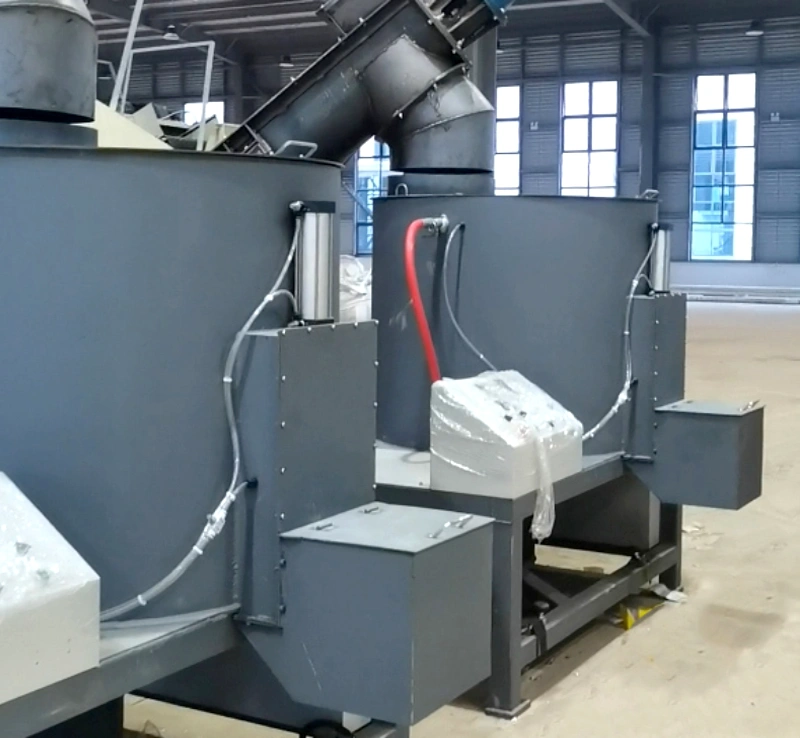
The line behind those numbers is documented rather than asserted. Intake is weighed and dosed before pressing, so every pallet receives a repeatable mass of fibre and binder. The press closes at 1600 tonnes and holds a mould temperature of 150 to 180 degrees Celsius at 15 to 20 MPa, curing the one-piece body to a density of 0.8 to 1.2 grams per cubic centimetre. There are no nails, no loose boards and no joints to re-tighten, so each unit leaves the automated pallet manufacturing line inside a tight dimensional class and holds that class across handling cycles. Because the pallet is pressed rather than sawn it is classed as a processed wood product, which keeps it outside the ISPM-15 heat treatment and fumigation requirement and removes a second queue from the same export channel. The unit that comes back is not a heavier twin of the one that left. It is the same pallet, tucked into the stack, carrying several times the quantity on the same trailer. That turns the return leg from a cost centre into capacity, and it is the part of a pallet production setup that pays back on freight rather than on purchase price. To size the nesting stack, pallet footprint and press cycle against your own return lanes, send your trailer type, current pallet specification and empty kilometres per trunk route to our engineers.
- Return-leg cost math stated in plain terms: 27-34 kg traditional block pallets, roughly 4:1 nesting, 60-70 percent less return volume, about 60 percent lighter than same-spec wooden pallets.
- Each section body is plain text with no HTML tags, attributes, Markdown or angle brackets; the fixed renderer creates the paragraph markup.
- Only the resolved product image index was used: the two source paths are AutoML designer gallery files imported once through wp_media_batch, with index ALT text.
- Traffic profile vocabulary used naturally: nestable pallet manufacturing, presswood pallet machine, molded pallet production line, compressed wood machine, wood waste to pallet conversion, ISPM-15 exempt pallet equipment, traditional stringer or block pallet as the old method.