Sawdust Dryer Retrofit Module
The expanding capex: when a full pressure line is the wrong answer
For a mid-size MDF or particleboard plant in an expansion or aging-dryer replacement phase, the DRYR sawdust dryer module drops into the existing press line on a common set of flange interfaces. The H-1010 to H-1815 four-model capacity ladder covers 0.8 to 2 tonnes per hour on one flange plan, so the plant can stage retrofit capacity today and step up to the next tier in two to three years without scrapping the press line.
Why the DRYR sawdust dryer fits as a drop-in module
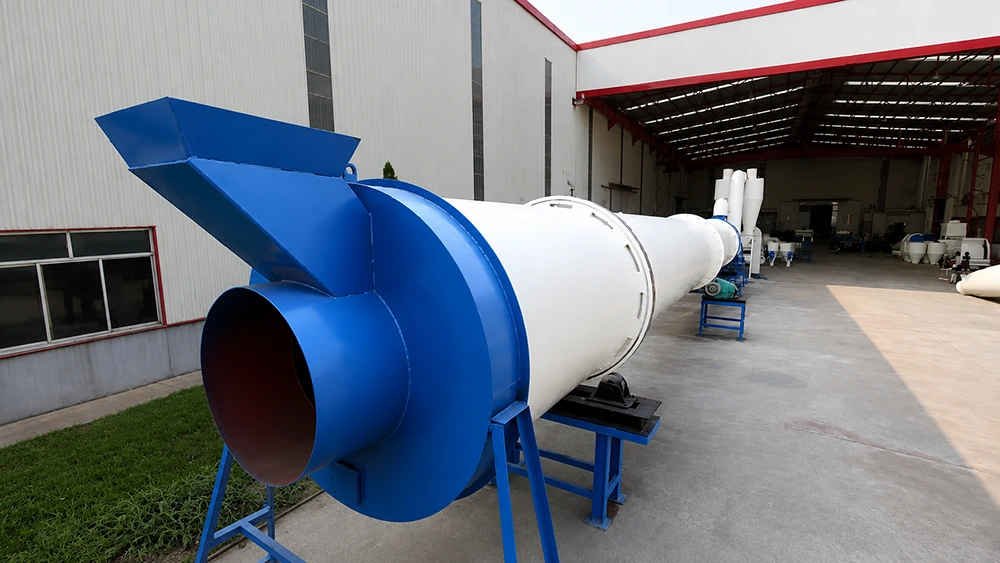
DRYR is positioned as that drop-in module. It is a rotary drum dryer built around an assembled structure with a common set of flange interfaces on the feed end, the discharge end, the hot air inlet, and the dust outlet. Four standard models — H-1010, H-1212, H-1512, and H-1815 — cover 0.8 to 2 tonnes per hour on the same flange plan. That means the engineer who specifies the drum for today's bottleneck can step up to a larger model in two to three years using the same screw conveyor flange, the same hot air furnace flange, and the same cyclone flange, without redesigning the line.
Specs and structure behind the line
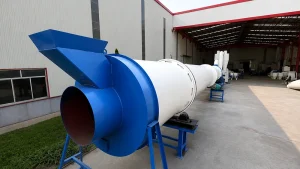
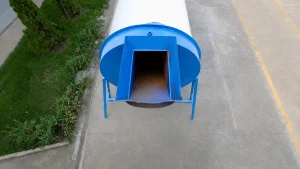
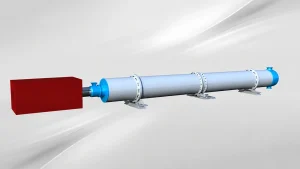
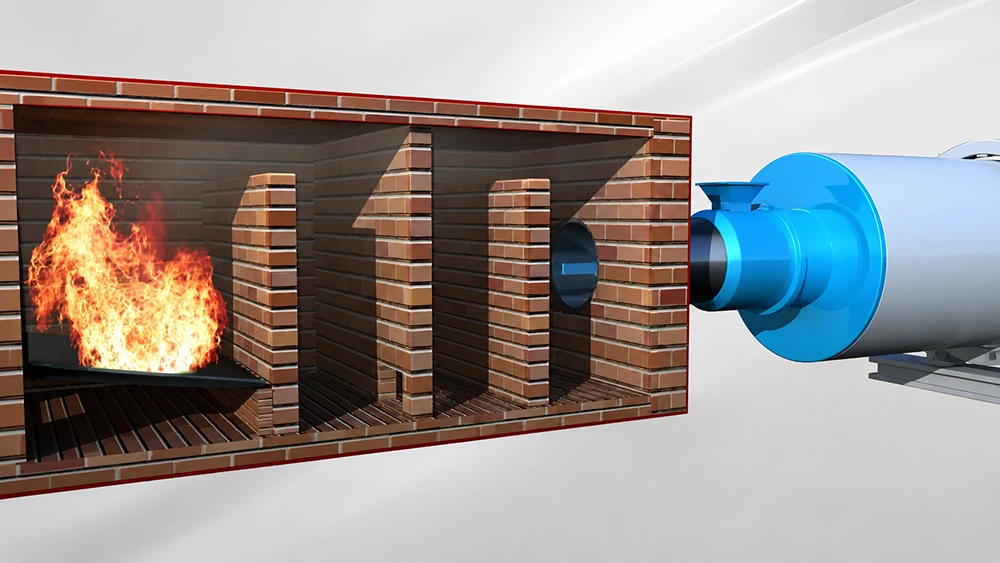
The four-model range is one platform at four scales. Drum diameters are 1000, 1200, 1500, and 1800 mm; main motors step from 4 kW to 5.5, 7.5, and 11 kW; induced draft fans step from 7.5 kW to 7.5, 11, and 15 kW. Output moisture drops below 10 percent on every model and coal consumption stays under 8 kg per ton of dried sawdust when the drum is paired with the multi-fuel hot air furnace. The drum ships in bolted flange sections — including the long 17 to 18 m configuration referenced in inland East Africa projects — so a brownfield gate that blocks a single welded drum still accepts the DRYR assembly. The first image shows exactly that drop-in logic: a DRYR rotary drum dryer with a blue feed hopper sized for the existing screw conveyor, a white cylindrical shell on steel roller supports, ready to mate to the press discharge on the other end. The second image is the 3D cutaway of the multi-fuel hot air furnace that bolts to the drum inlet — a refractory brick-lined combustion chamber with internal baffles and a side burner that can be fired with coal, oil, natural gas, or on-site biomass powder, depending on what the plant already buys.
The retrofit outcome
The retrofit outcome is concrete. The plant keeps its existing press, forming line, PLC, and operator base; it adds one drum on the existing pad, with the existing screw conveyor, cyclone, and control cabinet re-terminated to the new drum's flange. Capex drops to the cost of one DRYR module plus the re-termination hours, not the cost of a turnkey line. When the line needs another 30 to 50 percent output in two to three years, the plant can step from H-1212 to H-1512 or H-1815 on the same flange plan, with the same hot air furnace and cyclone. For a mid-size emerging-market MDF or particleboard producer, the DRYR capacity tier system turns dryer expansion and dryer replacement from a single binary capex decision into a staged, financeable capex path that fits the pressure line the plant already owns.
- DRYR sawdust dryer module drops into existing MDF or particleboard pressure line
- H-1010 to H-1815 four-model capacity tier system on a common flange plan
- 0.8 to 2 t/h with output moisture below 10 percent and drum shipped in bolted flange sections
- Staged retrofit capex instead of full pressure line replacement