Bio-organic fertilizer drying
Why bio-organic fertilizer lines run a sawdust dryer ahead of the disc granulator
Bio-organic fertilizer lines blend chicken manure at 70 percent moisture with sawdust as the dry carbon source, but fresh sawdust off the wood waste pile sits at 35 to 50 percent moisture and rewets fast in humid sheds. A DRYR rotary sawdust dryer pulls sawdust to a stable sub-12 percent moisture before it reaches the weigh hopper, so the dry carbon ingredient can absorb chicken manure water and bring the blend into the 20 to 25 percent wet-granulation window that disc granulators are calibrated for.
How the DRYR rotary drum and combined lifting flights handle organic-grade sawdust
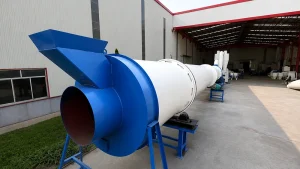
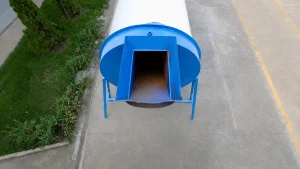
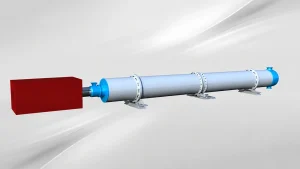
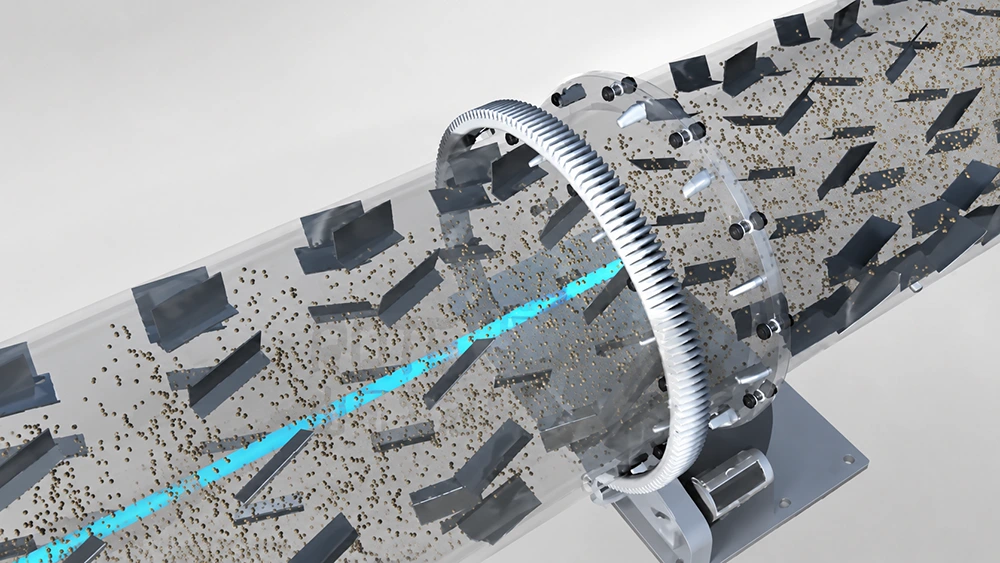
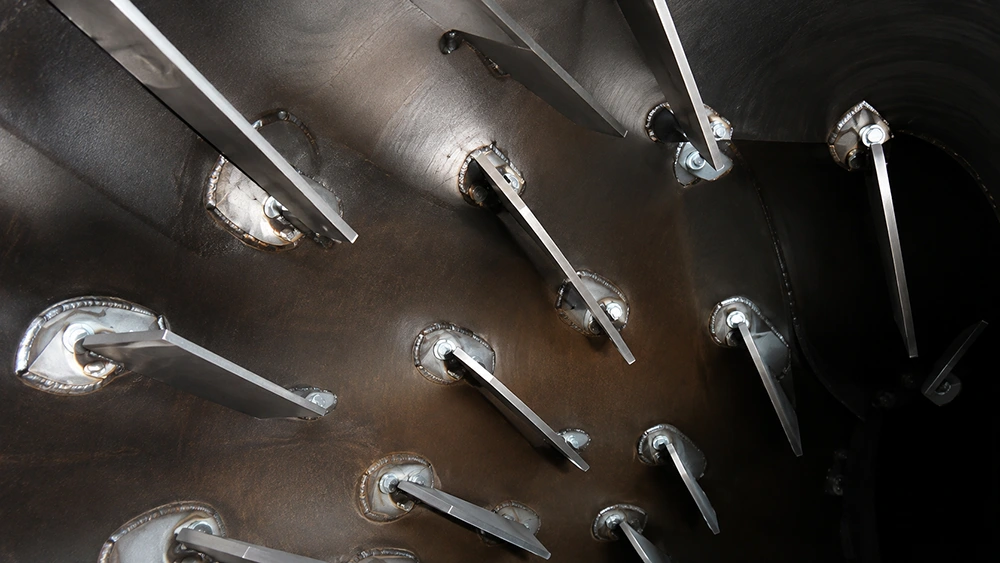
A DRYR rotary sawdust dryer treats the sawdust stream as the controllable input rather than another variable. The drum runs at a shallow slope with internal lifting flights welded to the inner shell, lifting and cascading the sawdust through the hot air stream for a controlled residence time. The combined lifting plate pattern, made of staggered paddle bars at multiple mounting positions along the drum axis, keeps the sawdust in curtain flow so heat exchange stays uniform and the dry product leaves the drum at a stable moisture reading rather than swinging with feed variation. The shell is self-insulating with a refractory-lined combustion chamber, so hot air reaches the sawdust at the temperature the PLC is set to without losing heat to the ambient. Output moisture is held below 12 percent on a continuous read, adjustable down to about 7 percent if the recipe asks for it. The multi-fuel furnace accepts coal, oil, natural gas, biomass powder or on-site wood waste depending on what the fertilizer plant already procures, so the dryer runs on the same fuel stream the boiler room uses.
Sizing and integration with the disc granulator line
The DRYR H-1010 to H-1815 four-model range covers 0.8 to 2 tonnes per hour, which matches the 1.0 to 1.5 t/h dry-sawdust feed rate of a typical 10 to 15 t/h bio-organic fertilizer disc granulator line. Each model shares the same bolted-flange interfaces for the upstream screw conveyor and the downstream cyclone dust collector, so the dryer drops into an existing shed on the existing civil foundation without bespoke steelwork. The drum diameter scales from 1000 mm on the H-1010 to 1800 mm on the H-1815, with main motors from 4 kW to 11 kW and induced-draft fans from 7.5 kW to 15 kW matched to the drum size. The drum discharge connects to a cyclone separator and optional baghouse for organic dust collection, with seal monitoring on the rotating joint to keep emissions inside the baghouse and prevent the drum from pulling in humid ambient air that would rewet the dried sawdust before it reaches the blender. The discharge end of the dryer feeds a sealed screw conveyor that runs straight into the weigh hopper on the disc granulator line.
Holding the 20 to 25 percent wet-granulation window through stable sawdust moisture
With pre-dried sawdust coming off the DRYR dryer at under 12 percent moisture and a measured hourly tonnage, the plant runs a fixed recipe against actual moisture instead of a moving target. For one tonne of chicken manure at 70 percent moisture, the mass balance asks for roughly three tonnes of sawdust at 10 percent moisture to land the blend at 25 percent, the upper edge of the wet-granulation window. The same recipe with sawdust at 25 percent moisture, the level it rewets to in an open humid shed, pushes the blend to about 35 percent — outside the window, where the disc granulator smears, the scraper loads up, and throughput drops by 20 to 40 percent. The DRYR output feeds a sealed screw conveyor directly into the weigh hopper, so the sawdust moisture stays where the dryer left it until the moment it meets the chicken manure and compost. The blend lands inside the 20 to 25 percent wet-granulation window, the disc granulator holds its nameplate throughput, the bio-organic fertilizer line gets a controlled feedstock instead of a moisture surprise, and the operator stops chasing the recipe by hand every shift.
- canonical_product equals Dryr
- sections count equals 4 and every body is plain text without HTML tags
- both image source_path values resolve inside the Dryr designer gallery and are not reused on a competing recent Dryr post
- content addresses the customer pain point on variable raw material moisture and the 20 to 25 percent wet-granulation window