MDI Presswood Lines
MDI lines for automotive and pharma still carry a manual take-out variable the camera cannot fix
MDI presswood lines serving automotive and pharma channels cannot rely on AI cameras alone to hold the dimensional consistency that sustainability audits and tier-1 customers ask for. The remaining variable sits one station earlier, at the take-out and stacking point right after a 1250 to 1600 ton press opens. AutoG is an automatic pallet take-out robot that pulls the freshly molded pallet straight out of the mold at around 80 degrees Celsius with a vacuum suction gripper, transfers it along a six-axis path, and lays it on the stack with the same end-of-arm pose every cycle, so the part that enters downstream inspection is the part the press produced, not a part a worker re-handled.
Why an automatic pallet take-out robot with one arm and two presses fits an MDI line
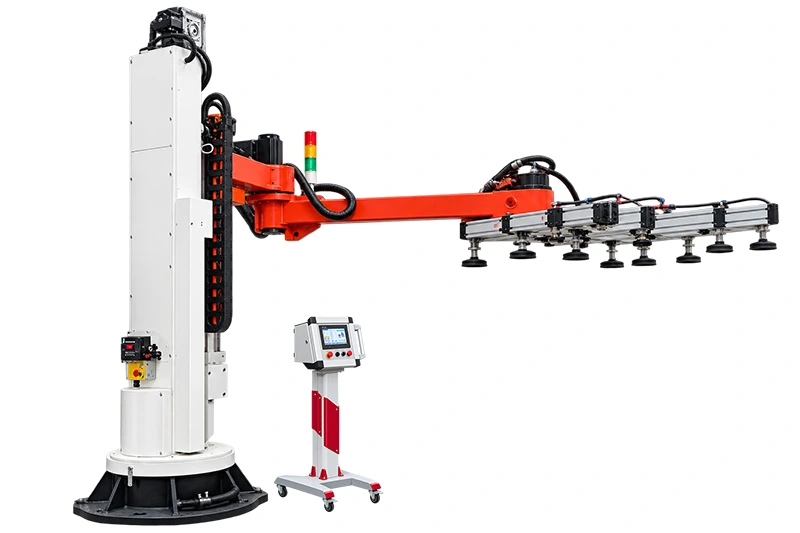
AutoG is the automatic pallet take-out robot that mounts beside the hot press on the presswood pallet production line, takes the pallet straight from the mold at around 80 degrees Celsius with a vacuum suction gripper, and stacks it without a second human lift. One arm serves two 1250 to 1600 ton presses in alternation, which matches the way an MDI line already schedules its 4 to 5 minute press cycle across two machines. Because the line PLC owns the press and the take-out sequence, the same recipe that controls press force, time and temperature also controls when the robot reaches in, how it lifts, and where it places the pallet on the stack. The take-out step stops being a free variable the downstream camera has to absorb and becomes part of the same recipe the line was sold on.
What the take-out station actually looks like on a dual-press MDI line
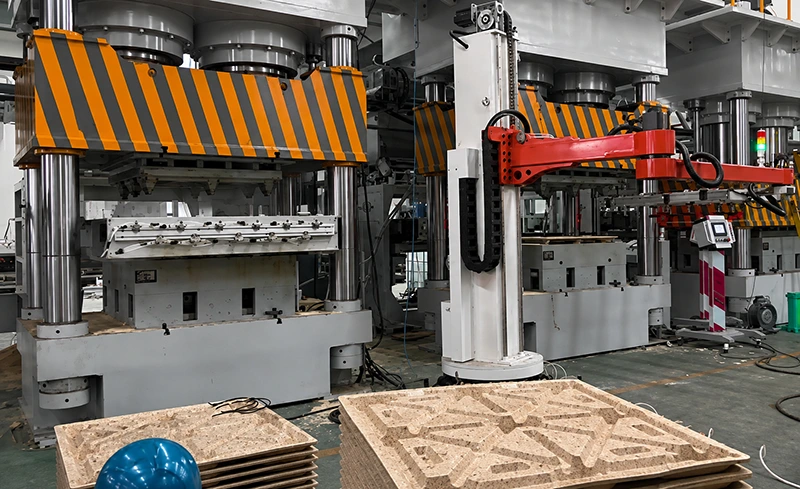
In the press-side cell, AutoG sits on a floor-mounted column with a long articulated boom, a multi-cup vacuum end effector, a cable carrier and a stack light, and is paired with a mobile control pedestal that lets an operator supervise the cycle away from the press danger zone. The robot reaches the open mold, applies the suction array, lifts the freshly molded pallet at around 80 degrees Celsius, swings it out along a six-axis path, and lays it on the stack with the same end-of-arm pose on every cycle. On a dual-press MDI line the same arm alternates between press A and press B, waits inside its safe envelope while the press is closed, and steps in only after the mold opens, so the press cycle and the take-out cycle stay locked together without a worker standing next to a 1600 ton press.
What changes for yield, audits and labor when the manual take-out is removed
With the manual reach into the press danger zone removed, about two take-out workers per shift come off the headcount, the freshly molded pallet reaches the stack without a worker re-handling it, and the downstream AI camera inspects a part whose position and pose on the conveyor is set by the robot rather than by a human lift. For an MDI line serving automotive and pharma channels that translates into a tighter dimensional consistency window entering inspection, fewer false rejects traced back to a drop or a slip, a documented take-out step the sustainability audit can verify, and a press cycle that can run through the night without a person standing next to a 1600 ton press waiting for the mold to open.
- Mentions automatic pallet take-out robot
- Mentions MDI presswood line and 80 degrees Celsius take-out
- Mentions automotive and pharma tolerance or dimensional consistency
- Mentions dual 1250 to 1600 ton presses and one-arm-two-presses tending