Press Cycle Synchronization
The 4–5 minute press cycle is a contract — manual take-out keeps breaking it
On a 4–5 minute presswood pallet press cycle, manual take-out keeps breaking the contract between the press and the operator. AutoG is the automatic pallet take-out robot that accepts the open/close signal from a 1250–1600 ton press and lifts the 80°C pallet the moment the mold opens, so the press stops waiting for a worker and the line runs at the takt it was sized for.
Why AutoG is built to take an 80°C pallet straight out of the mold
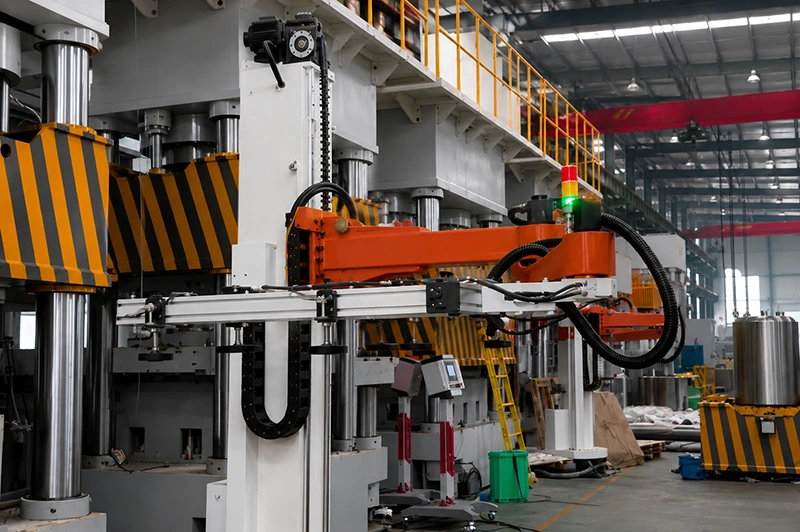
AutoG is an automatic pallet take-out robot built to live next to a 1250 to 1600 ton presswood press. Its six-axis articulated arm carries a multi-cup vacuum suction end effector, and the manufacturer rates it to handle the pallet at roughly 80°C straight out of the mold, so there is no cool-down buffer inserted between the press and the take-out. The arm hands off to the press open and close signal through the line PLC, so the moment the press reaches top-of-stroke and the safety conditions clear, the robot is already on its path into the mold. There is no waiting for a worker to step in, no glove change, no pallet cool-down timer. On a fully automatic presswood pallet production line, a single AutoG cell alternates between two presses — one arm serves two 1250 to 1600 ton presses, so the press on stand-by stays ready and the press that just opened starts its next stroke as soon as the pallet clears the cell.
Line-level evidence — six-axis arm, vacuum end-effector, press-side cell
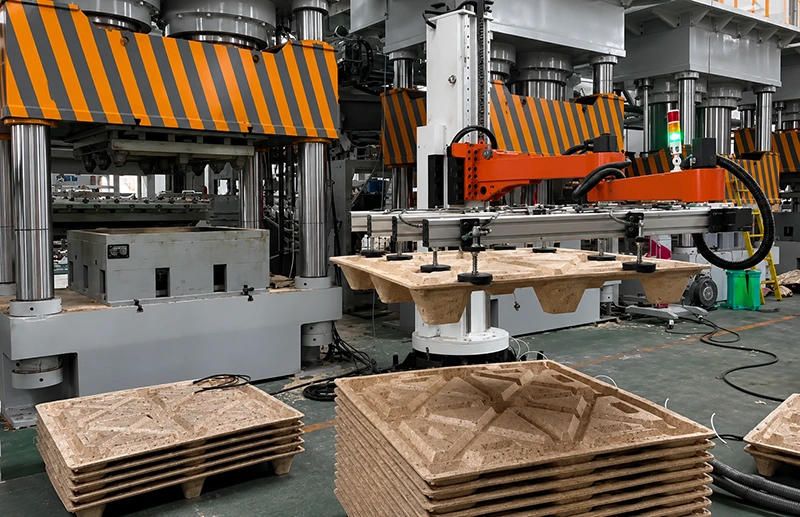
On a four-post presswood pallet hydraulic press with a striped safety enclosure, the AutoG cell sits beside the press platen. The long articulated arm reaches across the mold opening, the multi-cup vacuum beam grips the embossed face of the pallet, and the arm lifts and indexes the pallet out in a single continuous motion. A cable carrier runs along the boom to keep signal and vacuum lines managed through every joint, and a three-color stack light at the cell reports cell state back to the line PLC. The robot is installed as a press-side robotic cell rather than a stand-alone arm: it shares the press open/close interlock, the safety light curtain and the operator HMI of the press, so the take-out motion is locked to the press takt rather than to a free-running timer. A mobile control pedestal next to the cell lets the operator jog, teach and recover the arm without climbing onto the press deck.
Result — takt restored, single-line OEE up, two workers redeployed
The combined effect is that the press stops waiting. The 4 to 5 minute press cycle returns to being the press cycle, because the take-out is sequenced to the press open/close signal rather than to a worker’s shift in and out of the danger zone. On a two-press line, one AutoG cell replaces the two manual take-out operators that the original cell layout needed, which both removes a chronic hiring problem and clears two operators into higher-value tasks downstream. The line can run the 24-hour continuous operation pattern that the rest of the presswood pallet line is sized for, because the take-out station is no longer the first station to fall over. For plants sizing a 200,000 to 500,000 pallet annual capacity or upgrading from a semi-automatic line to a fully automatic presswood pallet production line, AutoG is the standard automatic take-out robot on the EMP line and the cell that closes the takt gap between the hot press and the rest of the line. Talk to EMP engineering about your press tonnage, mold size and existing press open/close interface to confirm fit and cycle match for your specific cell.
- Pain-point lede references the 4–5 minute press cycle and the manual wait that breaks it
- Mechanism sentence ties 80°C direct take-out to PLC hand-off with the press open/close signal
- Anchor AutoG to 1250–1600 ton press, six-axis arm, multi-cup vacuum end effector, one arm two presses
- Close with takt restored, single-line OEE up, two workers redeployed, contact CTA