Sawdust Dryer for Organic Fertilizer
Why Drying Eats the Margin on a Small Organic Fertilizer Line
On a small or mid-scale organic fertilizer line, drying is the single largest fuel line on the monthly cost stack. Chicken manure, composted manure, mushroom residue, and rice or wheat straw all enter the dryer wet and have to leave below the binding-window moisture the granulator downstream is calibrated for; the energy it takes to get there drives the bill. A DRYR multi-fuel sawdust dryer with a self-insulation shell and a hot-air furnace that accepts coal, oil, natural gas, or dry biomass powder, granule and chip lets the plant run that hot-air furnace on the sawdust, straw and rice husk it is already handling on site, holds coal spend below 8 kilogram per ton of dried material, and turns the drying stage into a closed-loop energy cycle that fits a circular-economy organic fertilizer operation.
Multi-Fuel Hot-Air Furnace: Coal, Gas, Oil, and On-Site Biomass Waste in One Fire Box
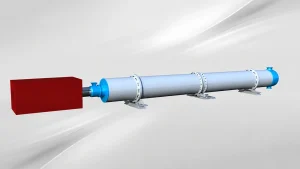
DRYR is built around this exact combination: a multi-fuel hot-air furnace that burns coal, oil, natural gas, or any dry biomass particle, granule or powder on site, paired with a self-insulation shell that holds thermal efficiency above 80 percent and cuts the hot-air fuel bill per ton of dried material. The hot-air furnace ships with a refractory brick-lined combustion chamber and an internal baffle wall, so the fire box holds temperature cleanly across solid biomass fuels that swing in calorific value, and the self-insulation shell stops the drum from radiating heat back into the hall. For an organic fertilizer plant, this is the match: the same facility that produces chicken manure and compost also receives sawdust from a sawmill down the road, rice husk from a rice mill, or straw bales from a neighboring farm. Instead of paying to haul that biomass away or paying a disposal fee, the dryer can be configured to burn any of those streams as primary or supplementary fuel, and the closed loop turns a waste-handling cost into a hot-air fuel credit.
DRYR Drum, Drive Train, and Four-Model 0.8 to 2 t/h Range
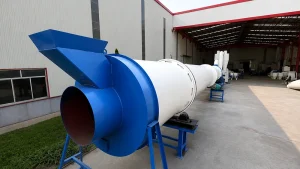
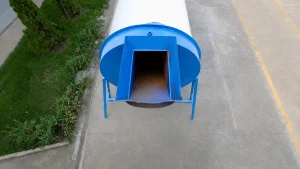
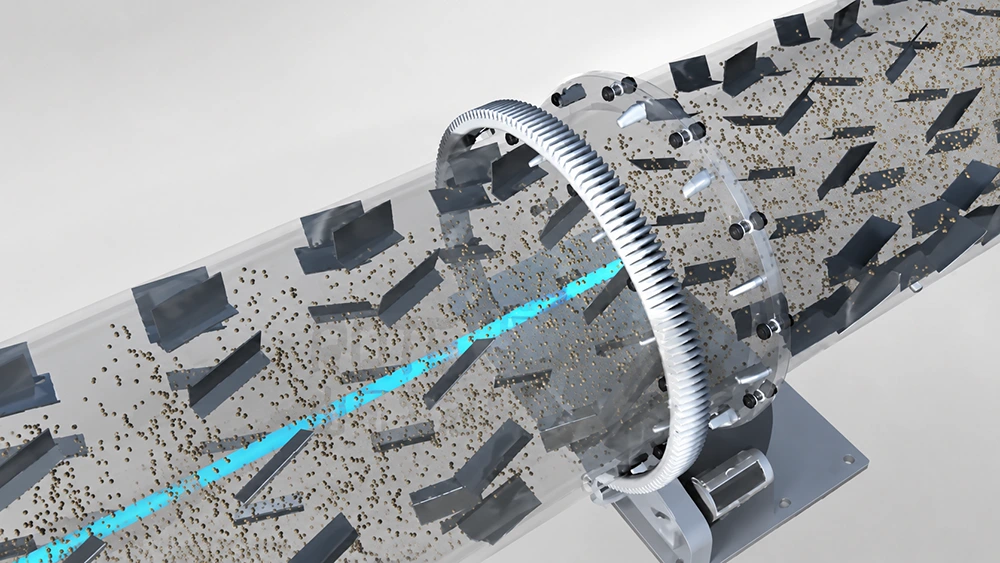
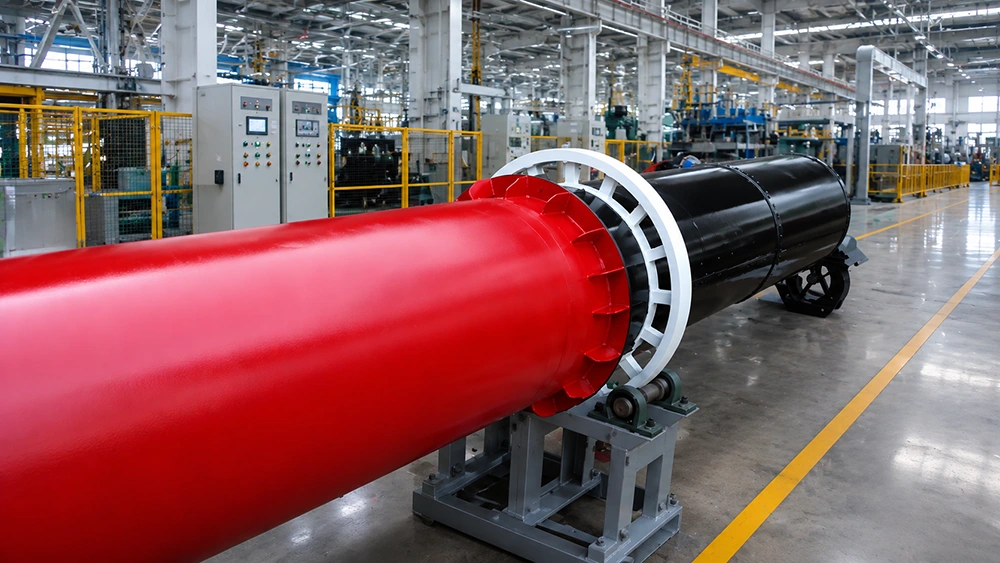
The four-model DRYR range covers 0.8 to 2 tonnes per hour on a continuous drum with an external girth gear, pinion drive, gearbox and motor, and a bolted-flange drum body that lets the dryer ship in standard 40HQ containers for inland sites. H-1010 sits at 1000 millimeter drum diameter with a 4 kilowatt main motor and 7.5 kilowatt induced-draft fan for 0.8 to 1 tonne per hour, H-1212 at 1200 millimeter and 5.5 kilowatt for 1 to 1.2 tonne per hour, H-1512 at 1500 millimeter and 7.5 kilowatt for 1.2 to 1.5 tonne per hour, and H-1815 at 1800 millimeter with 11 kilowatt main and 15 kilowatt induced-draft for 1.5 to 2 tonne per hour. Internal lifting flights lift and scatter the wet feedstock through the hot-air stream so contact time is consistent, and the drum slope carries the dried material toward the cyclone separator and dust handling at the discharge end. On the heat side, a multi-fuel hot-air furnace feeds the drum with combustion gas from coal, oil, natural gas, or dried biomass powder, granule and chip, and the self-insulation drum shell holds thermal efficiency above 80 percent. In a typical run on dry sawdust or rice husk as supplementary fuel with coal as the baseline, hot-air fuel spend lands below 8 kilogram of coal equivalent per ton of dried material. Cyclone dust collection, optional baghouse, induced-draft fan and control cabinet complete the line so the dryer is a single continuous process the operator can leave running across a shift.
Closed-Loop Energy Cycle: How the Fuel Bill Reshapes
With the DRYR multi-fuel hot-air furnace configured to burn on-site sawdust, straw, or rice husk, the organic fertilizer plant stops paying the full hot-air fuel bill in cash and starts paying it in the biomass it was already handling as waste or as low-cost feedstock. The dryer holds output moisture below 10 percent at the discharge end, so the granulator downstream stays inside the 20 to 25 percent wet-granulation window and the binding quality is no longer hostage to fuel cost. The closed-loop energy cycle reshapes the economics: hot-air fuel spend per ton of dried material drops, the waste-disposal line item drops, and the carbon-footprint claim that goes to the bagged organic fertilizer customer is now backed by the actual fuel substitution. On a 1 to 2 tonne per hour line running two shifts, the hot-air cost saving versus a single-fuel coal-only baseline typically covers the furnace configuration delta within a single project cycle, and the dryer keeps drying on a feedstock the plant was already paying to move.
- Multi-fuel hot-air furnace accepts coal, oil, natural gas, and on-site dry biomass powder, granule and chip in one fire box.
- Self-insulation drum shell holds thermal efficiency above 80 percent and coal spend below 8 kilogram per ton of dried material.
- Four-model DRYR range from H-1010 to H-1815 covers 0.8 to 2 tonne per hour with bolted-flange drum sections.
- Cyclone dust handling, optional baghouse, induced-draft fan and PLC control run continuous unattended drying.