Wood waste to finished pallet
The Recycler Whose Entire Margin Rides on the Ton Price
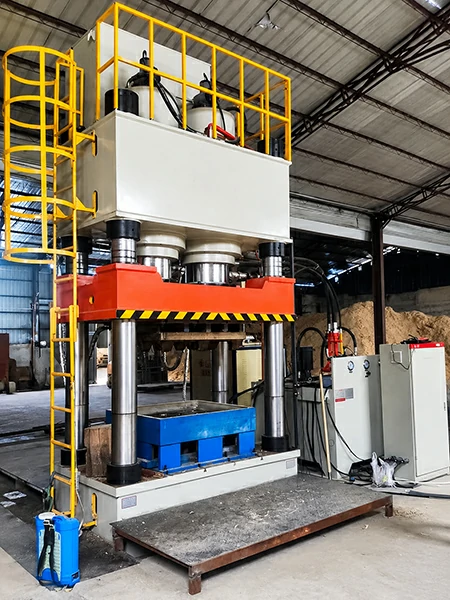
A wood recycler's tonnage is priced by what it becomes. As long as the endpoint is fuel chip or bedding, the same load is a bulk commodity sold by the ton and the margin rides the energy cycle. This page follows one change of endpoint: the same recovered wood, pressed on a wood pallet hydraulic press into a finished molded pallet that is priced by the piece instead of by the ton.
Why Better Grading Does Not Move the Margin
Grading improves the yard's position inside a category; it does not change the category. Grade A chip, Grade B chip and screened bedding all leave the gate as bulk material measured in tons, and all of them compete with virgin fibre, with construction and demolition residue, and with whatever the nearest boiler is willing to pay this quarter. When a terminal stalls or a boiler goes down for maintenance, the tonnage does not become cheaper to hold, it becomes unsellable, and the yard absorbs the storage, the handling and the working capital. The ceiling is structural rather than operational: as long as the endpoint of the material is fuel or bedding, the yard stays a raw material supplier and its revenue curve follows the energy cycle.
The Same Ton, Two Steps Further Down the Chain
A molded pallet changes the unit of sale. Instead of a ton of chip, the yard sells a countable, specifiable logistics consumable that warehouses, exporters and container packers buy by the piece, on demand driven by shipping and storage volumes rather than by fuel prices. That endpoint is reachable with the same recovered wood, pressed on a wood pallet hydraulic press. The press closes a heated mold onto a weighed, glued fibre mat and forms the whole pallet in one pressing: hot press molding at roughly 150 to 180 degrees Celsius and 15 to 20 MPa forming pressure over a hold window of about 180 to 240 seconds, with a no-formaldehyde MDI binder, produces a one-piece pallet at a density of about 900 kilograms per cubic metre. No nailing, no stringers and no separate assembly line, because the pallet is formed rather than built.
Structure, Parameters and What the Line Actually Delivers
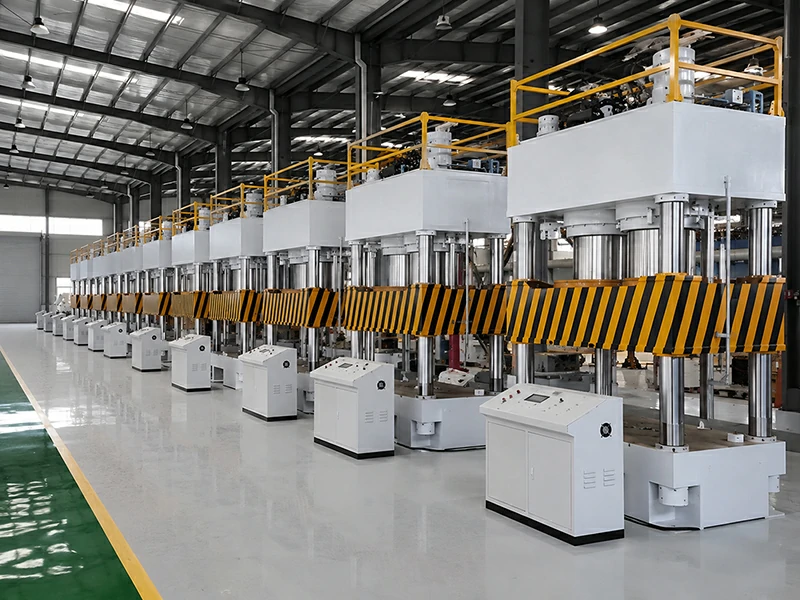
The machine is a three-beam four-column hydraulic press: top beam, slide and worktable carried on four solid columns that double as the guide and the frame lock, with the hydraulic station mounted on the back of the top beam and a separate control cabinet. Published tiers run from the Y-1250 at 12,500 kN on a 1700 by 1400 mm platen and a 55 kW motor, through the Y-1600 and Y-2000, to the Y-2500 at 25,000 kN on a 2500 by 1700 mm platen and 75 kW, at a 25 MPa system pressure with 700 to 900 mm slide stroke, and the Y32 frame splits for sea freight. On the finished side, the published pallet capability is a 1200 by 1000 mm unit at 2 tonnes dynamic and 8 tonnes static, and a 1200 by 800 mm unit at 1.5 tonnes dynamic and 5 tonnes static, nestable at roughly four to one and classified as a processed wood product, which keeps it out of the ISPM-15 heat treatment route. Two boundaries belong on the same page. The line is sold as a line, not as a bare press: crushing to a fine particle size, drying, moisture control in the low teens and MDI glue mixing all have to be in place, or the press has nothing to press. And the pallet figures are machine-side capability, so a plant still has to confirm its own output on its own material and mold.
- Focus keyword wood pallet hydraulic press is carried in the title, SEO title, slug, intro summary and both image alt strings.
- Every section body is plain text with no HTML tags, attributes or angle brackets; the fixed renderer creates all paragraph markup.
- Published load and density figures are machine-side capability only: about 900 kilograms per cubic metre, 1.5 to 2 tonnes dynamic and 5 to 8 tonnes static.
- The page states the line boundary, including the crushing, drying and MDI glue mixing prerequisites, and makes no double-station claim.


