Certification continuity
The plant and the file it already carries
A green certificate is not a one-off award, it is a standing promise that every pallet leaving the plant carries the same three elements the file was written around: recovered wood intake, adhesive with no added formaldehyde and a pallet that can be crushed and re-fed. This page follows an export-oriented molded pallet maker adding a second forming line on a wood pallet hydraulic press, and sets out the process platform the added capacity runs on: Y32 three-beam four-column at 1250 to 2500 ton, platens up to 2500 x 1700 mm, hot press molding at 150 to 180 C, recovered fibre crushed to about 5 mm, dried to 8 to 12 percent moisture and mixed evenly with MDI before the press forms anything. The boundary is stated plainly as well: the per-pallet carbon reference of about 5.967 kg CO2e comes from earlier supplier research, not from third-party verification, and the certificate, the annual audit and the Scope 3 answer stay on the customer desk.
Why added capacity used to dilute the claim
The usual way to grow a pallet business is to add a nailed stringer bench, buy heat-treated units in, or carry a fumigation and IPPC marking step on every export lot, and at 8 to 15 US dollars per purchased pallet the packaging cost simply scales with shipment volume. None of that helps the file. A nailed stringer pallet cannot be crushed and re-fed at the end of its life, a UF adhesive system puts formaldehyde back into the material story, and a heat treatment queue adds a phytosanitary step the plant has to keep proving. The deeper problem is that the added output then runs on different raw material, a different adhesive and a different forming temperature from the first line, so the certificate describes one process while the shopfloor runs two. Growth stops reinforcing the claim and starts thinning it. The reverse screen matters too: below about 10,000 pallets a year, buying the pallet is still cheaper than building the line.
Evidence the added line is held on the same process platform
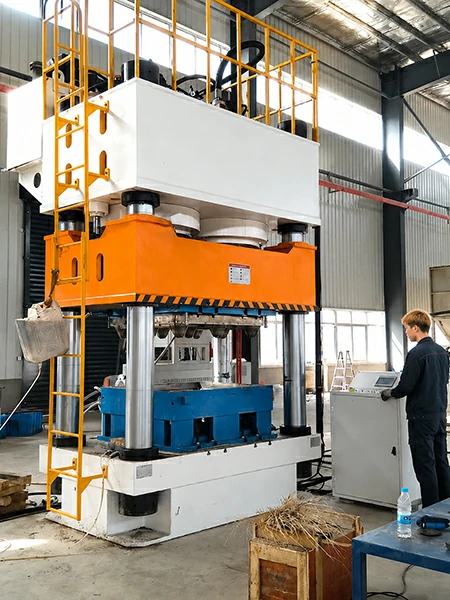
The machine in question is a molded pallet hydraulic press machine, a heated Y32 three-beam four-column hydraulic pallet molding machine built around a dedicated pallet die rather than a general purpose four-column press. The frame is the classic arrangement: top beam, moving slide and worktable held on four solid columns that both guide the slide and lock the closed frame together through lock nuts, with T-slots cut in the worktable face and the slide face for the upper and lower die, the hydraulic power pack mounted on the back of the top beam, and a separate control cabinet, safety railing and access ladder. Tonnage is chosen against pallet size and formed density across the Y-1250, Y-1600, Y-2000 and Y-2500 tiers: main cylinder force from 12500 kN to 25000 kN, effective platen from 1700 x 1400 mm up to 2500 x 1700 mm, slide stroke 700 to 900 mm, slide working speed 5 to 10 mm per second and servo motor power from 55 kW to 75 kW. Hot press molding sits at 150 to 180 C with a forming pressure of 15 to 20 MPa, a cycle of 180 to 240 seconds, a formed density around 900 kg per cubic metre and formed moisture under 12 percent. Recovered fibre goes in as waste wood, sawdust, wood chip, shavings, offcuts and agricultural residue, glued with MDI and no added formaldehyde, and it comes out as a one-piece molded wood pallet with no nails and no splinters, sized within plus or minus 1 mm, nesting about four to one so empty returns and warehouse volume drop, and classed as a processed wood product so it ships fumigation-free and ISPM-15 exempt. The same fibre can be crushed again at end of life, which is what closes the loop in the file. The structure travels: top beam, slide, worktable, four columns and cylinders ship as separate container-loadable pieces and re-assemble at the plant, which is how the same press model reaches a site that cannot take an oversized welded frame. Upstream steps stay where they belong: crushing to about 5 mm, drying, and even MDI mixing, with floor area above 600 square metres, clear height above 6 m and available power above 200 kW, and the press is not sold as a stand-alone machine.
What the plant ends up holding
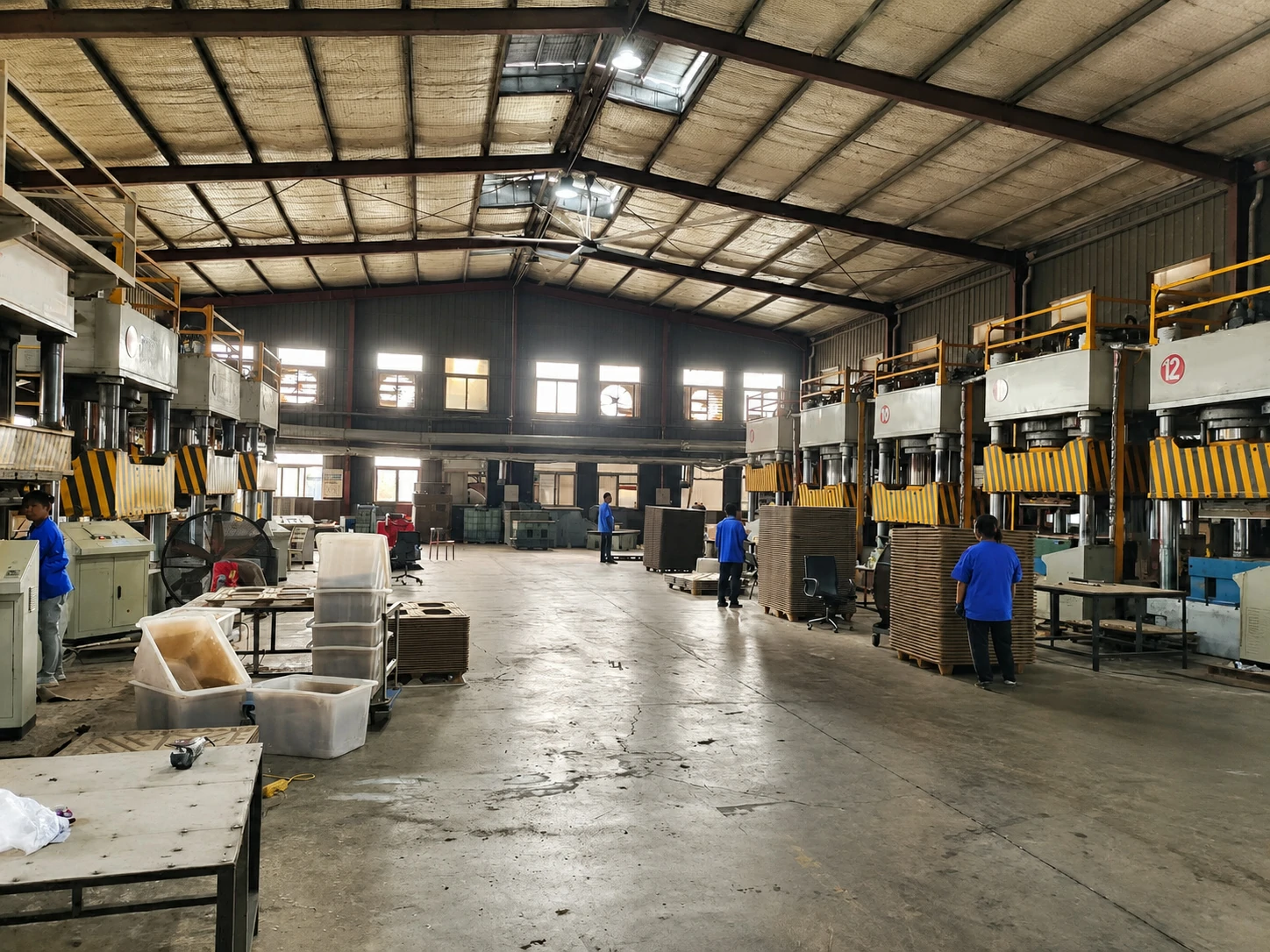
The result is one process file covering both lines: the same recovered fibre intake, the same MDI adhesive system, the same forming temperature and pressure window, the same nail-free, re-crushable pallet, and a documented chain that travels from raw material intake records through the adhesive system data sheet to the process temperature and pressure logs. That is what the plant hands an auditor on the annual review, and it is what it draws on when a large account sends another Scope 3 questionnaire asking for the material route and the carbon position of one unit rather than a certificate cover page. On carbon, the plant has a published reference point of about 5.967 kg CO2e per pallet from earlier research to quote alongside its own metered data, and it keeps the disclosure itself, because the manufacturing data is the customer's to report. For the buyer weighing the next step, the practical test is simple: if the added line can run the same three elements as the first one, capacity growth reinforces the claim instead of splitting it, and the plant keeps the green story it spent years building. Contact the EMP engineering team with your daily output target, your feedstock type and your available floor area for a layout and return model.
- One process platform: recovered fibre intake, MDI with no added formaldehyde and 150 to 180 C hot press molding are stated for the added line, not a second recipe.
- Published tiers used: Y-1250 to Y-2500, platens up to 2500 x 1700 mm, about 5 mm particle size and 8 to 12 percent moisture before forming.
- The Y32 three-beam four-column frame ships as top beam, slide, worktable, columns and cylinders in container-loadable pieces and re-assembles on site.
- Boundaries kept: the certificate, its annual audit and the Scope 3 answer stay with the customer, and about 5.967 kg CO2e per pallet is a research reference, not third-party verification.


