Sustainability Claims That Have To Survive Every Capacity Addition
The Buyer: An Export Pallet Supplier Whose Green Claim Has To Survive Every Capacity Addition
A sustainability claim is not a certificate on the wall, it is a standing promise that every pallet leaving the gate was made the same way. This page follows an export pallet supplier whose buyers keep sending Scope 3 questionnaires onto a molded pallet hydraulic press machine, where 100 percent recovered wood waste, an MDI adhesive with no added formaldehyde and a re grindable finished pallet stay inside one process window across the Y-1250 to Y-2500 ton tiers, so added capacity does not dilute the claim.
The Old Route: Capacity Added Outside The Claim, And A Process That Splits In Two
The straightforward expansion answer is to add nailed wooden pallet benches and buy heat treated pallets into the peak. That answer costs the claim twice. Every added heat treatment batch or purchased unit drags a fumigation and phytosanitary file behind it, and the sustainability story then rests on a purchased input the supplier does not control. Worse, a process added on a different machine, a different body design and a different adhesive splits production into two recipes, and the weaker branch becomes the figure the customer audits. Covering the shortfall with plastic pallets moves the feedstock off recovered wood fibre altogether. The failure mode is exactly the one this supplier was warned about: the more the plant expands along that route, the thinner the claim gets.
Why A Molded Pallet Hydraulic Press Machine Holds One Recipe Instead Of Two
A molded pallet hydraulic press machine, also searched as a presswood pallet press machine, closes the gap because the three elements the buyer asks about sit inside one process rather than in three supplier files. Recovered wood waste, sawdust, wood shavings and end of life pallets are crushed to roughly 5 mm, dried to 8 to 12 percent moisture and mixed with MDI adhesive that adds no formaldehyde, then hot press molded at 150 to 180 C into a pallet at a formed density of about 900 kg per cubic metre. The result is nail free and splinter free, nests roughly four to one for return freight, and can be re ground and pressed again, which is what keeps a circular content statement true after the first turnaround rather than only at first delivery. Capacity added on the same platform inherits the same recipe instead of forking away from it. The boundary goes on the page with the benefit: crushing, drying and even adhesive mixing have to be in place before the press forms anything, and the machine is not sold as a stand alone unit.
The Evidence Behind The Claim: Y32 Structure, Published Tonnage Tiers And The Document Chain
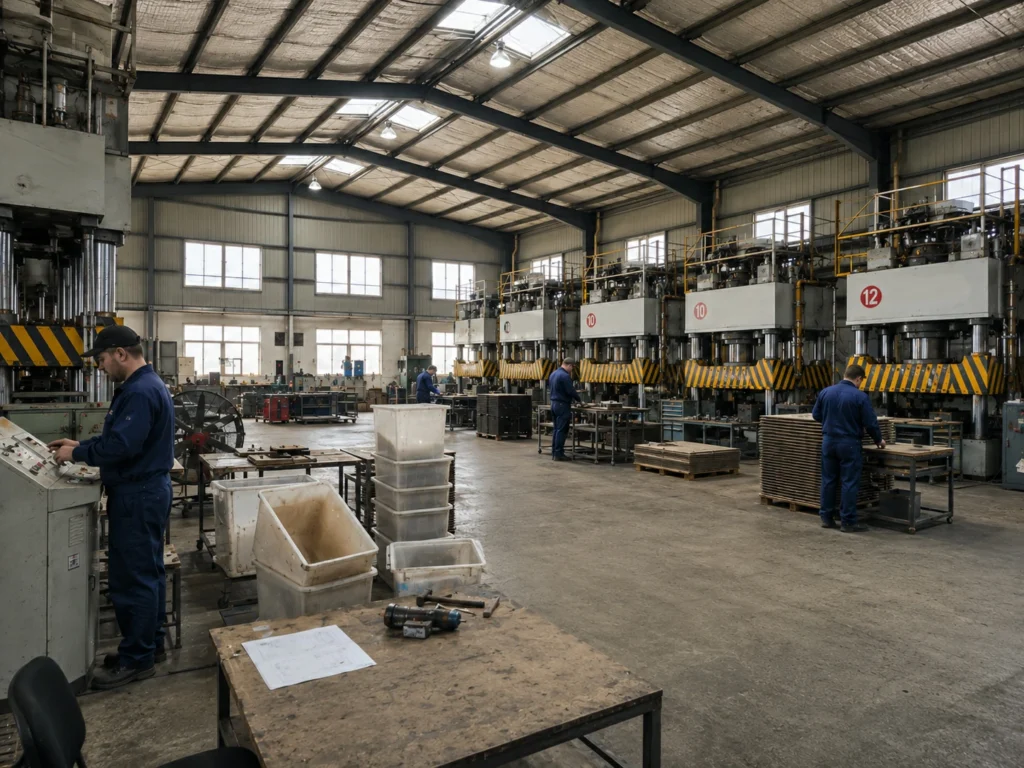
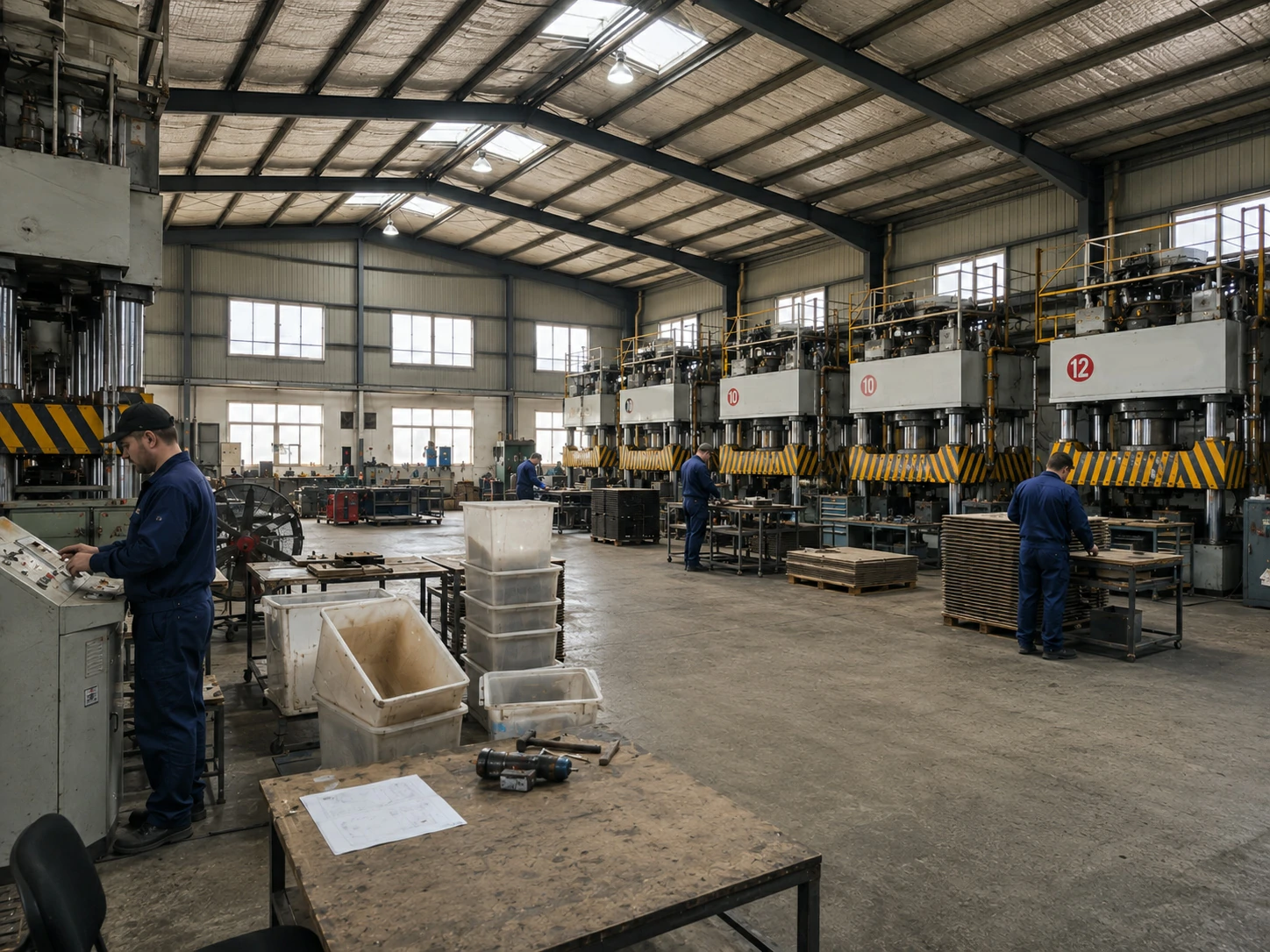
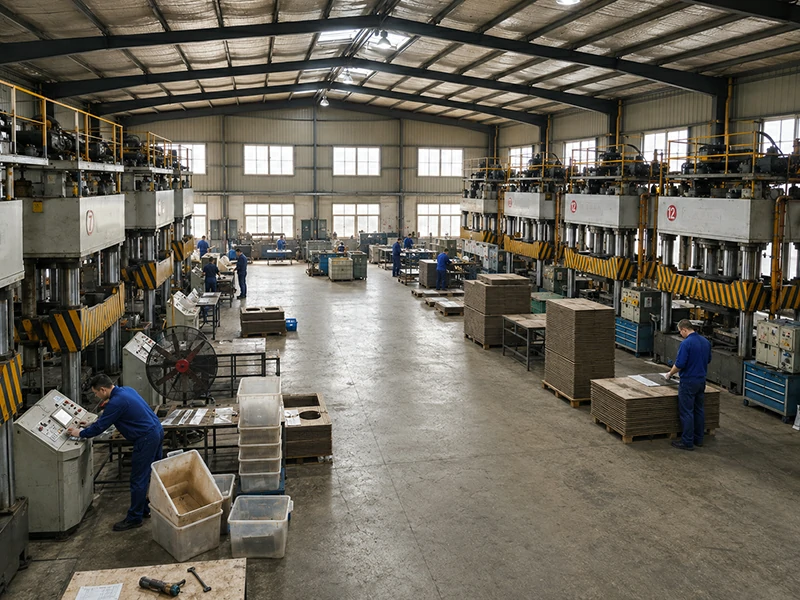
The machine is a Y32 three beam four column hydraulic press: a top beam, a moving slide and a worktable tied together by four solid columns that act both as slide guides and as the closed body of the press. Published tiers run from the Y-1250 at 12500 kN up to the Y-2500 at 25000 kN, with slide stroke from 700 to 900 mm, working platens from 1700 x 1400 mm to a maximum of 2500 x 1700 mm, 25 MPa system pressure and servo motors from 55 to 75 kW. The photographs on this page show what that means on site: the four column frame with the top mounted cylinder and slide, the yellow and black safety guards and railings, the independent control cabinet and the separate hydraulic power unit, and the row layout of presses serving one plant. Two honest limits travel with the numbers. The per pallet carbon figure quoted in the earlier research for this line, about 5.967 kg of CO2 equivalent, is a desk study reference value rather than a third party verified declaration, and it is the customer's own lifecycle assessment that carries such a figure into a Scope 3 answer. The bio based and circular content programmes usually named in these questionnaires turn on material characteristics, recovered feedstock, a binder with no added formaldehyde and a re grindable finished product, while the certificate itself stays in the customer's own file. What the supplier can actually buy here is the matching document chain, covering feedstock specification, binder system and process temperature window, so the annual audit and the next customer questionnaire are answered from records instead of from memory.
- Renderer body root is section.emp-section.emp-blog-p0.emp-blog-p0–tw-layout with no H1 added.
- Primary call to action uses emp-btn-primary and links to /contact/.
- Both images come from the resolved MldP designer gallery and no third party certification is claimed for the machine.
- All parameters, temperature and moisture windows match the MldP brief and the traffic profile, with the carbon figure labelled as an unverified desk study reference.


