Sawmill residue · Wood Pulverizer Machine
The Residue Pile Is Where a Sawmill's Margin Leaks
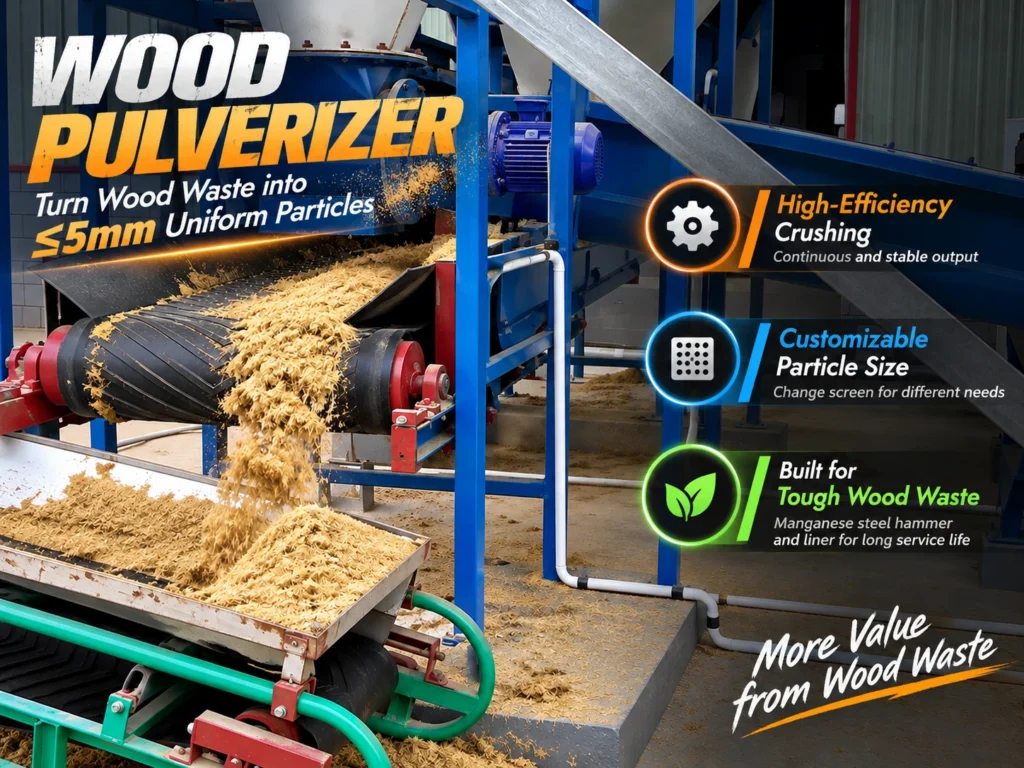
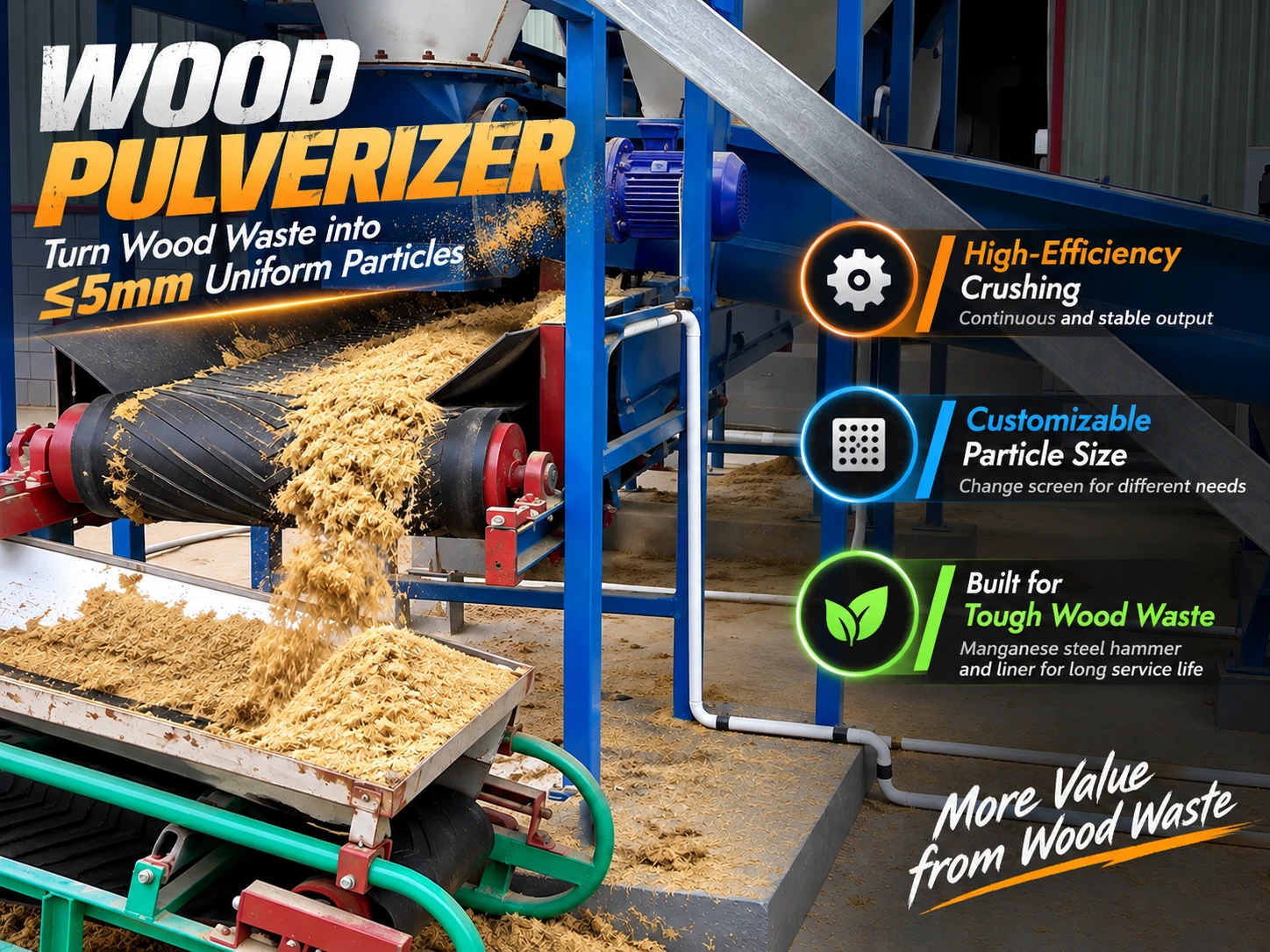
A sawmill that breaks logs down into sawn timber sends a large share of every log out the back door as slabs, edgings, trimmings, sawdust and planer shavings, and most small and mid-size mills still burn that stream or haul it to landfill. This page follows the residue pile from the saw line to the discharge end of a PULVZ Wood Pulverizer Machine: F-800 to F-1500 at 45 kW, 75 kW and 110 kW, nominal 1 to 8 t/h, replaceable 780 to 1480 mm screens holding output at 5 mm and finer, belt conveyor feeding for mixed uneven residue, manganese steel hammers and liner, and a hydraulic open cover for hammer and screen access, so the tonnage leaves as sellable fiber instead of a disposal line item.
Burning and Landfilling: Paying Twice for the Same Fiber
The traditional answer is the cheapest one on paper and the most expensive one over a year. Open burning on site turns a saleable fiber stream into smoke, and it puts the mill in front of dust, particulate and open-burning rules it does not control. Hauling to landfill converts the same tonnage into a tipping fee, a truck, a fuel bill and a paper trail, with nothing coming back. Giving it away to whoever will collect it is the same loss with better manners. Then the bill arrives twice: the mill that burned its shavings in the boiler still buys kiln-dry sawdust or bedding-grade fiber back from a supplier, at a price set by somebody else, and pays again for the fuel it could have replaced. Meanwhile the pile keeps its own cost: yard space, loader hours, and a permanent dust source close to the saw line.
Why a Wood Pulverizer Machine Fits a Mixed Residue Stream
A hammer-type wood pulverizer machine is built for exactly this kind of infeed. Blocky slabs, long edgings, short trimmings and loose sawdust can go in on one belt, be broken down inside the chamber, and leave through a screen as uniform particles instead of a mix of chunks and fines. The F-series covers the range a mill actually runs: F-800 at 45 kW with a 780 mm screen and a 680 x 380 mm infeed, F-1000 at 55 kW with a 980 mm screen, F-1200 at 75 kW with a 1180 mm screen and a 1050 x 420 mm infeed, and F-1500 at 110 kW with a 1480 mm screen and a 1350 x 450 mm infeed, for nominal output from 1 to 8 t/h. Screen choice sets the particle window, and the manufacturer states the working target as 2 to 5 mm with output at 5 mm and finer. Two boundaries are stated plainly. Nominal tonnage is a manufacturer figure and moves with species, moisture, infeed evenness and screen condition, so a mill running wet slab wood will not see the same number as a mill running dry shavings. And a pulverizer does not remove metal: nails, staples and wire from pallet wood, crating or demolition timber have to be taken out by a separation stage ahead of the machine.
Structure, Evidence and the Fiber That Leaves the Gate
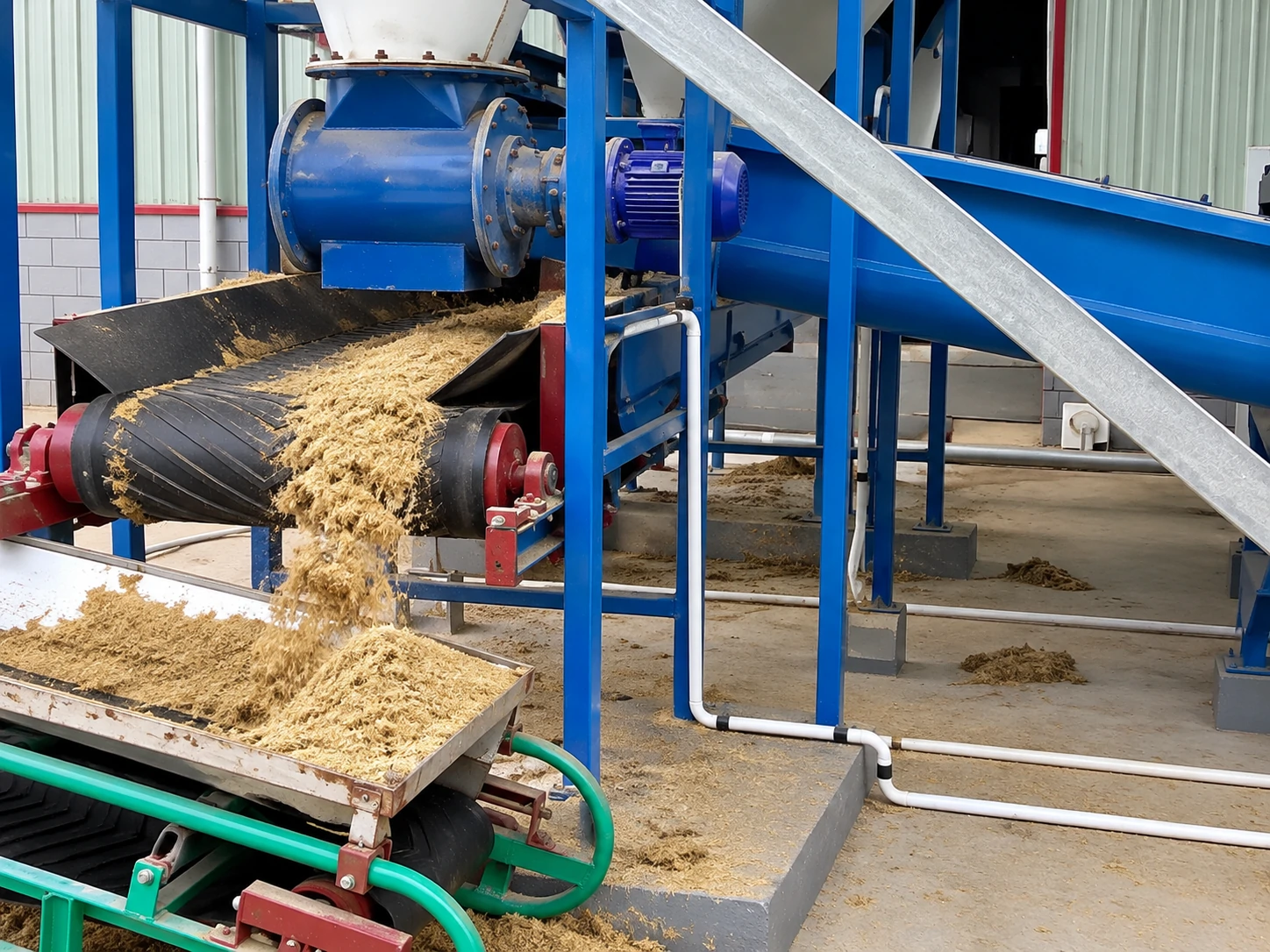
The structure is what makes the residue route practical. Residue arrives uneven, so a belt conveyor feeds the chamber continuously instead of in hand-loaded batches. Inside, thickened manganese steel hammer plates do the breaking work against a one-piece manganese steel liner, and dynamic balancing technology keeps the rotor stable across a long shift. Particle size is held by a high-hardness alloy screen between 780 and 1480 mm depending on model, and the screen is replaceable, so a mill can move its output window when the offtake changes. The hydraulic open cover opens the chamber for hammer and screen access, which is where maintenance hours are actually spent. At the discharge end the fiber can drop straight onto a conveyor or pass through a cyclone separator for dust control and separation. The result is a different balance sheet line: the same tonnage that was a tipping fee and a truck leaves the gate as board furnish, pellet feedstock, animal bedding or energy fuel, priced by the ton into a buyer list the mill can build, with intake and particle spec recorded at its own gate.
- Title, H1, slug and summary use the traffic profile's scene, product and result terms and duplicate no previously published Pulvz post title on presswoodpallet.com.
- Both body images are the two newly imported Pulvz designer-gallery files (20261010_134626_0004 and 20261010_134626_0012) with index ALT text; neither file was used in an earlier published post.
- All model, power, screen, infeed and capacity figures match the Pulvz blog brief, and nominal 1 to 8 t/h is stated as a manufacturer figure that varies with species, moisture, infeed evenness and screen condition.
- Boundaries are stated in the body: metal separation for nails, staples and wire is an upstream stage, and the 2 to 5 mm target with output at 5 mm and finer is the manufacturer's stated window, not a guarantee for every feedstock.