FRONT-END SELECTION
A Front End Is Selected From Five Numbers, Not From a Catalogue Page
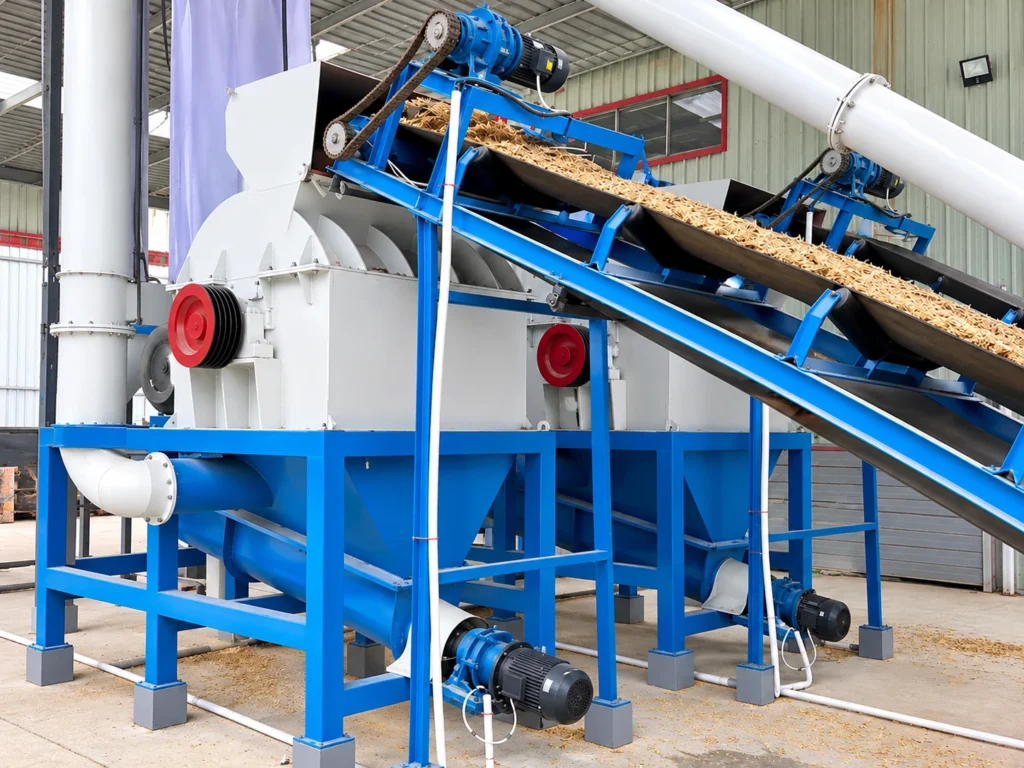
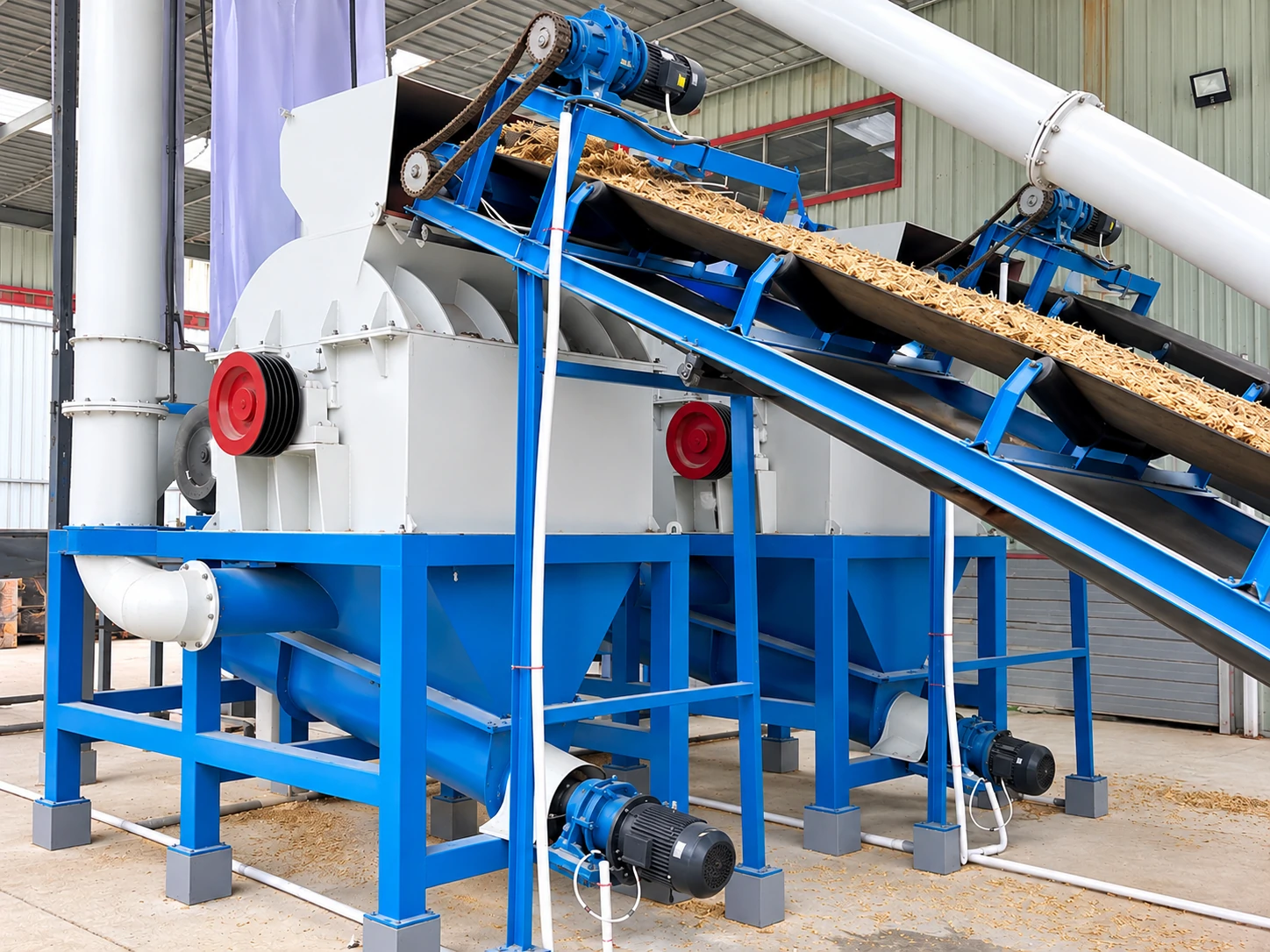
An integrator quoting molded pallet and board lines across several markets does not get one plant, it gets a spread: a small workshop trading at 300 pallets a shift, a mid-size plant feeding a single dryer, and a board mill that wants fibre by the tonne. A front end that exists in one or two sizes cannot answer all three, so the quote either pays for capacity nobody uses or carries a crusher that the dryer outruns. This page follows the Pulvz wood pulverizer machine as a selection ladder rather than a single model: F-800, F-1000, F-1200 and F-1500 covering a nominal 1 to 8 t/h on 45 kW, 55 kW, 75 kW and 110 kW drives, infeed openings from 680 x 380 mm to 1350 x 450 mm, and replaceable 780 to 1480 mm high hardness alloy screens that set the particle band. Belt conveyor feeding, thickened manganese steel hammer plates against a one-piece manganese steel liner on a dynamically balanced rotor, a hydraulic open cover for hammer and screen work and a cyclone separator where the layout calls for one are all part of the same platform. The limits are stated plainly: nominal tonnage moves with species, moisture, infeed evenness and screen condition, the 5 mm figure is a screen-set target band rather than a guarantee, and magnetic separation is a project-confirmed stage.
What a One or Two Model Catalogue Does to the Quote
When the front end of a line exists in only one or two sizes, the integrator ends up doing one of two things, and both are paid for twice. The safe route is quoting the largest machine available: a line that needs one tonne an hour then carries a 110 kW drive and a 1350 x 450 mm mouth it never fills, so capex, transformer capacity and civil work are all sized for a machine the site does not need. The other route is squeezing the small unit into a job that wants more, and the crusher instantly becomes the bottleneck the whole line is measured by, with the dryer and the press running under their own capability. The older route, before a machine is installed at all, is manual splitting by axe and saw, buying ready made sawdust at market price, or burning and landfilling the residue. All three leave the same gap: nobody can state what the front end will hold across a shift, so acceptance risk lands on whichever party promised the tonnage.
The F-Series Ladder as a Selection Instrument
The point of a model range is that the selection conversation happens in numbers rather than in adjectives. F-800, F-1000, F-1200 and F-1500 sit on one platform and span a nominal 1 to 8 t/h, driven by 45 kW, 55 kW, 75 kW and 110 kW main motors, with infeed openings from 680 x 380 mm up to 1350 x 450 mm so a small plant and a yard taking whole pallets are answered by different machines rather than by the same compromise. The grading element is a replaceable 780 to 1480 mm high hardness alloy screen, which is what turns a species and a moisture level into a particle band, and what lets the same machine be re-set when the feedstock changes. Thickened manganese steel hammer plates work against a one-piece manganese steel liner on a dynamically balanced rotor, belt conveyor feeding takes an uneven mixed stream instead of a hand-fed trickle, and the hydraulic open cover keeps hammer and screen work a planned stop rather than a torch job. A cyclone separator is added where the layout needs dust handled at the discharge, and magnetic separation stays a stage confirmed per project rather than an assumed standard item.
What Has to Be in the File Before the Configuration Is Fixed
Right sizing is not a table lookup, it is a file that has to be closed before the quotation leaves. That file holds the customer's feed size and species mix, a moisture figure rather than a description, the throughput the drying stage needs, the particle band the press or refiner accepts, a site layout showing the belt conveyor run and the cyclone position, and the local voltage and frequency schedule. A screen trial on the actual feedstock is what converts the nominal range into a defensible number, because species, moisture, infeed evenness and screen condition all move tonnage, and a wear allowance has to sit on top of the trial figure. The result the integrator can hand over is a quote where capacity matches the downstream stages on purpose rather than by accident: no oversized drive idling on a small line, no capacity gap hiding behind a machine that was never in the running, and a hammer plate and screen set listed as what it is, a consumable change that is planned instead of discovered.
- Feed size, species mix and moisture stated for the quoted line before any model is named
- Motor, infeed opening and screen size read off the F-800 to F-1500 ladder rather than a single default
- Site layout drawing and local voltage and frequency schedule confirmed with the customer
- 5 mm stated as a screen-set target band, with magnetic separation left a project-confirmed stage