Automated warehousing · molded pallet press
A Palletizer Cell Does Not Negotiate With a Pallet
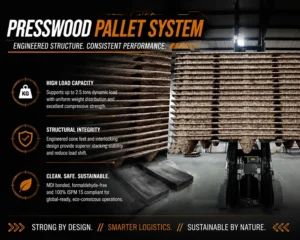
Automated storage and retrieval systems, AGV fleets and palletizer cells do not judge a pallet by how it looks, they judge it by whether the thousandth unit enters the same guide rail as the first. This page follows a pallet buyer moving light and medium loads onto a molded pallet hydraulic press machine: a steel mold closes under press tonnage on recovered wood fibre and MDI adhesive, so length, width and deck geometry repeat to plus or minus 1 mm from tooling rather than from a repair bench, with no nails and no splinters to catch a conveyor, at 9 to 15 kg per unit against 40 to 60 percent more for the same specification in solid wood. Load boundaries are stated plainly: roughly 1.5 to 2 t dynamic and 5 to 8 t static, aimed at light and medium loads and one-way flows, while heavy beam racking keeps its block pallet.
Why a Nailed Pallet Is Maintained Instead of Made Consistent
A nailed wooden pallet holds its dimension only while every board in it is whole. Each trip loosens nail heads, dries or swells a board and lets one corner of the deck drop a few millimetres, and the plant floor answer is a repair bench: pull the unit out of the lane, knock the board off, re-nail it, put it back into service. The bench works, and it is a cost that rises with automation penetration, because a repaired pallet is a pallet with a different unit weight, a different deck plane and, often enough, a nail sitting 2 mm proud of the surface. On a roller conveyor a proud nail head is not a cosmetic defect, it is a snag that stops the line; under an AGV it is a deck that no longer sits flat. Consistency is bought back one unit at a time, and the purchase repeats every shift, on every lane, for as long as the pallet pool runs.
Tooling Sets the Tolerance Before the Press Closes
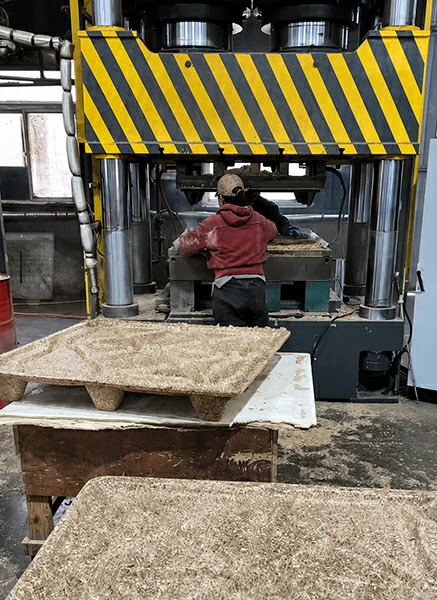
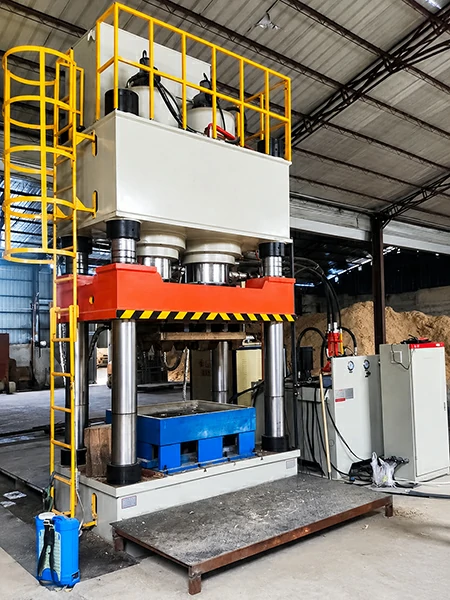
A molded pallet hydraulic press machine answers the tolerance question upstream of the pallet. Recovered wood waste, sawdust and shavings are crushed, dried and mixed with MDI adhesive, and the charge is formed in a steel mold under hot press tonnage on a Y32 three-beam four-column frame, in single or double station layout, across a Y-1250 to Y-2500 ton ladder with platens up to 2500 x 1700 mm. The mold, not the repair bench, decides the pallet: length, width and deck plane repeat to plus or minus 1 mm, and unit one hundred thousand is formed in the same cavity as unit one, so batch consistency is a property of tooling instead of a property of the maintenance team. The same closed mold produces a one-piece body with no nails, no screw heads and no splintered edges for a conveyor or a gripper to catch on, and the finished unit runs 9 to 15 kg, roughly 40 to 60 percent lighter than the same specification in solid wood, which is the figure an AGV cycle time and an air freight bill both read. The forming station shown above is the step that fixes all three numbers at once.
Where the Molded Unit Takes Over, and Where the Block Pallet Stays
The honest scope is light and medium load, one-way and closed-loop flows, and any lane where a person or a machine lifts the unit. At roughly 1.5 to 2 t dynamic and 5 to 8 t static, a molded pallet carries AGV and conveyor transport, palletizer infeed, air freight and the light end of the racking mix, and it does so while nesting when empty, so the return lane is no longer paying to move air. Heavy-duty beam racking still belongs to the block pallet, and this press is not sold as a replacement for that duty; it is a complementary category sitting on the same flow, next to the block units a fleet keeps for its heaviest positions. For an automation project the sizing step is a mold rather than a catalogue number: change the mold and the pallet specification changes, so a buyer's own unit footprint, deck opening pattern and weight target can be tooled, including small batches a nailed line cannot justify setting up for. Send the pallet drawing, the load case and the handling equipment list, and tonnage, mold and station count are confirmed against that flow.
- Article copy uses only MldP figures: plus or minus 1 mm dimensional repeatability, 9 to 15 kg unit weight, 40 to 60 percent lighter than solid wood, 1.5 to 2 t dynamic and 5 to 8 t static load, Y-1250 to Y-2500 ton, platens to 2500 x 1700 mm, single or double station.
- Section order follows the required chain: automation scenario, nailed pallet maintenance problem, molded press fit, structure and parameter evidence, final result with the block pallet boundary kept in place.
- Live publication titles were read before writing and no existing MldP post carries this title, slug or H1 wording.
- Both images are the two MldP designer gallery files imported in this run, with index ALT text; no cross-product or knowledge-library asset is used.