Circularity accounting for pallet pools
The reuse dividend is already in the baseline
A pallet pool that has already booked the carbon benefit of reuse needs a new, defensible increment for its 2040 net-zero file, and every further kilogram of avoided CO2 is harder to find than the last. This page follows one pool operator's Scope 3 reporting line back to the molded pallet hydraulic press machine, where recovered wood waste, sawdust and repair-shop rejects are crushed to about 5 mm, dried to 8 to 12 percent moisture, mixed with MDI adhesive and hot press molded at 150 to 180 C on a Y32 three-beam four-column frame from Y-1250 to Y-2500 ton with a platen up to 2500 x 1700 mm and a 55 to 75 kW servo main motor, producing a one-piece nail-free unit of 8 to 12 kg that is crushed back to fibre at end of life instead of repaired, and that nests about four to one when empty. A project-level figure of roughly 5.967 kg CO2e per pallet is quoted with its conditions rather than as a label: final numbers move with grid mix, fibre moisture and the pallet specification ordered.
What a nailed sawn timber pallet cannot answer
A nailed hardwood pallet carries the carbon of new sawn timber before it carries a single carton, and it drags a treatment program behind it wherever it crosses a border: heat chamber hours, segregation lanes, stamp custody and a record that has to survive an inspection in another country. Inside the loop it drags a repair bench, because a nailed assembly is kept alive with new boards and new nails rather than returned to material, and it ends as landfill or firewood because nobody separates a nailed pallet cleanly back into fibre. When it is empty it stacks a few high at best, so a closed loop that genuinely eliminates empty running still moves a great deal of air. Every one of those is a real cost with a real emission behind it, and none of them is something a pallet pool can put in front of a customer asking for the fourth increment.
Where a molded pallet hydraulic press machine changes the arithmetic
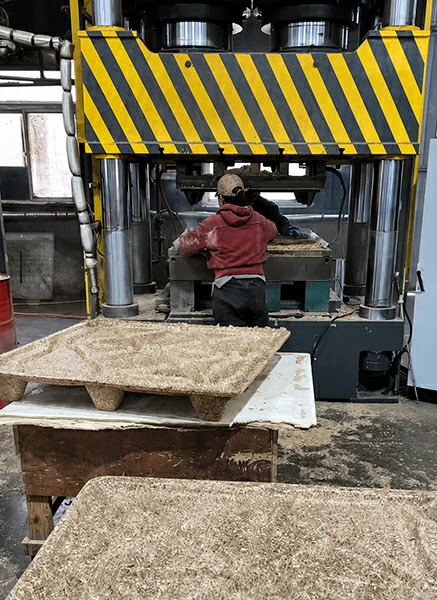
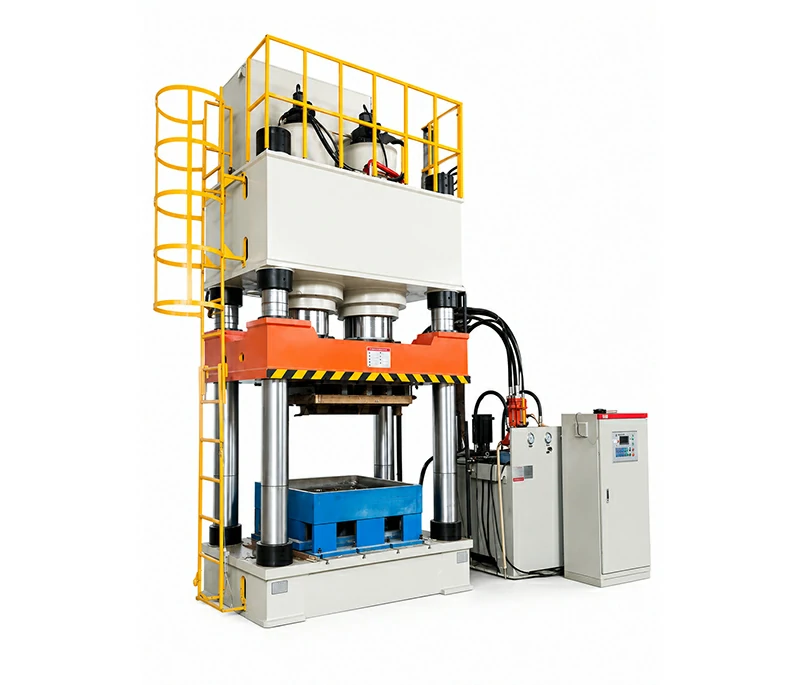
The press takes the material a pool already owns as a problem: recovered wood waste, sawdust, offcuts and its own repair-shop rejects, crushed to about 5 mm, dried to 8 to 12 percent moisture and mixed with formaldehyde-free MDI adhesive, then pressed in a heated mold at 150 to 180 C and 15 to 20 MPa into a single-piece pallet in one cycle of about 180 to 240 seconds, with a molded density near 900 kg per cubic metre and length, width and deck plane repeating to plus or minus 1 mm from tooling. The frame that holds that mold is the standard Y32 three-beam four-column layout, top beam, slide and worktable locked by four solid columns, two main cylinders on the top beam, T-slots on both the table and the slide face for the two mold halves, sized from Y-1250 at 12500 kN and a 1700 x 1400 mm platen through Y-1600 and Y-2000 to Y-2500 at 25000 kN and 2500 x 1700 mm, on 25 MPa system pressure, 5 to 10 mm per second working speed and a 55 to 75 kW servo main motor. The two photographs on this page are the evidence rather than the illustration: the forming station shows a fiber pallet in the mold under the slide, and the machine view shows the platen, mold base, guardrail, hydraulic power unit and control cabinet that carry the tonnage and the repeatability behind every number in the report.
What the 2040 file finally holds
Three increments come off that same press. Material first: 100 percent recovered wood fibre with MDI and no added formaldehyde, sized at roughly 5.967 kg CO2e per pallet in a pre-project study on one pallet specification, which is the figure to re-run and document against a new sawn timber pallet before it is published, since grid mix, fibre moisture, transport distance and pallet weight all move it. Waste second: a unit that fails is crushed back to fibre and pressed again instead of being repaired with new boards, which is the closed loop a zero waste commitment actually needs and the reason the repair bench stops being a standing cost. Transport third: a four to one nesting ratio cuts the volume of an empty return, and a trailer or container that carries four times the units per trip removes trips rather than re-labelling them. EMP can support the disclosure with material composition and the calculation basis behind the carbon figure; the limits are stated plainly, because a report that hides them is the one that gets challenged: the process needs crushing to about 5 mm and even MDI mixing before the press, tonnage, platen and mold are confirmed per project, destination acceptance of a fumigation-free pallet stays a buyer and plant protection question, and the press is not sold as a stand-alone machine without the drying and glue stages in front of it.
- Title, slug and all body copy use the traffic profile vocabulary (molded pallet hydraulic press machine, pallet pool, export pallet, ISPM-15 exempt, nestable, recycled wood fibre) and no title repeats an existing molded pallet post on presswoodpallet.com.
- Every technical figure traces to the resolved product material: Y-1250 to Y-2500 ton, 1700 x 1400 to 2500 x 1700 mm platen, 25 MPa, 5 to 10 mm per second, 55 to 75 kW servo motor, 150 to 180 C, 15 to 20 MPa, 180 to 240 second cycle, 900 kg per cubic metre, 8 to 12 kg unit, plus or minus 1 mm, 4 to 1 nesting, 5 mm crush and 8 to 12 percent moisture.
- The 5.967 kg CO2e per pallet figure is presented as a project-level estimate with its conditions and a requirement to re-run it per specification, not as a certified or third-party verified value.
- Both image source_path values are inside the resolved MldP designer gallery, the alts match those files, and every section body is plain text with no HTML tags, attributes, markdown or angle brackets.



