Molded Pallet Density Engineering
Where the Density Ceiling Bites: A Husk-Fed Pallet Plant Selling Only Into Dry, Light-Load Lanes
A molded pallet hydraulic press machine decides how heavy a molded pallet can ever be sold as, long before the sales team quotes it. This page follows one husk-fed pallet plant that can only sell into dry, light-load lanes, because its press runs out of tonnage before the fibre reaches the density the heavier grades need. It sets out the upgrade path on the same Y32 three-beam four-column platform, from Y-1600 and Y-2000 up to Y-2500 tonnage with platens to 2500 x 1700 mm, against the EMP reference pallet at around 900 kg per cubic metre, roughly 1.5 to 2 t dynamic load and 5 to 8 t static load, and the two-grade product structure that opens racking pallet, shipping pallet and outdoor turnaround business.
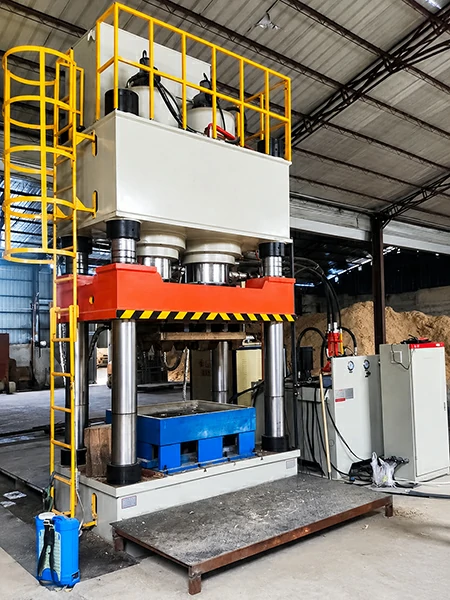
Why More Husk and a Longer Cycle Do Not Lift Density, but Unit Pressure Does
On a molded pallet hydraulic press machine, density is a pressure number before it is a recipe number. The fibre mass sitting in the mold is roughly fixed per unit area, and what changes is how hard the slide pushes it. A press sized for a light-load husk pallet runs out of tonnage before the material reaches the density the heavier grades need, so the pallet stays soft on its densest section and uneven across the deck, and moisture absorption follows the same curve. That is the ceiling an operator feels as indoor-only storage. Upgrading the same plant to a Y-1600, Y-2000 or Y-2500 hydraulic press moves that ceiling, because unit pressure rises with tonnage on the same mold footprint. Nothing upstream has to be rebuilt for the trial: the same wood waste, sawdust, wood fibre and agricultural residue, crushed to about 5 mm, dried to 8 to 12 percent moisture, mixed with MDI adhesive and hot press molded at 150 to 180 C. The change is tonnage, platen and tooling, confirmed against the customer's own fibre, moisture and glue mix rather than a catalogue assumption.
The Upgrade Scope: Y-1600 to Y-2500 Tonnage on a Three-Beam Four-Column Frame, Hot Press Molding at 150 to 180 C
The upgrade lands on the same Y32 three-beam four-column platform EMP builds across the range: top beam, slide and worktable structure on solid columns, hydraulic cylinders sized to the tonnage tier, platens up to 2500 x 1700 mm, and a single station or double station pallet press layout so capacity can grow without a second building or a second molding room. Cycle, mold temperature and pressing curve are set per mold and per mix. The reference point is EMP's own presswood pallet output: a one-piece molded shape at around 900 kg per cubic metre, rated at roughly 1.5 to 2 t dynamic load and 5 to 8 t static load in the published pallet parameters, with a uniform load surface, no nails and no splinters for a handler or a conveyor to catch, and a nestable design that cuts empty return volume. That is the grade a light-load husk pallet cannot reach on a smaller press, and it is the grade racking, container shipping and outdoor turnaround pallets are bought against. Hot press molding at 150 to 180 C also sterilises the fibre as part of the process, which keeps the plant's existing ISPM-15 exempt, fumigation-free export pallet and custom certificate narrative intact.
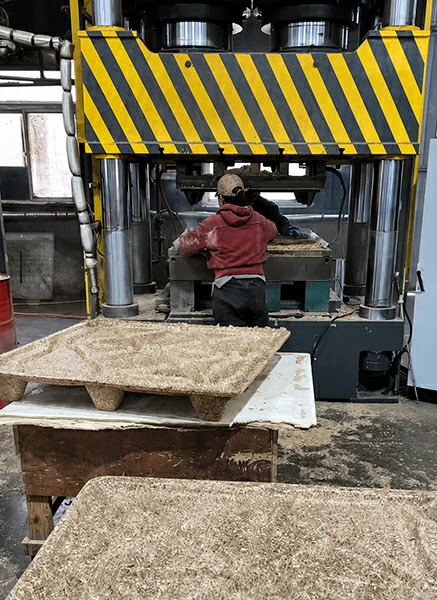
The Result: A Two-Grade Product Structure That Opens Racking, Shipping and Outdoor Turnaround Lanes
What comes out of the upgrade is not a replacement line but a two-grade product structure: the existing light-load sunflower husk grade for one-way food, pharmaceutical and electronics flows, plus a new heavy-density grade for warehouse pallet and racking pallet duty, logistics pallet and forklift pallet handling, export pallet and container shipping pallet lanes, and outdoor turnaround where a plywood pallet or plastic pallet was previously the only answer. The second grade is where the margin sits, because it competes on load class and moisture behaviour instead of on price per unit, and because a reusable molded pallet with a short molding cycle, less manual labor and a nestable return keeps cost per trip down. Boundaries are stated plainly: density, dynamic load, static load and molding cycle are confirmed per project on the customer's own fibre, moisture and MDI mix; tonnage, platen size, mold and station count are project decisions; and destination acceptance of a fumigation-free export pallet stays a buyer and plant protection question.
- Density, dynamic load and static load figures are EMP published pallet parameters and are re-verified per project on the customer's own fibre, moisture and MDI mix.
- Tonnage tier, platen size, mold design and single or double station layout are confirmed per project, not fixed by this page.
- Crushing to about 5 mm, drying to 8 to 12 percent moisture and even MDI mixing remain upstream preconditions of the molding result.
- Destination acceptance of a fumigation-free export pallet remains a buyer and plant protection question.



