Presswood Pallet Line – Press Exit Automation
Where the take-out labor curve is actually set on a multi-press floor
A molded pallet main base with three 1250 to 1600 ton hot presses used to mean three take-out posts per shift, because press-exit labor scaled with press count rather than with output. AutoG is EMP's automatic pallet take-out robot for the presswood pallet production line: one vacuum-suction arm installed at the press exit that alternates between two presses, so a further press adds capacity without adding a further operator to the press open-to-close window.
Why one arm can serve two presses instead of one
The reason a single arm can hold two press stations is the duty cycle, not the machine size. On a hot press the die is closed for most of the cycle, so the take-out task sits idle while the mold is shut and demands attention only when the press opens. Two presses running offset from each other therefore produce two short, separated open windows rather than one continuous workload, and that is exactly the shape an alternating arm can cover.
The sequence is straightforward. The arm stands ready while press A is closed, takes the hot pallet out of A on A's open signal, transfers it to the stacking position, then swings across to press B and repeats on B's open signal, returning to A in time for the next cycle. The pallet is stacked where it leaves the gripper, so the secondary manual lift disappears with the take-out itself. Because the arrangement is loaded per pair of presses rather than per press, capacity can be added in pairs without a matching pair of operators: one robot, two presses, two take-out operators removed from the roster. On a fully automatic line configured around two EMP-1000T presses, that press-exit function is part of the standard equipment, and the line runs at roughly three people in total. Semi-automatic tiers do not include it, so on an existing plant the take-out robot is the incremental device that closes the press-exit step when a line is upgraded from semi-automatic to fully automatic.
Structure and interface evidence: arm, vacuum end effector, press signal
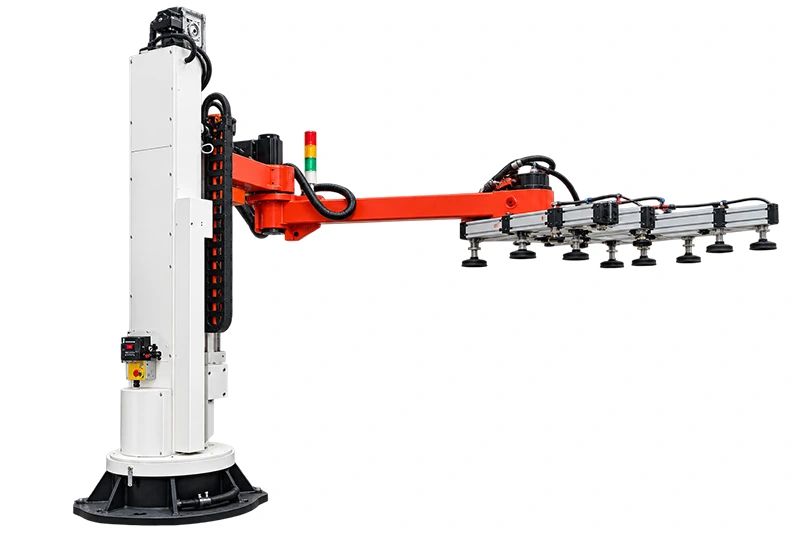
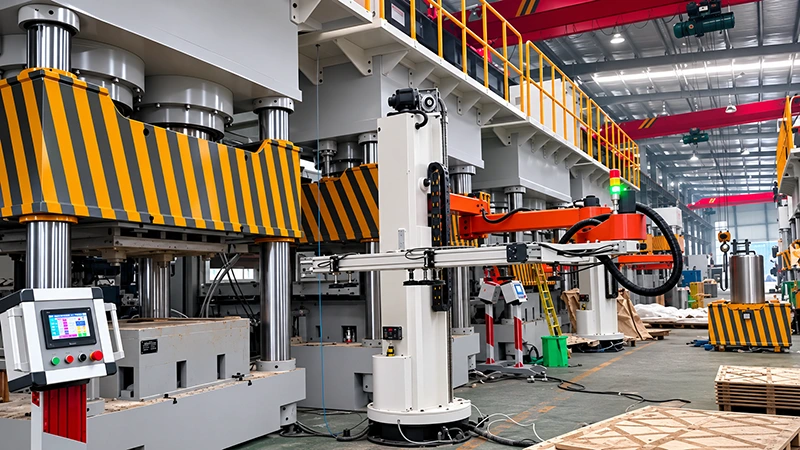
The white-background unit photographed for this range is a column-type handling arm: a vertical column on a heavy base, a long horizontal boom, an articulated section at the end, and a vacuum gripper head built from a row of suction pads rather than jaws. Cable management runs on a drag chain along the boom, and a three-colour stack light shows state from the floor. The separate view of a four-column press with a robotic transfer arm beside it is the context shot: it shows the press-exit position the arm works from, with the control console and safety guarding on the press line behind it.
The end effector is the part that decides whether this station works at all on a molded pallet. A presswood pallet has a textured, contoured deck with recesses and a formed underside, so the take-out uses vacuum suction: the pad array seats on the deck face and negative pressure holds the unit while the arm lifts it clear of the die, turns it and sets it on the stack. Because the pallet is taken directly as it leaves the mold at about 80 degrees Celsius, the press does not wait for the unit to cool before the next cycle starts. Control is not a separate island either: the take-out sequence is synchronised with the press open and close signals on the line control system, so the arm and the press share one cycle logic instead of being reconciled by hand.
The boundary matters for a buyer. This is the automatic pallet take-out robot at the press exit of a presswood pallet production line; it is not the hydraulic press, it is not the crushing, drying, glue mixing or mat-forming stage, and it is not a general-purpose case or bag palletizer. It cannot be operated as a line on its own. It does not perform warehousing, packing or dispatch – what it produces is the automatic stack at the press exit, and everything downstream of that stack is a different scope.
The result on a multi-press floor, and which numbers are still unconfirmed
The number to put against the labor stack is the pairing: one robot covers two presses and stands in for about two take-out operators, which is the difference between a per-press headcount and a per-pair headcount. On a three-press floor that is the difference between three press-exit posts per shift and two, on a four-press floor four and two, and it does not move when the shift roster does. The same pairing also decides where the capital goes, because the alternative to one arm across two presses is a second arm bought for the second press – the capital efficiency argument is the second press station covered without a second unit.
The limits are stated as plainly. Published data does not include the arm's rated load, working radius or repeat positioning accuracy, the suction pad count and arrangement, the vacuum generation method, the installed footprint and mounting detail, machine power or air demand, or the robot body source. The 1250 to 1600 ton press range and the 4 to 5 minute MDI cycle are the working conditions this station is described against, and the 80 degrees Celsius figure describes what the gripper is stated to handle rather than a published thermal specification. No payback period, ROI figure or hourly output is claimed anywhere in this range. Confirm tonnage, press count, layout, control interface and gripper configuration against your own plant before a quotation is written: send the press specification, the number of press stations and the floor arrangement through the contact route and the press-exit scope is answered on those numbers.
- AutoG is positioned as the automatic pallet take-out robot at the press exit of a presswood pallet production line; it is not the hydraulic press, not a general case or bag palletizer, and it does not perform crushing, drying, glue mixing, mat forming or pressing.
- One arm is described as serving two 1250 to 1600 ton presses in alternating take-out and standing in for about two take-out operators per press pair; rated load, working radius, repeat accuracy, suction configuration, vacuum source, installed dimensions, power and air demand stay project-confirmed.
- The 80 degrees Celsius handling figure, the 4 to 5 minute MDI press cycle and the three-person fully automatic line reference come from EMP product material for this range; no ROI, payback period or hourly output is claimed.
- Renderer markers preserved by the fixed renderer: root section carries emp-section with emp-blog-p0, the body keeps emp-btn-primary, and the call to action links to https://presswoodpallet.com/contact/.