Chemical Drum Handling
The load under a two-tier 200 L drum stack
A specialty chemical group moving polyurethane, silicone and propylene glycol across regions ships them in 200 L steel drums and IBCs, and the pallet under those drums is asked to do something a nailed wood pallet was never built for: hold a two-tier drum stack of roughly 2 to 2.4 tonnes on a deck plane that stays flat. This page follows one drum lane from the load arithmetic through the failure of the board-deck incumbent, and sets out what a one-piece molded deck held to plus or minus 2 mm changes for 200 L drum double stacking, with the 1140 x 1140 double-face unit specified for it.
Where the nailed heat-treated wood pallet gives up
The incumbent on most drum lanes is the nailed wood pallet: top boards, bearer boards and blocks, assembled with fasteners and heat treated for export. Boards are sawn, so they arrive with crown, cup and thickness spread, and the deck plane is the sum of those board tolerances rather than a single machined surface. Between the boards there are gaps and, on a two-tier stack, a chime ring can land close to a board edge. Under 2 to 2.4 tonnes the top boards deflect between bearers, the gaps close unevenly, and a drum that was seated at the start of the shift is standing on a plane that has tilted a few millimetres by the afternoon. On a flat-bottomed carton that is a cosmetic problem. On a curved drum bottom it is a tipping moment and a chime load, and a chime that deforms or a bung that works loose is a chemical leakage prevention failure, not a packaging complaint. Add moisture: an uncoated board deck takes water in a humid drum bay or on a sea freight leg, swells, and the plane moves again.
Why a one-piece molded deck suits a curved drum bottom
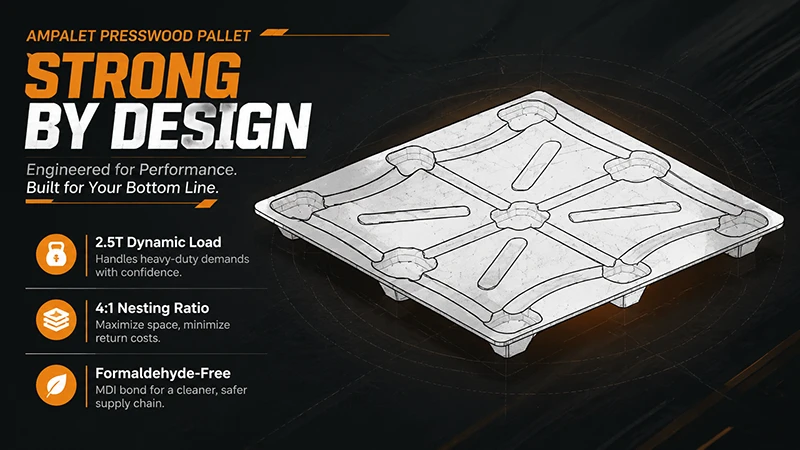
Ampallet is a pressed wood pallet, and the pressed wood part is the answer to the geometry. Recovered wood fibre and an MDI binder are molded in one piece in a steel mold on a 1600 ton hydraulic press, so the deck, the reinforcement ribs and the support feet are one body, with no board joint, no fastener and no separate foot to work loose. Because the deck plane comes off a steel mold and not off a stack of sawn boards, it is controlled as a tolerance rather than as an average: hold the deck to plus or minus 2 mm and four chime rings land on the same plane every time, which is the whole point for a 200 L drum double stack. High pressure molding also gives the deck a dense, non-splintering surface, so nothing under the drum is lifting a splinter or a nail head into the chime. Add the MDI binder and the finished moisture stays low, so a humid drum bay or a container leg does not move the plane the way a wet board deck does.
The specification that carries 2.4 tonnes, and the result
For this lane the mold to specify is the 1140 x 1140 mm drum unit, the size chemical drum handlers search as the 1140x1140mm pallet. The standard unit carries a four-way entry deck with guide slots and a 92 to 96 mm fork entry, and the heavy duty answer for double stacking is the double-face reinforced build: a molded deck above and below, a cross-base structure between them and a 15 mm particleboard strip in the reinforcement, assembled by bolt, giving a double-deck platform rated at 2.5 tonnes dynamic and 8 tonnes static, so the layer weights in this article sit under the rating with margin instead of on it. Set four drums a layer, two layers, on that deck and the result is a stack whose bottom plane does not deflect under the second tier: drums stay seated on their chimes, the load centres stay where the forklift put them, and the leak path that a deflected board deck opens is closed off. The pallet is also a processed wood article, so a cross-region drum lane can be planned without a heat treatment chamber, a stamp or a phytosanitary certificate. Limits are stated plainly: load is confirmed against the specification sheet for the actual drum count and stacking height, the double-face unit is a bolt-assembled configuration rather than a nestable single-face pallet, and the fumigation-free reading stays a destination rule and forwarder question rather than a promise.
- Deck flatness tolerance and 2.5 t dynamic / 8 t static rating stated against the 2 to 2.4 t two-tier drum load
- Load arithmetic built from published drum weights and a four-drum layer count, with margin confirmed per specification sheet
- Double-face reinforced 1140 x 1140 build named as a bolt-assembled configuration, not a nestable single-face pallet
- Fumigation-free use framed as a processed wood material reading subject to destination rule and forwarder confirmation