Skip to content
Home » October 28, 2026

October 28, 2026

Real warehouse photo of presswood pallets supporting stacked industrial containers and chemical cans

Two-Tier 200L Drum Stacking at 2.4 Tonnes: Holding a Chemical Load on a ±2 mm Presswood Pallet Deck

  •  

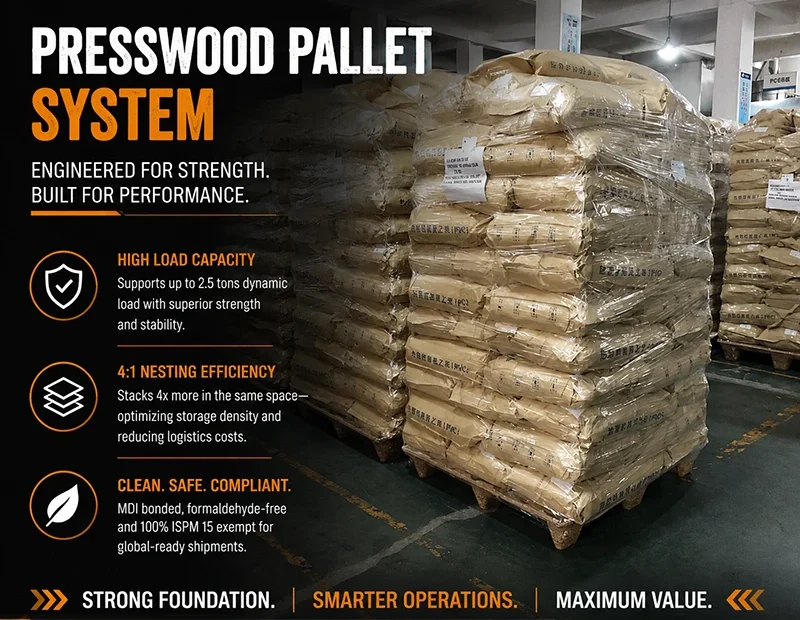
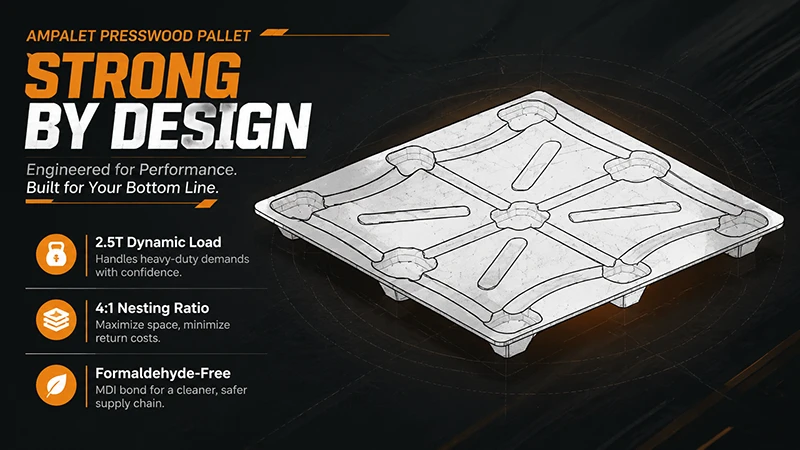
A specialty chemical group shipping polyurethane, silicone and propylene glycol in 200 L drums and IBCs across regions asks one thing of the pallet under the load that a nailed wood pallet was never built for: hold roughly 2 to 2.4 tonnes across two drum tiers on a deck plane that stays flat. The arithmetic is plain: a filled 200 L steel drum runs about 250 to 300 kg, four drums to a layer, two layers, and a drum sits on a rolled chime ring with a concave bottom, so the mass travels through a narrow annular contact band. On a sawn board deck the plane is the sum of board crown, cup and thickness spread; under 2 to 2.4 tonnes the boards deflect between bearers, the plane tilts, and a tilting drum is a chime load and a leak path rather than a cosmetic complaint. Ampallet is a pressed wood pallet molded in one piece from recovered wood fibre and an MDI binder on a 1600 ton press, deck and reinforcement ribs and support feet as one body, deck flatness held to plus or minus 2 mm, and for this lane a 1140 x 1140 mm double-face reinforced build with a cross-base structure and a 15 mm particleboard strip, bolt assembled, rated 2.5 tonnes dynamic and 8 tonnes static. Limits are stated plainly: load is confirmed against the specification sheet for the actual drum count and stacking height, the double-face unit is a bolt-assembled configuration rather than a nestable single-face pallet, and a fumigation-free reading stays a destination rule and forwarder question.
Real container loading scene with four jumbo bags secured by cross lashings on a fumigation free export pallet

ISPM 15 Detention at the Port Gate: A Fumigation-Free Pressed Wood Pallet for EU, US and ANZ Export Lanes

  •  

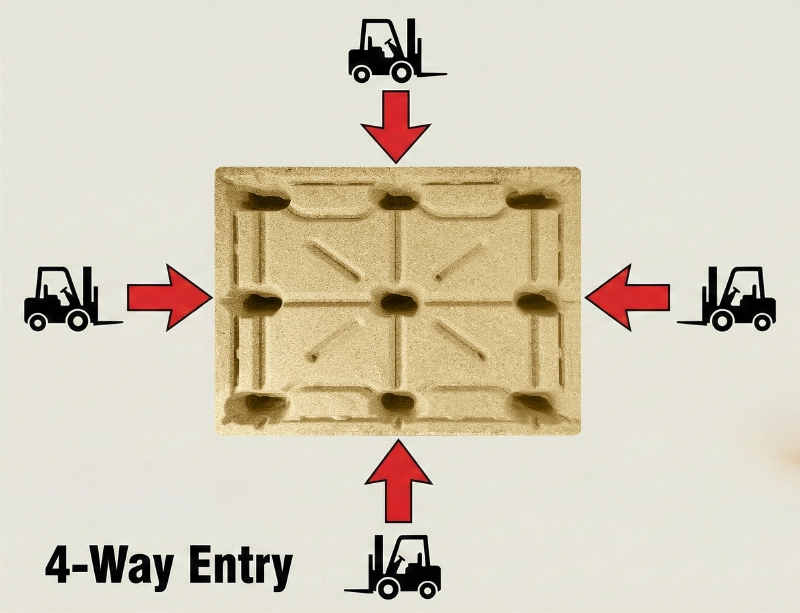
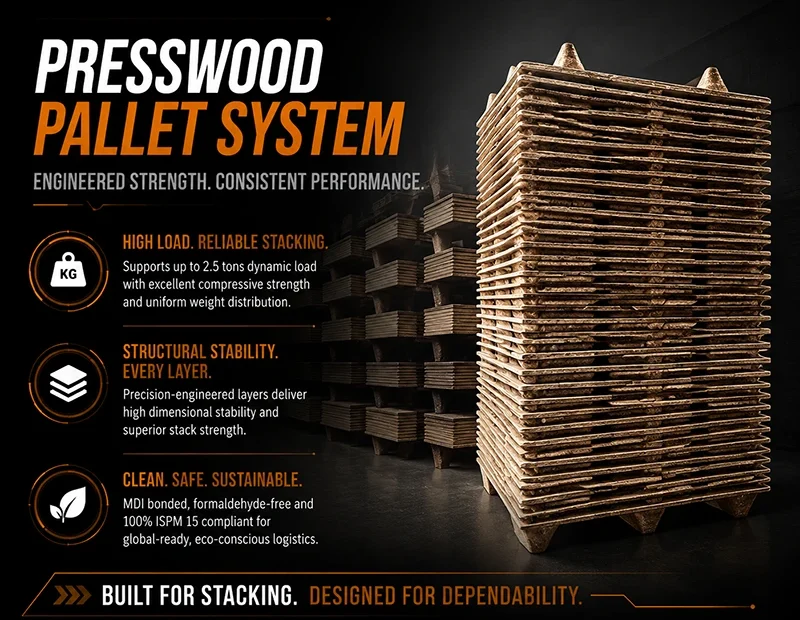
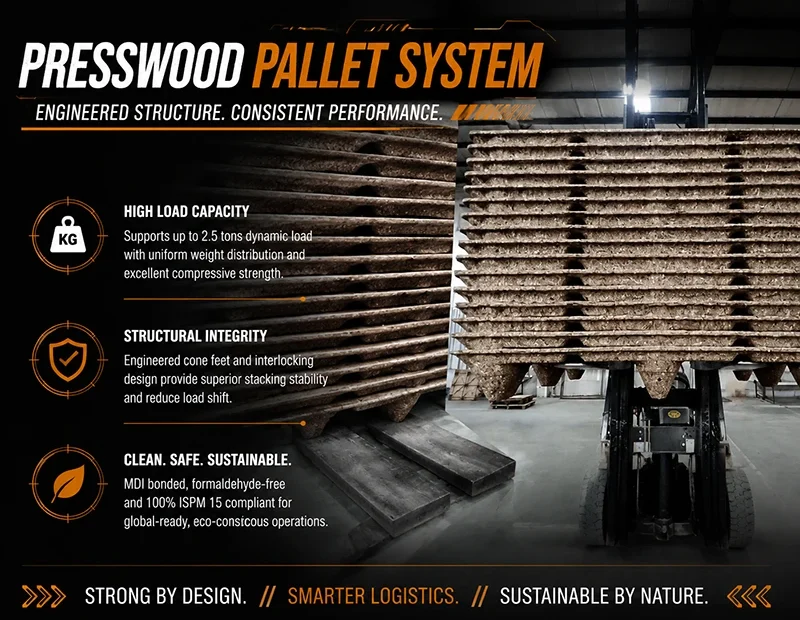
A material science and specialty chemical group shipping drums, jumbo bags and bagged mineral cargo into Europe, North America, Australia and New Zealand does not buy a pallet on those lanes, it buys a compliance route: every solid wood pallet and crate has to be heat treated to 56 degrees Celsius core temperature for 30 minutes or fumigated with methyl bromide, stamped with a compliant IPPC mark and covered by a phytosanitary certificate before a plant protection officer will let it land. Ampallet is a pressed wood pallet molded in one piece from recovered wood fibre and an MDI binder on a 1600 ton press at about 150 to 180 degrees Celsius, and it ships inside the ISPM 15 processed wood category that the standard itself exempts, the same category as plywood, particleboard and presswood. Model references: 1140 x 1140 x 135 mm drum unit at 17 kg, 2500 kg dynamic and 7000 kg static with 96 plus or minus 3 mm fork entry; 1200 x 800 x 125 mm nine-leg at 14 kg, 2000 kg dynamic and 6000 kg static; 800 x 600 x 125 mm six-leg at 6 kg, four-way entry, guide slots and about 4 to 1 nesting. Limits are stated plainly: the exemption is a material-category reading, destination rule, forwarder reading and plant protection authority decision still govern, and the nestable single-face unit is not a long-term racking pallet.

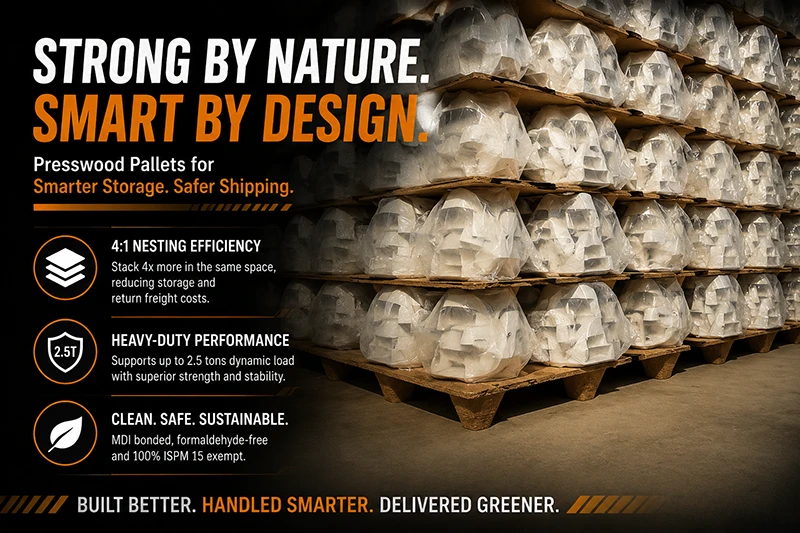
Presswood pallet supporting shrink-wrapped bulk bags in warehouse racking, with molded support feet visible

Nail Heads and Splinters Under the Jumbo Bag: A No-Nail Presswood Pallet for Responsible Care Chemical Handling

  •  

A chemical site handling FIBC jumbo bags and coated drums keeps finding the same fault under the load: a solid wood pallet is an assembly of boards and nails, so every re-boarded unit puts metal and splintered timber back into a lane where a person still touches the deck by hand. Nail heads stand proud of the top board, bag weave is abraded where it meets the timber, drum base rings are scraped down to bare steel and board edges lift splinters under a glove, none of which shows up as a dramatic event but all of which lands in an EHS near-miss log that a Responsible Care audit reads. Ampallet is a nail-free presswood pallet pressed in one piece from recovered wood fibre and an MDI binder on a 1600 ton press at about 150 to 180 degrees Celsius, deck, ribs and nine conical feet as one body at roughly 9 percent finished moisture, mold-formed chamfered and round corners, no fastener, no separate foot and no board joint. Model references: 1140 x 1140 x 135 mm drum unit at 17 kg, 2500 kg dynamic and 7000 kg static with 96 plus or minus 3 mm fork entry; 1200 x 800 x 125 mm nine-leg at 14 kg, 2000 kg dynamic and 6000 kg static; 800 x 600 x 125 mm six-leg at 6 kg. Limits are stated plainly: the nestable single-face unit is not a long-term racking pallet, a one-piece body is replaced rather than re-boarded, load follows the confirmed specification, and removing one mechanical hazard is not a zero-incident claim.

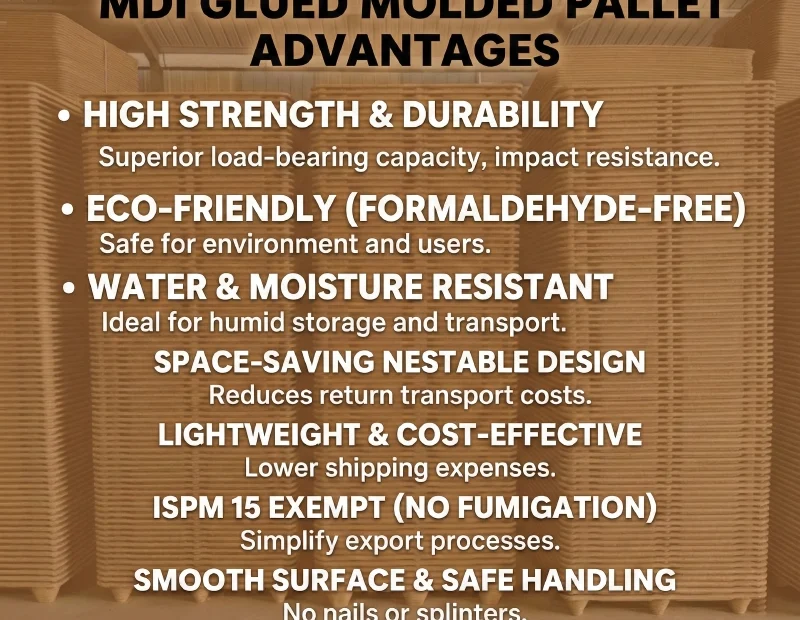
Stacked MDI glued molded pallets with nestable design and smooth, nail-free surfaces

Scope 3 Packaging Carbon at the 2030 Chemical Buyer Gate: How a Presswood Pallet Made From Recovered Wood Fibre Qualifies a Drum and Jumbo Bag Supplier

  •  

A chemical buyer that has booked a 25 percent cut in Scope 1 and 2 and a 15 percent cut in Scope 3.1 by 2030 works its supplier questionnaires back to the platform under the drum, and a nailed heat treated solid wood pallet now arrives with a treatment certificate, a repair bench and a return leg attached to it. Ampallet is a presswood pallet molded in one piece from recovered wood fibre and an MDI binder, steam dried from about 148 to 138 degrees Celsius, pressed at about 220 degrees Celsius to 9 percent finished moisture, with no nail, no board to re-board and no separate foot. Model references: 1140 x 1140 x 135 drum unit at 17 kg, 2500 kg dynamic and 7000 kg static with 96 plus or minus 3 mm fork entry; 1200 x 800 x 125 nine-leg at 14 kg, 2000 kg dynamic and 6000 kg static; 800 x 600 x 125 six-leg at 6 kg. Limits are stated plainly: the nestable single face unit is not a long-term racking pallet, one-piece molding cannot be locally repaired, certification is supplied per product and per plant, a carbon figure is re-run per specification and lane, and a fumigation-free reading stays a destination and forwarder question.

AGV Pallet Consistency at ±2 mm: Compressed Wood Pallet for an Automated Chemical Warehouse That Cannot Afford a Jam

  •  

A chemical site that hands its internal moves to AGVs, an automatic store and a palletizer stops buying a pallet as a platform and starts buying it as a tolerance: a nailed heat treated wood pallet arrives with millimetres of spread in length and width, a deck plane that moves between units and boards that split along a nail line, so a fork cannot square to a pallet that is 6 mm out, a photo-eye reads a load that was not there and the line faults out into a manual re-stack. Ampallet compressed wood pallets are molded one piece in a steel mold from wood fibre and MDI adhesive, no nails, no separate feet, deck and nine conical support feet in one body, with the specification sheet holding height at plus or minus 2 mm, corner height difference at 3 mm or less, round corners at R25 or R35 plus or minus 2 mm and finished moisture at 9 percent or below. Model references: 1200 x 800 x 125 nine-leg at 14 kg, 2000 kg dynamic and 6000 kg static with 92 plus or minus 3 mm fork entry; 1140 x 1140 x 135 drum unit at 17 kg, 2500 kg dynamic and 7000 kg static with 96 plus or minus 3 mm; 800 x 600 x 125 six-leg at 6 kg, 1000 kg dynamic and 3500 kg static. Limits are stated plainly: nestable single-face geometry is not a long-term racking pallet, and the AGV fork, roller, pin stop and sensor interface are confirmed per lane with the integrator.

Warehouse-stacked presswood pallets wrapped for export, showing nestable pallet design and empty pallet storage density

Chemical Plant Pallet Pool: Nestable Presswood Pallet Cuts Empty Pallet Storage to About a Quarter of the Floor

  •  

A chemical producer running a couple of hundred sites pays for empty pallets twice: once to buy them, once on every square metre of covered floor they hold between loads. Solid wood GMA and Euro pallets and most heavy-duty plastic pallets are rigid bodies with fixed feet, so an empty unit takes the same floor as a loaded one, a stack of the same count runs to about 2.7 metres instead of 0.75 metres, and the yard competes with raw material and finished goods storage. Ampallet is a nestable presswood pallet molded in one piece from wood fibre and MDI adhesive, with inverted cone feet that settle into the deck recesses below at roughly a 4 to 1 nesting ratio, so the same pallet count occupies about a quarter of the floor and site-to-site buffers can be rebalanced without a chamber booking or a truck carrying air. Design references put the 1140 x 1140 chemical drum size at 2500 kg dynamic and 7000 kg static load, 92 to 96 mm fork entry with guide slots, four-way entry and flatness near plus or minus 2 mm; a 1200 x 800 unit runs about 13 to 14 kg. Published positioning places empty pallet storage saving near 70 percent and storage capacity at about 2.5 times on the same floor. Limits are stated plainly: load, nesting ratio and floor saving are recalculated per site and mold, the nestable single-face unit is not a racking pallet, and fumigation-free use stays a destination and forwarder question.

Warehouse-stacked presswood pallets wrapped for export, showing nestable pallet design and empty pallet storage density

Nestable Presswood Pallet for One-Way Chemical Export: Cutting Empty Pallet Return Freight and Yard Cost

  •  

A chemical B2B exporter shipping drums and jumbo bags into ninety-plus countries pays for the pallet on both legs. Ampallet is a nestable presswood pallet pressed in one piece from wood fibre and MDI adhesive, with an inverted cone foot geometry that lets empty units settle into each other at about a 4 to 1 nesting ratio, so empty return volume falls to roughly a quarter of the solid wood equivalent and a 1200×800 unit runs about 13 to 14 kg. Design records put the 1140×1140 chemical drum size at 2500 kg dynamic and 7000 kg static load, 92 to 96 mm fork entry with guide slots, 4-way entry and a processed wood position that supports a fumigation-free ISPM 15 reading, subject to destination rule and forwarder confirmation. Published positioning places empty pallet storage saving near 70 percent, return freight reduction near 60 percent and one-way cost near a third of a plastic pallet; those figures are recalculated per lane rather than assumed, and the pallet is not a racking pallet.

Formaldehyde-free presswood pallet with reinforced rib pattern and one-piece molded wood fiber deck

REACH and CARB-NAF Formaldehyde Pressure on Chemical, Pharma and Personal Care Cargo: Auditing a Presswood Pallet Binder Before the Supplier Sustainability Review

  •  

A specialty chemical, pharmaceutical or personal care shipper that answers a customer sustainability review is asked one packaging question it cannot dodge: what binder is in the pallet under the drum. Heat treated solid wood keeps the ISPM 15 treatment, marking and certificate attached to every consignment, and a low cost pressed pallet bonded with urea formaldehyde carries free formaldehyde that releases in humid heat and swells once it takes water, which is a contamination path with a REACH restriction and a CARB limit attached. Ampallet molded wood pallets are bonded with MDI, a polyisocyanate adhesive named on the material sheet, and hold a CARB-NAF no added formaldehyde position: no formaldehyde in the binder to release, moisture curing rather than moisture sensitive, plus a one piece nail free deck pressed at 150 to 180 C on a 1600 ton press, deck flatness to about plus or minus 2 mm, 2500 kg dynamic and 7000 kg static load references, four way entry, 4 to 1 nesting and ISPM 15 exemption as processed wood. Limits are stated plainly: the pallet does not replace the shipper’s own REACH registration and SDS obligations, and certification is supplied per product and plant.

Get a Pallet Machine Price Quote & ROI Plan
Request Quote WhatsApp
🇬🇧 EN 🇪🇸 ES 🇫🇷 FR 🇷🇺 RU 🇮🇹 IT 🇩🇪 DE 🇳🇱 NL
×

Get a Precision Quote

Leave your requirements below. Our engineers will reply within 12 hours with customized technical details and pricing.