One-Way Export Pallet Economics
The Leg Nobody Prices on a One-Way Export Lane
A material science B2B supplier shipping drums, jumbo bags and bagged mineral cargo into more than 160 countries pays for the pallet on both legs, even when the pallet never comes back. A nailed heat treated solid wood pallet is a rigid body, so the same count of empty units runs to roughly 2.7 metres where a nested stack runs to about 0.75 metres, and a return container carries air. A heavy duty plastic pallet answers the durability question at roughly 40 to 120 US dollars a unit and 20 kilos and up, and it still takes full floor when empty, which is the wrong bill to pay on a pallet that ends its life abroad. Ampallet is a nestable presswood pallet molded in one piece from recovered wood fibre and an MDI binder, with inverted cone feet that settle into the deck recesses below at about a 4 to 1 nesting ratio, a 1200 x 800 nine-leg unit at about 13 to 14 kilos, and no nail, no board joint and no repair bench behind it.
Why a Nestable Pressed Wood Pallet Fits a Pallet That Is Consumed
Ampallet is a pressed wood pallet molded in one piece from recovered wood fibre and an MDI binder on a 1600 ton press at roughly 150 to 180 degrees Celsius. Two structural decisions make it fit a one-way export program rather than a returnable pool. The first is the foot geometry. The support feet are inverted cones, so an empty unit settles into the deck recesses of the unit below instead of standing on top of it, at about a 4 to 1 nesting ratio. Four empty pallets take the floor of one, which is the difference between a yard that has to hold empty count and a buffer that holds itself. Published positioning places empty pallet storage saving near 70 percent and storage capacity at about 2.5 times on the same covered floor. The second is that there is nothing to maintain. Deck, reinforcement ribs and support feet are one molded body with no fastener, no board joint and no separate foot, so there is no nail to withdraw, no board to re-board and no repair bench to staff between loads, and a worn unit is replaced rather than sorted and re-boarded. Because the body is a molded wood product, it sits in the processed wood material category that the ISPM 15 standard exempts, the same category as plywood and particleboard, which supports a fumigation-free reading on an export lane and keeps the treatment program off the pallet. On weight, a 1200 x 800 unit runs about 13 to 14 kilos, so freight both ways is paid on a lighter body. The pallet is not asked to come back, and it is not built as if it will.
The Structure and the Numbers Behind the 4 to 1 Nesting
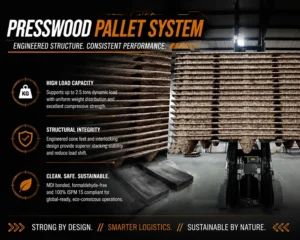
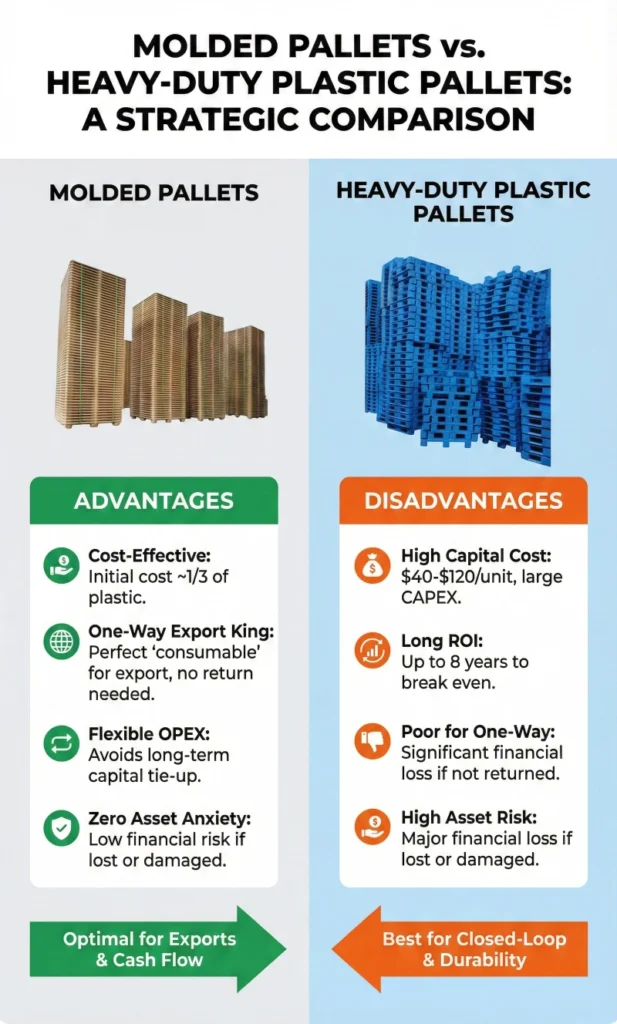
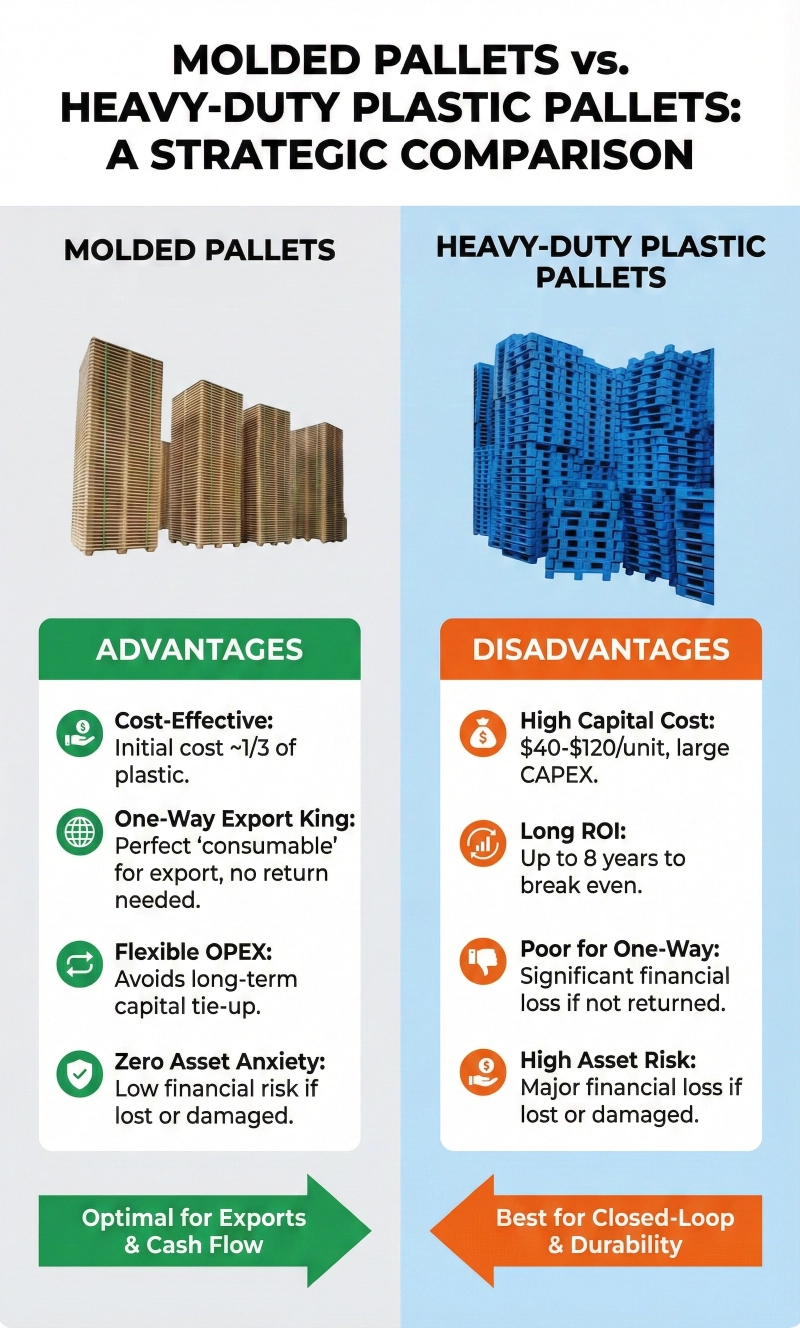
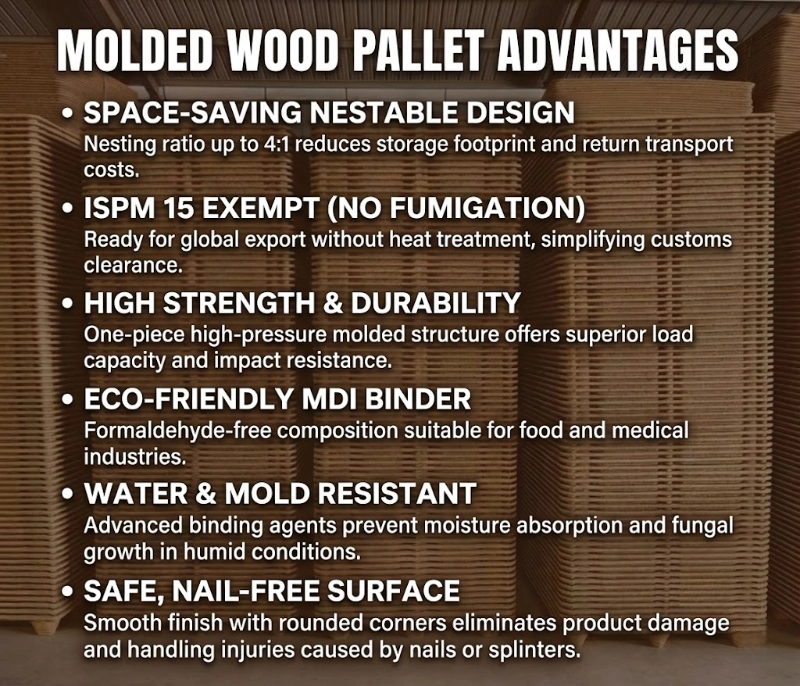
The reference figures are specification figures, not a marketing claim. The 1200 x 800 x 125 mm nine-leg unit runs about 13 to 14 kilos with 2000 kg dynamic and 6000 kg static load, four-way entry, guide slots for fork alignment and 92 plus or minus 3 mm fork entry, with about 4 to 1 nesting. The 1140 x 1140 x 135 mm drum unit runs about 17 kilos with 2500 kg dynamic and 7000 kg static load and 96 plus or minus 3 mm fork entry, for chemical drum and IBC lanes. The 800 x 600 x 125 mm six-leg unit runs about 6 kilos with 1000 kg dynamic and 3500 kg static load for lighter cartons. Across the range, deck flatness is held near plus or minus 2 mm, corners are molded round rather than cut square, and finished moisture sits around 9 percent, which matters when a unit sits in a humid container for six weeks. The images on this page are evidence rather than decoration. The first compares molded pallet economics against a heavy duty plastic pallet for export logistics, low unit cost and one-way use on one side, high capital cost and a long payback on a pallet that is not suited to one-way flow on the other. The second shows nested molded units stacked in a warehouse, which is the geometry that produces the floor saving. Nesting is a mold decision, not a stacking technique, and it is the reason the empty count stops being a yard problem.
What the Lane Looks Like at the End of the Quarter
The end result on a consumed pallet lane is arithmetic rather than a slogan. Empty return volume falls to roughly a quarter of the solid wood equivalent, published positioning places return freight reduction near 60 percent and one-way cost near a third of a plastic pallet, and a 13 to 14 kilo body keeps the freight paid on the load rather than on the platform. There is no pallet pool to reconcile, no repair bench to staff, no de-nailing, and no accumulation of empty units waiting for a return decision that never gets made. The limits are stated as plainly as the figures. Load, nesting ratio and floor saving are recalculated per site, per mold and per lane rather than assumed, and the load rating is confirmed against the specification sheet for the actual cargo and stacking height. The nestable single-face unit is not a long-term racking pallet, and a racking lane keeps its block pallet as a complementary category. A fumigation-free reading of the processed wood position stays a destination rule, a forwarder question and a plant protection authority decision, and certification is supplied per product and per plant. Within those limits, the pallet stops being an asset that has to be tracked across 160 countries and goes back to being what it should have been on a one-way lane: packaging that leaves with the cargo and costs what it costs once.
- Nesting ratio, unit weight, load ratings and fork entry figures are Ampallet specification references and are re-confirmed per mold and per lane.
- The 160-country flow is described as a published supply chain footprint, not as a named customer reference or an endorsement.
- Return freight near 60 percent, empty pallet storage saving near 70 percent, about 2.5 times storage capacity and one-way cost near a third of a plastic pallet are published positioning figures, not a forecast.
- The nestable single-face unit is not a long-term racking pallet, and a fumigation-free reading stays a destination rule, forwarder question and plant protection authority decision.