Multi-site warehouse space
Every base in the footprint asks the same warehouse question
A group running more than a hundred manufacturing bases, the footprint a composite chemical producer like Dow carries at 106 sites, does not buy pallets by the truckload: it buys a pool and then pays rent on the covered floor where that pool waits empty. Solid wood GMA and Euro pallets and heavy duty plastic pallets are rigid bodies, so an empty unit takes the same floor as a loaded one and the same count stacks to about 2.7 metres instead of 0.75 metres. Ampallet is a nestable pressed wood pallet molded in one piece from recovered wood fibre and an MDI binder, with inverted cone feet that settle into the deck recesses below at about a 4 to 1 nesting ratio, so the same empty pallet count in a space-constrained warehouse occupies roughly a quarter of the floor, with a 1200 x 800 nine-leg unit at about 13 to 14 kilos rated 2000 kg dynamic and 6000 kg static. Limits are stated plainly: floor saving is recalculated per site and per mold, and the nestable single-face unit is not a long-term racking pallet.
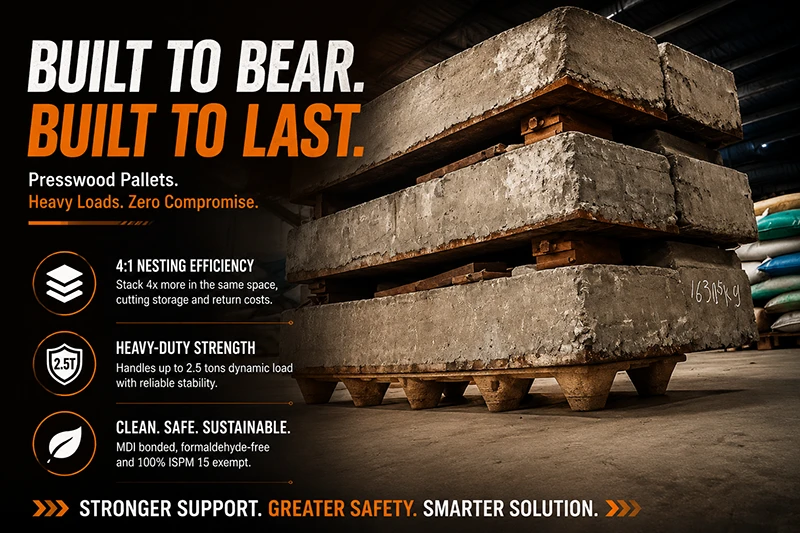
Where the solid wood and plastic pallet stops paying: the same floor, loaded or empty
A nailed solid wood GMA or Euro pallet, and most heavy duty plastic pallets, are rigid assemblies with fixed bearers or feet, so nestability is not available at any price. An empty unit occupies the same footprint as a loaded one, a stack of the same count runs to roughly 2.7 metres where a nested stack of the same count reaches about 0.75 metres, and the surplus yard quietly expands back into the bay. A plastic unit answers durability at 40 to 120 US dollars each and still takes full floor when empty. None of this shows up as a defect, which is why it survives so long: the cost is distributed across rent, extra forklift travel between the overflow yard and the dock, and a site-to-site transfer cadence that has to wait until enough empty units are gathered in one place before a truck is worth loading. Standardising on a non-nestable pallet across bases locks that arithmetic into every site at once.
Where a nestable pressed wood pallet fits: inverted cone feet that settle into the deck below
Ampallet is a molded wood pallet pressed in one piece from recovered wood fibre and an MDI adhesive, deck, ribs and support feet as a single body with no nail, no board joint and no separate foot to come loose, formed on a 1600 ton hydraulic press at about 150 to 180 degrees Celsius. The inverted cone design is the part that answers the warehouse problem: the conical feet of one unit drop into the recesses of the deck beneath it, guide slots square the stack for a forklift, and empty units settle at about a 4 to 1 nesting ratio. Four-way entry keeps the pallet jack and forklift handling routine on a narrow bay floor. Specification references: 1200 x 800 x 125 mm nine-leg unit at about 13 to 14 kg, 2000 kg dynamic and 6000 kg static load, 92 plus or minus 3 mm fork entry, four-way entry and guide slots; 1140 x 1140 x 135 mm chemical drum unit at about 17 kg, 2500 kg dynamic and 7000 kg static, 96 plus or minus 3 mm fork entry; 800 x 600 x 125 mm six-leg unit at about 6 kg, 1000 kg dynamic and 3500 kg static. Deck flatness is held near plus or minus 2 mm, finished moisture at about 9 percent, round corners at R25 or R35, and the MDI binder is formaldehyde-free with a CARB-NAF position, with a fumigation-free reading supported by the processed wood material category. The images in this article show the batch stacking in a presswood pallet warehouse and the nested stack that replaces the surplus yard.
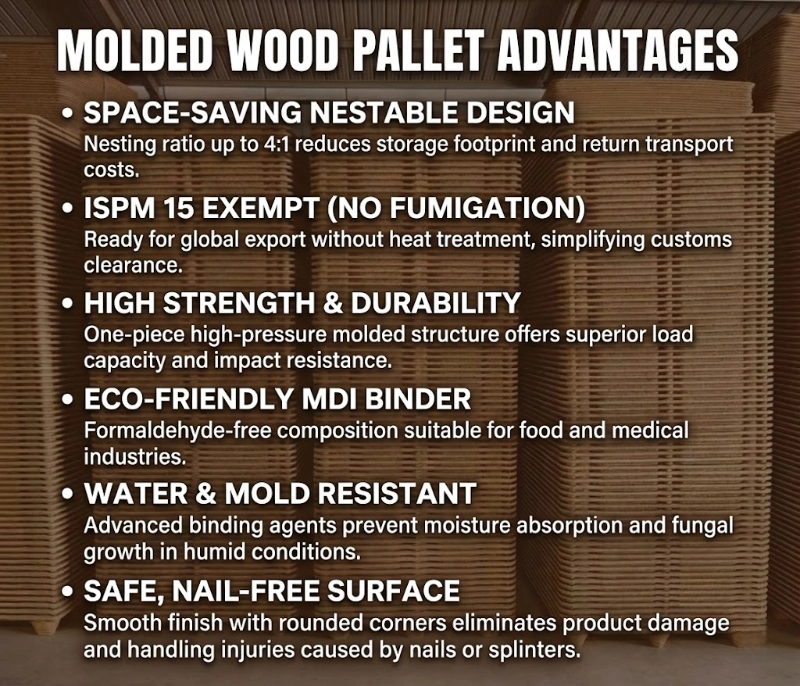
The result: empty pallet buffers sized in a quarter of the floor, site by site
At a 4 to 1 nesting ratio the same empty pallet count occupies about a quarter of the floor of the solid wood equivalent, and published positioning for the pressed wood pallet places empty pallet stacking saving near 70 percent with storage capacity at about 2.5 times on the same floor. Practically, that means a space-constrained warehouse can hold the buffer inside the bay instead of in a rented overflow yard, a site-to-site transfer can be released sooner because nested units load into a truck at nested density, and the pallet budget stops being a warehouse space problem and returns to being a pallet decision, with one-way export lanes getting the same benefit since the processed wood position removes fumigation booking from the route. Measure it before quoting it: count empty units per base, note the bay clear height and the stack height your forklift can reach, and confirm the mold and the load rating against the specification sheet, because floor saving, nesting ratio and load are recalculated per site and per specification. Two limits worth stating in the same breath: the nestable single-face unit is not a long-term racking pallet and is a one-way and buffer unit rather than a beam-racking platform, and a fumigation-free reading stays a destination rule and forwarder question rather than a blanket claim.
- Chain kept: multi-site scenario, old non-nestable problem, fit, structure and specification evidence, result and limits
- Product, scene, problem and result words from the traffic profile used in title, summary, body and image alt
- Title and angle do not repeat the existing empty pallet storage, 160-country and one-way export posts
- Every figure marked as a specification or published positioning reference, with site-level recalculation stated



