Automated warehouse pallet tolerance
Where a millimetre becomes a stopped lane
An automated store does not read a pallet the way a person does. A stacker crane, a palletizer gripper and an AGV fork read fork entry height, deck plane and outside length as numbers, and a pressed wood pallet that arrives a few millimetres out of that interface is not a small defect, it is a fault at the infeed. A nailed wood pallet is assembled by hand from sawn boards, so its length and width can spread 10 to 15 mm between units and its deck plane is the sum of board crown, cup and thickness variation; a lane sized on one pallet is then asked to accept the next one. Ampallet is a molded wood pallet pressed in one piece from recovered wood fibre and an MDI binder in a steel mold, with height held to about plus or minus 2 mm, corner height difference at 3 mm or less, four way entry with guide slots and no nail, no board joint and no separate foot to come loose. This page follows the tolerance as an interface: what the mold fixes, what the automated lane gets back, and where the limits sit.
Why a nailed wood pallet cannot hold an interface tolerance
The old solution is a solid wood pallet, and it fails this job by construction rather than by neglect. A nailed unit is an assembly: boards sawn to a nominal size, nailed to bearers, with hand-built spread of roughly 10 to 15 mm in length and width between units, board crown and cup under the load, and thickness variation stacked into the deck plane. Under a palletizer cycle the nails work, board ends split along the nail line, and a deck that was flat at goods-out is crowned by the time it reaches the infeed. Sea freight and humid air add a second variable, because sawn timber takes on moisture and moves, so a batch bought in one shipment no longer matches itself six months later. None of this is visible in a price per pallet and all of it is visible at the photo-eye: false reads, deck edges out of position, loads that were never where the sensor expected them, and a maintenance log that keeps a manual re-stack on the books.
What the steel mold fixes before the pallet reaches the line
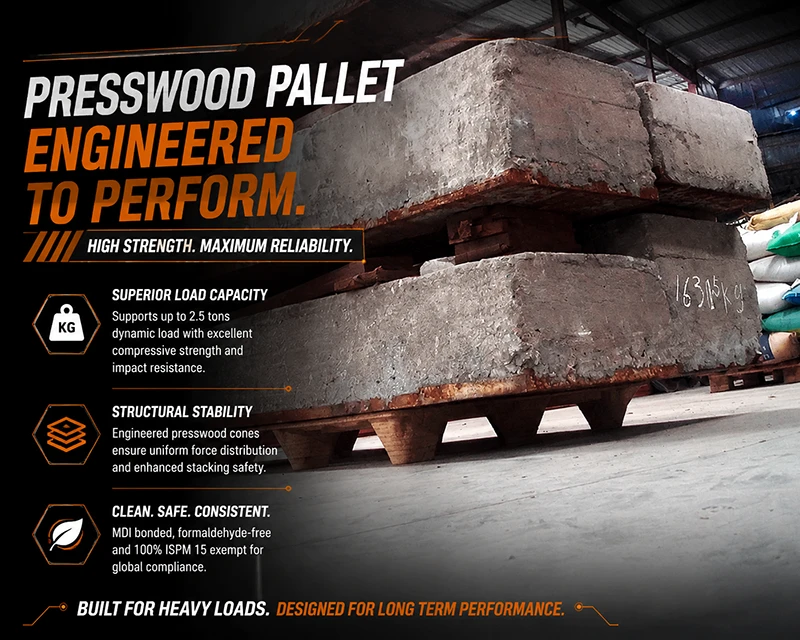
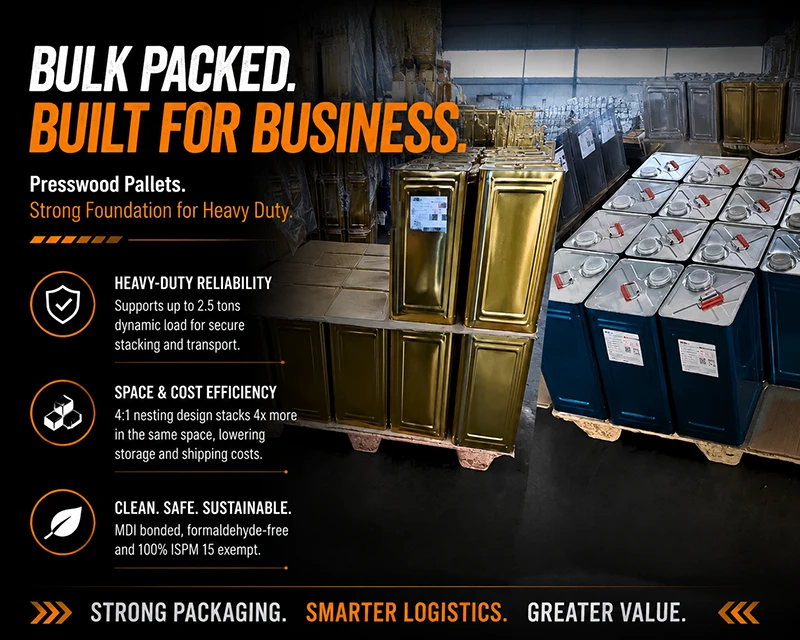
Ampallet compressed wood pallets are molded, not assembled. Recovered wood fibre is blended with an MDI adhesive and hot press molded at about 150 to 180 degrees Celsius on a 1600 ton press, so deck, reinforcement ribs and support feet come out of the mold as one body. Because the outside geometry is the steel mold rather than a bench, the specification sheet holds height at about plus or minus 2 mm, corner height difference at 3 mm or less, round corners at R25 or R35 within 2 mm, and finished moisture at 9 percent or below, with four way entry, guide slots and mold-formed chamfers. Fork entry sits at 92 mm on the 1200 x 800 nine-leg unit, 95 mm on the 800 x 600 six-leg and 96 mm on the 1140 x 1140 drum unit, each within 3 mm. The first photo shows a unit holding stacked concrete blocks with the deck plane intact under load rather than bowing between bearers, and the second shows nested units lifted as one settled stack, conical feet and all, which is the condition a line feeder actually receives. There is no nail head to stand proud, no splinter to catch a conveyor and no foot to come loose, and part numbers stay dimensionally consistent across batches.
What the automated lane gets back, and where the pallet stops
The recovery is boring and that is the point: a lane that sees the same deck height, the same outside length and the same fork clearance on unit ten thousand as on unit ten gets fewer photo-eye faults, fewer dropped loads and fewer manual re-stacks, so the takt holds through a night shift and unmanned operation stops depending on a person standing by. Model references are confirmed against the specification sheet for the load rather than assumed: the 1200 x 800 x 125 mm nine-leg at about 13 to 14 kg with 2000 kg dynamic and 6000 kg static load, the 1140 x 1140 x 135 mm drum unit at about 17 kg with 2500 kg dynamic and 7000 kg static, and the 800 x 600 x 125 mm six-leg at about 6 kg with 1000 kg dynamic and 3500 kg static, all rated for an operating range of about minus 10 to plus 70 degrees Celsius. Limits are stated plainly. The nestable single-face unit is not a long-term racking pallet, so an AS/RS rack lane needs the double-face or reinforced build. The AGV fork, roller, pin stop and sensor interface are confirmed per lane with the integrator rather than inferred from a datasheet, and load is confirmed per specification for the actual unit load and stacking height. Tolerance at plus or minus 2 mm is a tooling and inspection position, not a blanket promise for every custom footprint. Send the lane drawing and the unit load to the team through the contact page and the pallet specification comes back against it.
- Every section body is plain text only, with no HTML tags, attributes, Markdown or angle brackets, because the fixed renderer owns all paragraph markup.
- The rendered body root is the renderer-owned section carrying emp-section, emp-blog-p0 and emp-btn-primary with a call to action to /contact/, and no H1 is added.
- Both selected images come from the resolved ampallet designer gallery and use the index ALT text, with the hero attachment set as the featured image.
- Load, fork entry and tolerance figures follow the Ampallet specification sheet by model, and limits are stated plainly: the nestable single-face unit is not a long-term racking pallet and AGV, crane and palletizer interfaces are confirmed per lane.



