Chemical drum and IBC double-stacking
Where the 2.4 tonnes actually lands
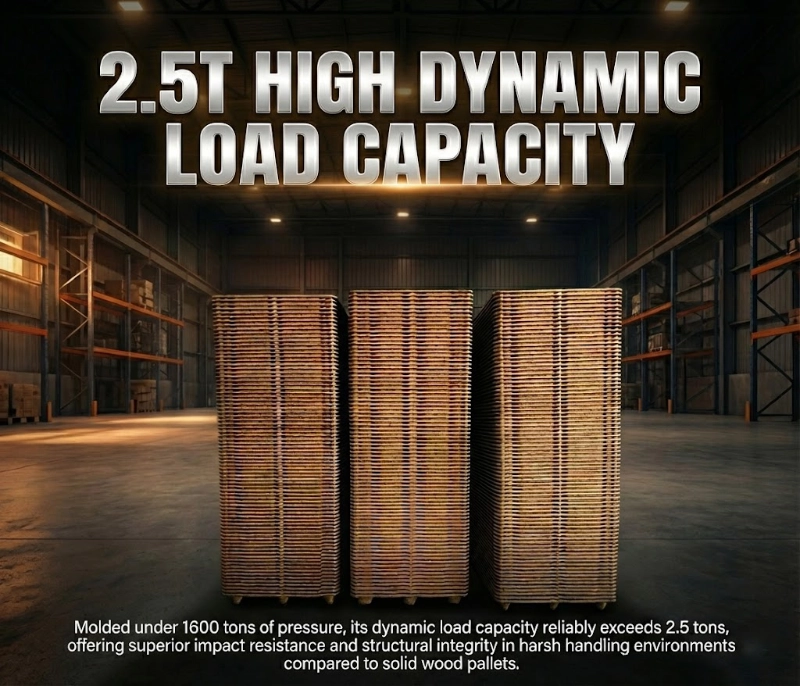
A filled 200 L steel drum runs about 250 to 300 kg, and an empty drum still weighs 16.5 to 21.5 kg before anything goes into it. Four drums to a layer, two layers, and one deck carries roughly 2 to 2.4 tonnes through four narrow, rolled chime rings, because a drum bottom is concave and only its rim touches the timber. That is the whole specification problem: a pressed wood pallet is judged here on deck flatness and pressed density rather than on board thickness, since a deck plane that bows between bearers tilts the drum, opens the chime contact and turns a stacked load into a leak path. Ampallet molds the deck, the reinforcing ribs and the support feet as one body from wood fibre and an MDI binder on a 1600 ton hydraulic press, holds the deck plane to plus or minus 2 mm, and rates the 1140 x 1140 mm double-face reinforced build at 2.5 tonnes dynamic and 8 tonnes static for exactly this two-tier drum and IBC lane.
Why a nailed or heat treated wood pallet loses that plane
A solid wood pallet, GMA pattern or Euro, is an assembly of sawn boards fixed to bearers or blocks, and its deck plane is the sum of board crown, cup and thickness spread across the units in a lot. Under 2 to 2.4 tonnes the boards deflect between the bearers, the plane tilts, and a drum standing on a concave bottom starts to lean. Once it leans, the chime ring loads on one edge, the tier above shifts, and the outcome is no longer packaging wear: it is a chemical leakage prevention problem, a drum body that has to be righted with a forklift in an aisle, and a near-miss entry in the log. Two more faults come with the same construction. A nailed wood pallet puts nail heads proud of the deck, so a drum base ring is scraped and a coated drum is punctured where it meets metal, and every re-boarding writes that risk back in. Heat treatment and the ISPM 15 stamp add a chamber booking and certificate custody to a lane that ships continuously. None of this is a claim that solid wood always fails. It is a statement about flat surface pallet requirements: a deck assembled from boards cannot promise a plane, and a two-tier drum column is the one load that reads that plane as a safety number.
What the 1600 ton press and the double-face build change
Ampallet is a pressed wood pallet molded in one piece from wood fibre, recovered wood residue, with an MDI polyisocyanate binder, pressed on a 1600 ton hydraulic press at roughly 150 to 180 degrees Celsius to about 9 percent finished moisture. High temperature and high pressure molding densifies the mat into a single body: deck, reinforcement ribs and support feet come out of the same mold, with no nail, no board joint and no separate foot to work loose, and the deck surface is molded flat rather than planed or sanded back into shape. Flatness is held to plus or minus 2 mm, which is the number that matters under a drum: a plane inside that band keeps the chime ring in full contact and keeps the tier above square. For the drum lane specifically, the 1140 x 1140 x 135 mm double-face reinforced unit is built on a cross-base structure with a 15 mm particleboard strip and bolt assembly, four-way entry with guide slots and about 92 to 96 mm fork entry, rated 2.5 tonnes dynamic and 8 tonnes static load, so a 2 to 2.4 tonne two-tier column is covered inside the published rating rather than at its edge. The same press produces the nestable single-face sizes used elsewhere on site: 1200 x 800 x 125 mm nine-leg at about 13 to 14 kg with 2000 kg dynamic and 6000 kg static, and 800 x 600 x 125 mm six-leg at about 6 kg, both nesting at roughly 4 to 1 for empty pallet stacking.

The result at the storage block and on the export lane
With the deck plane held at plus or minus 2 mm and the load held by ribs molded into the same body, the two-tier drum column stops being the item the shift supervisor watches. Drums stay seated on their chime rings, the tier above keeps its alignment, and the deck does not take a permanent set that has to be discovered later on the loading dock. Because there is no fastener at the working surface, a coated drum or IBC base is not scraped or punctured, and the round corners and molded edge keep the pallet off the drum body when a unit is nudged into position. On the export side the same unit ships inside the processed wood category, which supports a fumigation free and ISPM 15 compliant reading and removes the heat chamber and methyl bromide route from the lane, subject to destination rule and forwarder confirmation. Limits are stated plainly: the 2.5 tonne dynamic and 8 tonne static figures belong to that specified 1140 x 1140 double-face build, load is confirmed against the specification sheet for the actual drum count, stacking height and IBC type on your lane, the double-face drum unit is a bolt-assembled configuration rather than a nestable single-face pallet, the nestable single-face unit is not a long-term racking pallet, and reagent compatibility with a spilled product is confirmed by a sample soak rather than assumed. Share your drum diameter, tier count and stacking height with our team and the deck build is quoted against those numbers.
- Deck flatness is specified at plus or minus 2 mm on a one-piece molded deck, not an assembled board plane.
- The 1140 x 1140 x 135 mm double-face reinforced build is rated 2.5 tonnes dynamic and 8 tonnes static for the two-tier drum and IBC lane.
- Load, stacking height and IBC type are confirmed against the specification sheet before a pallet is quoted for a lane.
- The double-face drum unit is a bolt-assembled configuration and the nestable single-face unit is not a long-term racking pallet.



