Chemical raw material handling
The Splash Zone Is a Narrow Band, Not the Whole Deck
A corrosive raw material rarely floods a presswood pallet. It drips at the bung, splashes at the filling head, sits in the drum chime and never quite dries after a washdown, and that narrow band of wet chemistry is where a nailed solid wood deck fails first: the nails rust and swell, the board joints open, the grain lifts into splinters, and the debris that follows ends up in the drum ring, in the bagged powder and in the claim file. A published customer case record, the BASF Freeport plant account reported by Penno Packtech, puts annual damage from pallets failing under corrosive raw material spills at about USD 180,000 before the plant changed the platform under the load.
What That Drip Does to a Nailed Solid Wood Deck
A nailed wood pallet is an assembly, and every joint in it is a capillary. Steel fasteners in a wet corrosive environment oxidise, expand and stain the drum chime and the bag surface; board edges lift into splinters that travel with gloves, pallet jacks and shrink wrap; a swollen board that will not dry is pulled from service and re-boarded, so the repair bench becomes a fixed operating cost on the same lane. The published BASF Freeport account reported by Penno Packtech describes exactly this failure mode on corrosive raw material and puts the annual damage bill near USD 180,000 before the switch. That number is what a chemical site is actually buying when it keeps a nailed platform under a corrosive load: a consumable that fails slowly, a contamination path into the product, and a quality claim that is hard to disprove because the evidence is sitting in the deck.
Why a Molded Wood Pallet Reads Differently Under the Same Reagent
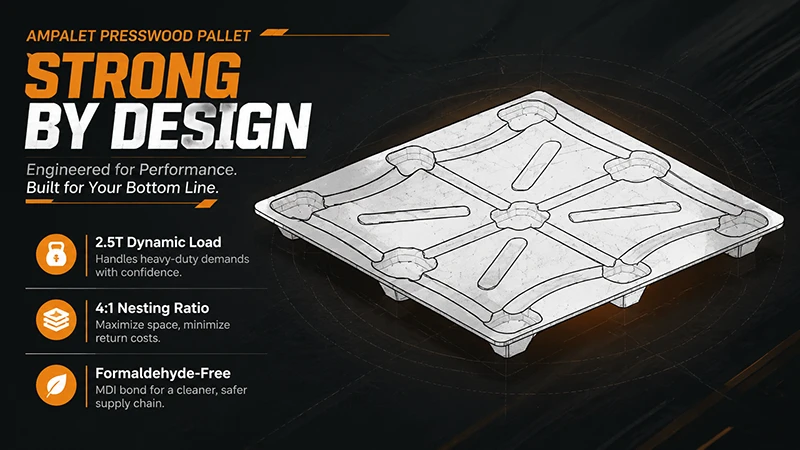
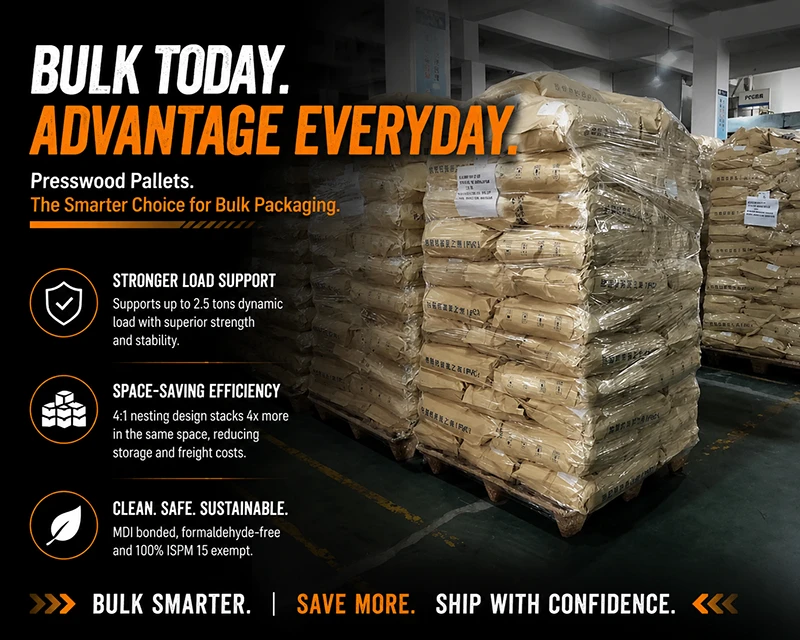
Ampallet is a presswood pallet pressed in one piece from wood fibre and an MDI polyisocyanate binder on a 1600 ton hydraulic press at roughly 150 to 180 degrees Celsius to a finished moisture near 9 percent, so the deck, the reinforcing ribs and the support feet come out of the mold as one body. There is no nail to rust, no board joint to wick liquid sideways and no separate foot to work loose, which removes the three landing points described above rather than treating them. The MDI chemistry is moisture curing rather than moisture sensitive, and the cured binder consolidates the fibre into a dense, closed, flat surface that does not raise loose grain under a wet drum and holds a CARB-NAF no added formaldehyde position. A corrosive drip still has to be cleaned, but it has nowhere to hide and nothing to corrode into the cargo.
Structure, Numbers and a Soak Test Before the Spec Is Signed
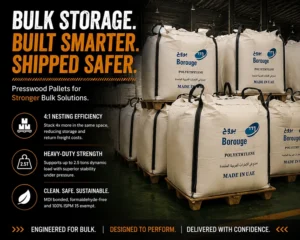
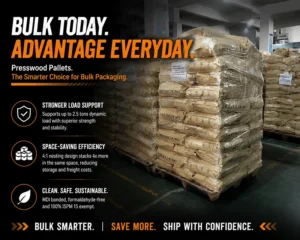
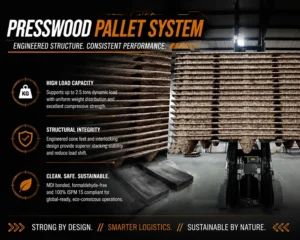
Design references for the chemical lane: a 1140 x 1140 x 135 mm nine-leg drum unit at about 17 kg with 2500 kg dynamic and 7000 kg static load and 96 plus or minus 3 mm fork entry; a 1200 x 800 x 125 mm nine-leg at about 13 to 14 kg with 2000 kg dynamic and 6000 kg static, four-way entry, guide slots and about a 4 to 1 nesting ratio for one-way export and empty pallet return. The photographs above show the two facts a buyer asks for: chemical cans and industrial containers stacked on a molded deck with no fastener in the surface, and the corner and underside close-up of the pressed fibre body with molded ribs, chamfered edges and fork pockets. Before a specification is signed, the reagent goes on the deck: a sample unit is wetted, left to stand and checked, so compatibility is measured instead of assumed. Limits are stated plainly: the USD 180,000 belongs to that published case and is not a forecast; the pallet does not replace the shipper's SDS or REACH duties; the nestable single-face unit is not a long-term racking pallet; and a fumigation-free reading stays a destination rule and forwarder question. The result on the line is a pallet that stops being a corrosion test and becomes a stable, inspectable packaging item, with the rust and splinter path to a quality claim closed at the source.
- One-piece molded body with no nails, no board joints and no separate feet
- MDI polyisocyanate binder, moisture curing, CARB-NAF no added formaldehyde position
- Reagent compatibility confirmed by a sample soak rather than assumed from the material sheet
- USD 180,000 figure attributed to the published Penno Packtech BASF Freeport case record