
Why Dismantled Timber Is Hard to Sell as a Standard Product
A dismantled pallet produces boards of different lengths, thicknesses and grades, usually with fasteners still embedded. The output is not a product with a specification; it is a mixed lot. Buyers of reclaimed timber grade it themselves, and the price follows whichever fraction they can use. Boards that are split, stained or too short are effectively a disposal item with a recovery discount attached.
That is a limitation of the form, not of the wood. Fibre recovered from those boards is still usable material if it can be brought to a defined state. Moulding is relevant here precisely because it does not need a board: it needs fibre of a known size, moisture and cleanliness.
What the Moulding Route Does Differently
In a pressed pallet, the geometry comes from the steel mould rather than from the dimensions of the input pieces. Length variation in recovered slats stops being a grading problem once the material has been reduced to fibre. What replaces it is a new set of requirements that the recovery process has to meet.
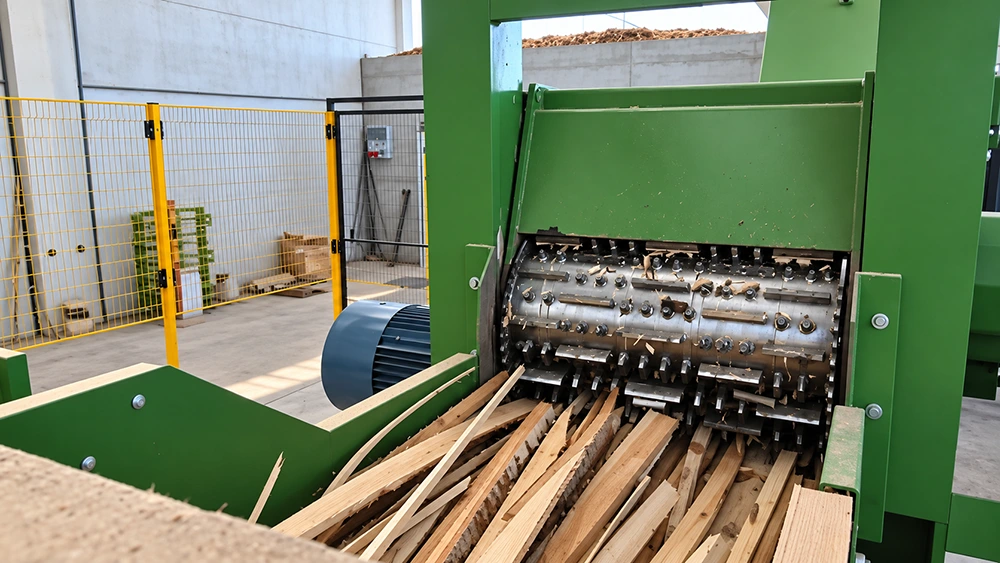
The route runs from nail and contaminant removal, through crushing and drying, into metered binder blending, weighed spreading, hot pressing and take-out stacking. The crushing stage converts mixed slats into a stream; the mould then defines the pallet that comes out. In between, the fibre has to sit inside the geometry and moisture windows the pressing stage works with.
Fastener and metal removal
Nails and staples are the defining contaminant in this stream. Magnetic separation and screening are specified to protect the crusher and to keep metal out of the mould. The acceptable residual level is a technical limit, established against the actual incoming material.
Fibre preparation and moisture
Recovered wood often carries paint, markings, dirt and variable moisture from outdoor storage. Drying brings it into the target band; separation removes what cannot be accepted. Both steps determine what fraction of a load actually reaches the press.
Finished part performance
The performance of the resulting pallet depends on the fibre, the binder system, the tooling and the process settings together. It is not inherited from the original boards, and it is not guaranteed by the press. Trial runs against the intended load requirement are the basis for any performance statement.
What Cannot Be Assumed
It should not be assumed that all recovered pallet wood is suitable. Treated or chemically contaminated timber, material with heavy plastic or laminate content, and loads with a high proportion of fines or rot need to be excluded or assessed separately. Heat-treated or stamped pallets also carry a documentation question that belongs in the receiving procedure rather than in the equipment specification.
Nail removal, crushing, contamination control and finished pallet performance all have to be confirmed for the specific configuration and the specific material. A statement about one recovery stream does not transfer to another.
Where the Commercial Question Sits
A recycling operation considering this route is adding a manufacturing step, with its own labour, energy, binder, maintenance and quality responsibilities. The benefit is that a mixed lot with a limited market becomes an input to a countable product. Whether that is an improvement depends on the reject rate of the incoming material, the cost of preparing it, and the outlet for the finished pallets. Equipment capability is not the same as a viable operation.
Next Step
Characterise a representative batch first: fastener content, board condition, moisture range and non-wood contamination. Those figures decide whether the front end is a simple separation stage or the dominant part of the project.
FAQ
Do all the nails have to be removed by hand?
No. Magnetic separation and screening are the normal approach, but the acceptable residual metal level depends on the incoming load and the configured separation stages. It is confirmed by testing rather than assumed.
Can painted or stamped pallet boards be used?
Not automatically. Coatings, treatments and markings affect both the process and the documentation of the finished product. Each stream needs its own assessment and acceptance rule.
Will the finished pallet be as strong as one made from fresh fibre?
Performance depends on fibre quality, binder, tooling and process settings. It is established by testing the specific combination, not inferred from the source material.
What fraction of a dismantled load is typically usable?
There is no general figure. It depends on how the material was collected, stored and sorted. A reject route has to be part of the layout regardless.
Can we start with a smaller line?
A semi-automatic configuration is possible where capital is limited, but the front-end separation requirement does not disappear. Cutting back on preparation is not a saving if it pushes contamination into the mould.