
What Holding the Material Does Not Give You
A company that already has wood fibre, a chipping operation or a drying stage often assumes it is close to making pallets. It is not. A molded pallet is a pressed, one-piece part formed in a steel mould under heat and pressure. Nothing about owning the input material produces that part. The gap is not a purchase order for one machine; it is the set of operations that turn loose fibre into a dimensionally consistent, load-bearing product that can be stacked, counted and shipped.
This matters commercially because the buyer at the other end is not buying fibre. A buyer specifies a pallet size, a nesting behaviour, a fork entry, a load rating and a delivery schedule. Every one of those requirements is decided downstream of the material, inside the process chain. A supplier that stops at partial processing still has to answer for all of them.
The Stages That Actually Produce a Deliverable Pallet
A complete molded pallet production line is normally discussed as a sequence rather than a list of machines. Each stage changes the material in a way the next stage depends on.
Size reduction and drying
Wood residues arrive as offcuts, chips or mixed scrap. Crushing or pulverising brings them to a fibre geometry the mould can fill evenly. Drying then brings moisture into a controlled band. Both steps exist because hot pressing is sensitive to water: moisture that is not removed before the mould turns into steam during the cycle, and the part that comes out is not the part that was specified.
Glue metering and blending
Binder is dosed and mixed into the dried fibre. The point is not simply that glue is present, but that the ratio is repeatable from batch to batch. A metered dosing pump and a mixing stage remove the guesswork that otherwise shows up as density variation across a run.
Weighed spreading and pressing
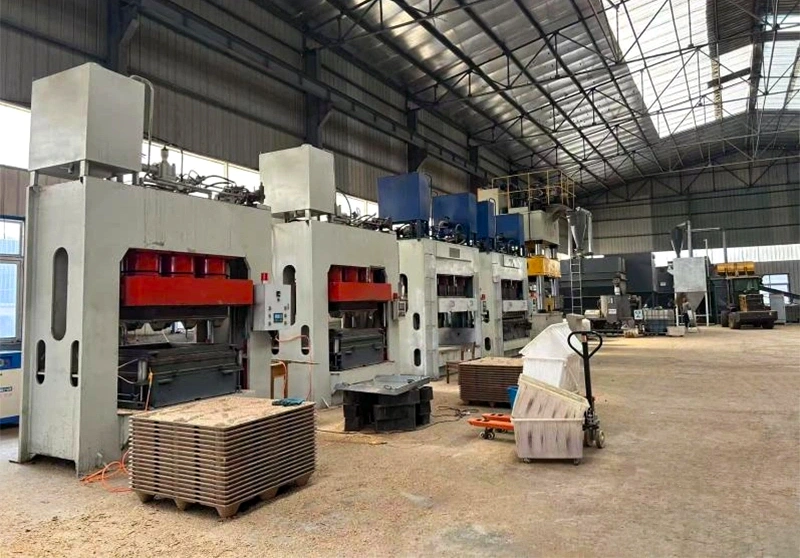
A spreading unit weighs the charge, distributes it across the mould and levels it before the press closes. The hydraulic press then forms the pallet in a heated mould. Once the mould is closed, nothing can be corrected; the charge weight and its distribution decide the finished part. See the mould specifications and presswood pallet machine pages for how tooling and press are specified.
Demoulding and stacking
The formed pallet has to leave the mould and be stacked without distorting while still warm. A take-out and stacking stage closes the chain and sets the pace the whole line has to hold. Finished parts are then countable units, which is the point at which a delivery commitment becomes possible.
Why One Missing Stage Stops the Whole Chain
The stages are coupled, so a weak link does not just reduce output at that point. Fibre that is too wet cannot be rescued by a longer press cycle without affecting the part. A charge that is weighed but poorly spread gives a pallet with uneven ribs. A press without a defined take-out method leaves operators working next to a hot mould, and the line’s real cycle is then set by people rather than by the machine.
This is the practical reason to discuss the chain as a whole. It is also why a project that buys only the forming step often ends up rebuilding the interfaces later, at a point when the layout, power supply and material flow have already been fixed.
How to Assess the Gap in Your Own Operation
Before any equipment discussion, the existing position can be described against a short set of facts:
- What form the fibre is in today, and how consistent that form is across a week of production.
- Its moisture range at the point where it would enter a line, not at the point where it is produced.
- Whether a steady volume is available, or whether supply is seasonal and intermittent.
- Which pallet specification the target buyers actually order, including size and load requirement.
- What floor area, ceiling height and electrical capacity are available for the added stages.
- Where the finished pallets would go, and in what quantities.
Answering those questions produces a layout discussion with real boundaries. The line selection guide is a useful starting point for matching configuration to those constraints.
Where the Scope Has to Be Confirmed
The equipment described here is the process logic, not a fixed bill of materials. Which of these stages are supplied, which are semi-automatic and which the customer already owns depends on the project configuration. Semi-automatic layouts can omit front-end crushing and drying as well as rear-end automatic spreading and robotic take-out, leaving the press and blending stage as the core. That choice is legitimate, but it shifts work back to the customer’s own operation and has to be stated explicitly.
Final equipment scope, interfaces and acceptance conditions are confirmed during technical review and set out in the agreed proposal and contract. Nothing on this page should be read as a promise that a particular stage is included in every configuration.
Next Step
If you already hold fibre or run part of the process, the useful next conversation is a stage-by-stage review of what is missing between your current position and a countable finished pallet. Bring the six facts above and the target pallet specification, and the discussion can stay with the process rather than with brochures.
FAQ
Can we keep our existing chipping or drying equipment?
Often yes, provided its output meets the fibre geometry and moisture band the pressing stage needs. Output consistency matters more than rated capacity, because the mould cannot compensate for variation. Existing equipment should be assessed by sampling its output before it is written into a layout.
Is a press alone enough to start making pallets?
A press forms the part, but it assumes a weighed, blended and evenly spread charge is delivered to the mould, and that the formed part is removed. Without those stages the work is done manually, and the resulting consistency and cycle time depend on the operators. It is a valid starting configuration in some projects, but it is not a complete production chain.
Do we need the fully automatic version?
Not necessarily. Where capital is limited or labour is inexpensive, a semi-automatic configuration that keeps the press and blending stage can be the more sensible first step. The trade-off is higher dependence on manual work and a lower ceiling on repeatability; both should be understood before choosing.
What decides the pallet specification we can make?
The mould decides the geometry, and the press and process conditions decide whether that geometry is produced consistently. Buyer requirements for size, nesting, fork entry and load rating have to be established first, then matched to tooling.
How long before a line produces saleable pallets?
There is no fixed interval that applies across projects. Site preparation, services, tooling, material qualification and process tuning all sit between delivery and steady output. A project that expects to ship perfect pallets immediately after installation is carrying a schedule risk that should be addressed in planning.