
Why a Buyer Wants a Specification, Not a Material
A wood processing plant generates offcuts every day. The problem with selling them is not volume but form: loose, low-density material has few buyers, a short economic transport radius and a price that follows someone else’s demand. It is a by-product with an outlet, not a product with a specification.
A pallet is the opposite. It has a defined footprint, a fork entry, a nesting behaviour, a load expectation and a count. A buyer orders a number of units to a drawing, on a delivery schedule. Turning offcuts into that kind of item is what changes the commercial position, and the change happens in the process chain rather than in the pile of material.
What the Process Chain Adds
AutoML treats qualifying plant fibre as the input to a sequence of operations that each remove one source of variation. The result is a one-piece pressed pallet rather than an assembly of boards.
Fibre geometry and moisture
Offcuts cannot be fed to a mould as they arrive. Size reduction brings them to a fibre geometry that fills a mould evenly; drying brings moisture into a controlled band. Our process documentation describes a reference window for fibre length and thickness at mould entry, but the applicable range depends on the material and the tooling and is confirmed per project.
Metered blending and weighed spreading
Binder is dosed at a controlled ratio and mixed so that the fibre is coated evenly. A spreading unit then weighs each charge and distributes it across the mould. Both steps exist to make one pallet the same as the next, which is the condition a repeat order is written against.
Hot pressing and take-out
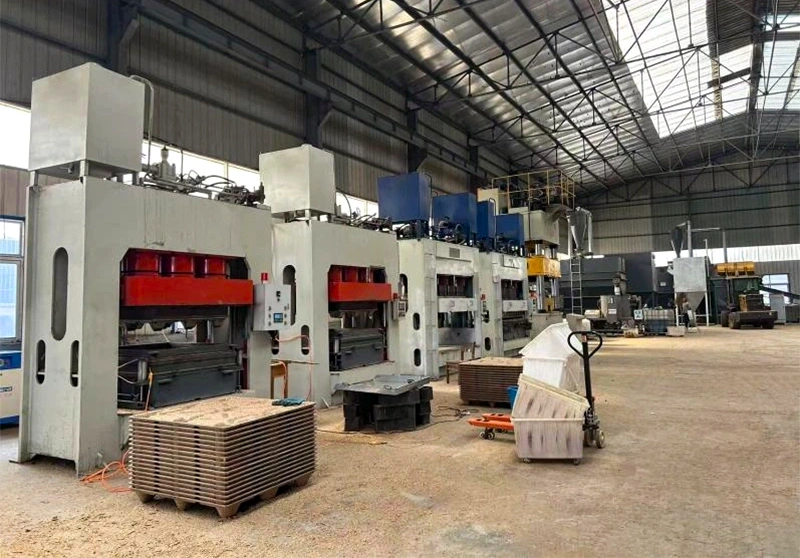
The press forms the part in a heated mould under pressure. Once the mould closes, nothing about the charge can be corrected. Demoulding and stacking follow, and it is at that point that loose offcuts have become countable units that can be shipped. See the molded wood pallet and nine-leg molded wood pallet pages for the product forms, and mould specifications for how geometry is set.
Three Questions That Decide Whether It Is a Business
A line that can make pallets is not the same as a pallet business. Before equipment is discussed, these are the points that have to hold:
- Whether the offcuts can be supplied at a steady volume, in a consistent form, across the whole year.
- Whether their fibre geometry, moisture and contamination level can be brought into the required window without disproportionate cost.
- Which pallet specification a real buyer would order, including footprint, fork entry and load requirement.
- Whether the output is for internal use or for sale, since the two have different acceptance and documentation paths.
- Whether local or export demand exists at a volume that matches a line’s minimum sensible output.
- What the alternative outlet for the offcuts is worth today, so the comparison is made against a real number.
The line selection guide helps connect those answers to a configuration. A project that only needs pallets for its own despatch has a different scope from one that intends to supply outside customers.
Where the Scope Has to Be Confirmed
The pallet market, the target specification and the suitability of the offcuts all require project verification. Equipment capability does not establish a buyer, a price or an accepted specification. Pallet dimensions, fork openings, load rating and transport suitability are confirmed against drawings and test results, not inferred from the fact that a mould exists.
Some offcuts will not qualify without additional preparation, and some will not be economic to prepare at all; sampling and trial runs settle that. The final equipment scope, the product specification and the acceptance conditions are confirmed during technical review and set out in the agreed proposal and contract.
Next Step
The most productive starting point is a description of the offcut stream and a description of the pallet a buyer would actually accept. With both on the table, the discussion can stay with the process needed to join them rather than with assumptions about what the material is worth.
FAQ
Can all offcuts be used as moulding fibre?
No. Geometry, moisture and contamination decide suitability, and mixed or treated material may need preparation that is not economic. Sampling and trial runs are the only reliable way to establish which fractions qualify.
Should we find a buyer before specifying a line?
Yes, in practice. The buyer’s drawing determines the mould, and the mould determines a large part of the configuration. Specifying tooling before the target specification is known tends to produce pallets that are easy to make and hard to sell.
Is internal use simpler than selling pallets?
It removes the external sales function but not the specification question. An internal user still needs a footprint, fork entry and load behaviour that suit its own loads and handling equipment, and those still need to be verified.
How much fibre goes into one pallet?
It is set by the mould, the target density and the charge weight agreed for that specification. It is not a fixed number that transfers between pallet designs, so it is established during tooling and process trials.
Is a semi-automatic configuration an option for a first step?
It can be. Keeping the blending and pressing stages and handling part of the front end manually lowers the entry capital, at the cost of higher dependence on operators and a lower ceiling on repeatability. Whether that trade is acceptable depends on the volumes in the answers above.