
What the Export Buyer Actually Specifies
An export packaging requirement is rarely just a footprint. The pallet has to suit the load, the container or trailer it is packed into, the forklift or pallet jack that moves it, and the stacking pattern used in transit. The buyer may also specify a nesting behaviour for empty returns, a weight limit, a marking and a document set. Each of those is a property of a delivered unit, not of a material.
This is where hand-built wooden pallets create friction: dimensions and fork openings are produced by an operator’s work rather than by a fixed tool, so a batch can vary around the drawing. A buyer that packs high-value cargo wants the variation removed from the process, not inspected out afterwards.
What a Matched Mold Fixes
Geometry is set by tooling
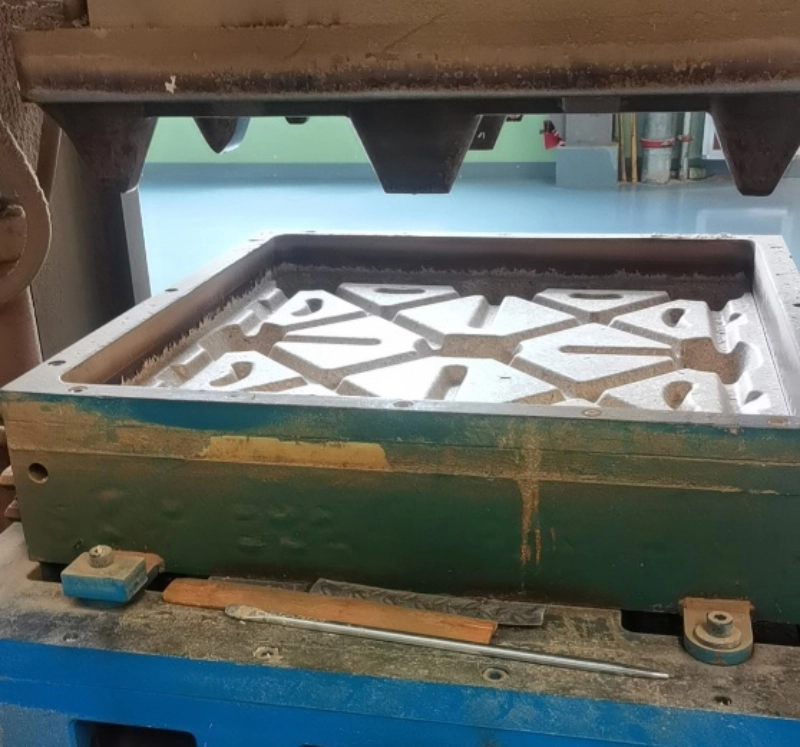
In a molded pallet line the footprint, leg or stringer form, fork openings and rib pattern are cut into the steel tool. Every cycle closes on the same cavity, so the geometry does not depend on who is working that shift. The mould specifications and pallet moulds pages describe how tooling is matched to a target pallet.
Charge weight is set by weighed spreading
An automatic spreading unit weighs the fibre charge before distributing and levelling it across the mould. Holding the charge weight from one cycle to the next holds the density and the finished weight within the range the process was set for. Combined with a controlled moisture band and a metered binder ratio, this is what makes a production run describable as repeatable. The hydraulic press then holds the temperature, pressure and dwell for each cycle.
What neither of them establishes
A tool fixes geometry; it does not by itself establish a load rating, a racking behaviour or transport suitability under a specific cargo. Those are verified against the drawing and by test on the finished product, with the packing pattern and handling equipment in view. A repeatable part still has to be the right part.
Turning a Packaging Requirement Into Tooling
Before a mould is ordered, the packaging requirement has to be written in terms a toolmaker and a process engineer can act on:
- Footprint and the tolerances the buyer will accept, including any diagonal or squareness requirement.
- Fork entry direction, opening dimensions, and the handling equipment that will actually be used.
- Static, dynamic and, where relevant, racking load requirements and the test method behind them.
- Container or trailer loading pattern, stack height and any nesting requirement for empty returns.
- Target pallet weight, surface requirements and any marking or identification to be moulded in.
- The document set the buyer expects with each delivery, and who signs off the first article.
The quality certification page is a useful reference for the product-level documentation side of that list; the line selection guide covers the configuration side.
Where the Scope Has to Be Confirmed
Pallet dimensions, fork openings, load rating and transport suitability are confirmed against drawings and test results, not assumed from the existence of a mould. A single tool produces one geometry; additional specifications require additional tooling or a changeover arrangement, and the changeover affects cycle rhythm, cost and scheduling. It is not correct to promise that one configuration covers every export specification a buyer might request.
The tooling scope, the number of specifications to be produced, the test route and the acceptance conditions are confirmed during technical review and set out in the agreed proposal and contract. Sample approval should be part of that process rather than an afterthought at the first shipment.
Next Step
Bring the buyer’s pallet drawing and the packing pattern, and the tooling discussion can be held against a fixed target. That is the point at which repeatability becomes a specification rather than a claim.
FAQ
Can one mould make several pallet sizes?
A mould cavity produces one geometry. Other sizes or fork arrangements need separate tooling or a changeover design, and the changeover has an effect on output and scheduling that should be costed before it is promised.
What changes if the buyer alters the footprint?
The tool and the charge weight are the main items, along with the spreading pattern and the test route for the new part. It is a tooling project, not a parameter adjustment.
How is load rating confirmed?
Against the agreed drawing and by testing the finished pallet under the conditions the buyer specifies. Process repeatability and load performance are related, but one does not substitute for the other.
Does weighed spreading remove the need for inspection?
No. It reduces variation at the source, which makes inspection more meaningful and less wasteful, but first-article approval and ongoing checks still belong in the quality plan.
What do we need to supply for a tooling quotation?
The pallet drawing with tolerances, the load and handling requirements, the target volume, the packing pattern and the documentation the buyer expects. With those, a mould can be specified against a defined part.