 | Are your palletizing robots constantly halting because a warped wooden board tripped the laser sensors? Or perhaps your warehouse is overflowing with unstackable empty pallets, leaving no room for finished corrugated boxes? When your automated packing line is forced to stop due to dimensional inconsistencies or nail pops tearing through bottom-layer cartons, you are losing throughput by the minute. It’s time to upgrade your end-of-line logistics. |
Why Traditional GMA Pallets Are Choking Your Automated Packing Lines
In high-speed corrugated box manufacturing and automated bagging facilities, precision is everything. Before: Your automatic palletizer is programmed to drop loads at exact coordinates. However, traditional GMA wood pallets suffer from severe dimensional variations due to moisture swelling and manual assembly. A pallet that is off by just half an inch will trigger sensor misreads, causing the robotic arm to freeze and halting your entire 24/7 production line. Even worse, protruding nails and splinters instantly puncture the bottom layer of your cardboard boxes or agricultural feed bags, creating immediate product loss before the load even leaves the dock.
The Dimensional Consistency Logic: How It Works
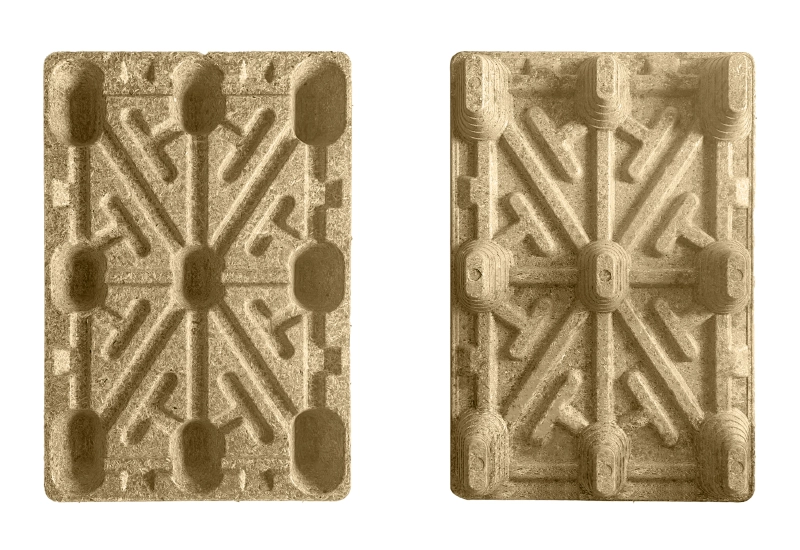
Why it works: The compressed wood pallet is manufactured using a 1600-ton servo-controlled hydraulic press. Wood fibers and formaldehyde-free MDI adhesive are fused under 220℃ heat in a precision steel mold. This one-piece construction guarantees a dimensional tolerance of strictly ±2mm (±0.07 inches).
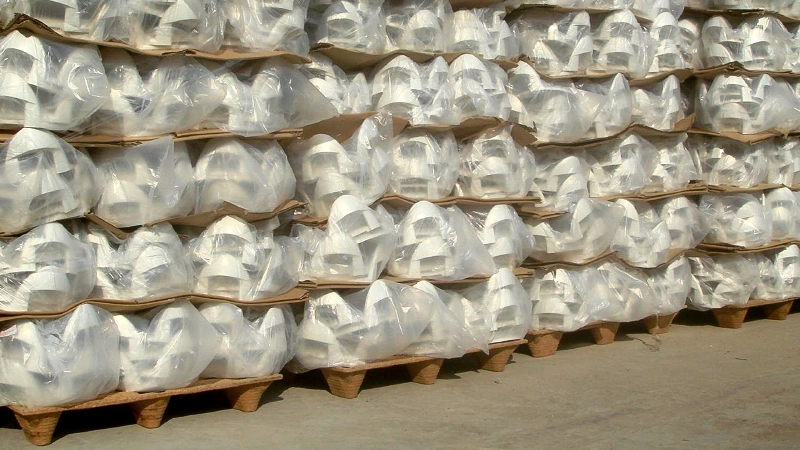
After: When this perfectly uniform molded wood pallets enters your automated stretch wrapper or palletizer, the laser positioning systems read it flawlessly every single time. Because there are absolutely zero metal fasteners (nail-free design), the flat top surface cradles your fragile corrugated boxes and bagged goods securely. You eliminate bottom-layer box damage and drop your line-jamming incidents to zero.
Reclaiming Your Packaging Warehouse with 4:1 Nestability
Before: A packaging supplier typically gives away the pallet as a carrier for their boxes. Storing hundreds of bulky, non-nestable solid wood pallets eats up massive amounts of premium floor space. A stack of 50 traditional pallets towers at 17.7 feet, creating a chaotic and cramped finished goods area.

Why it works: Designed with patented inverted cone support legs, these pallets nest perfectly into one another. The void spaces of the bottom pallet swallow the legs of the top pallet.
After: That same stack of 50 nested pressed wood pallet units now measures just 6.8 feet high. You instantly compress your empty pallet storage footprint from 1,600 sq. ft. down to just 430 sq. ft., freeing up 75% of your warehouse space for revenue-generating packaging inventory. Furthermore, weighing in at just 28 lbs (compared to a 48 lb wooden pallet), your dock workers can handle them effortlessly without risking back injuries.
Seamless AGV and Forklift Interaction
Fast-paced dock bays cannot afford operators struggling to align forks. This engineered one way pallet features a standard 4-way entry with dedicated guide slots.
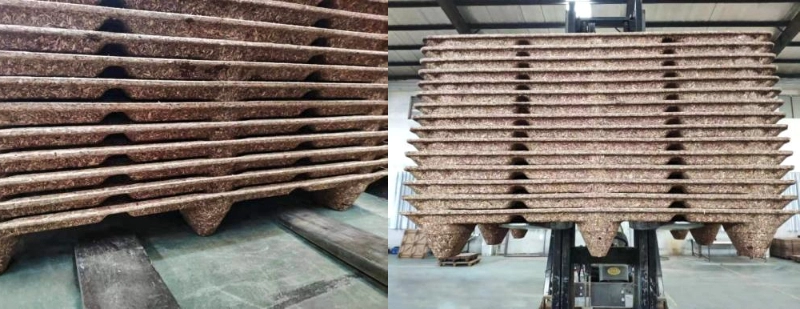
Whether your facility relies on manual pallet jacks, yellow combustion forklifts, or laser-guided AGVs, the forks glide smoothly into the 3.5-inch clearance without catching or splintering the wood. This optimized entry angle boosts loading speed by up to 15%, keeping your automated logistics chain moving at peak efficiency.
Frequently Asked Questions for Automated Packing Facilities
1. Will the compressed wood pallet trigger sensor errors on our palletizing robots?
No. Because they are molded in precision steel dies, they maintain a strict ±2mm dimensional tolerance. This guarantees zero misreads from your automated line’s laser positioning sensors.
2. Can these pallets handle the weight of double-stacked corrugated boxes or feed bags?
Absolutely. They boast a high dynamic load capacity of 2.5 Tons (approx. 5,500 lbs) and a static load of up to 7 Tons, easily handling heavy, multi-layered stacks of packaging materials without buckling.
3. Are there any nails that could puncture our bottom-layer cartons?
No. The one-piece hot press molding process completely eliminates the need for nails, staples, or any metal fasteners, ensuring your fragile packaging products remain 100% intact.
4. Do we need ISPM 15 heat treatment stamps if we ship our packaging overseas?
No fumigation is required. These pallets are classified as “processed wood” under international guidelines, making them naturally ISPM 15 exempt and ready for immediate export without customs delays.
5. How much warehouse space can we realistically save?
Thanks to their 4:1 nestable design, you can store up to 2,500 nested pallets in the same footprint that would normally only hold 1,000 traditional wooden pallets, reducing your empty pallet storage area by over 70%.