Batch Delivery Stability
The call-off got stricter while the production rhythm stayed human
A buyer that raises the delivery-stability requirement is not asking for a faster machine, it is asking for a batch date that survives three shifts, a new crew and a change of fibre. On an AutoML presswood pallet machine the pace of a run is set by the press cycle and the back-end take-out rather than by how many experienced hands are standing on the floor, which finally gives a supplier a production rhythm it can plan a call-off against.
What AutoML changes: the beat moves to the press cycle and the take-out
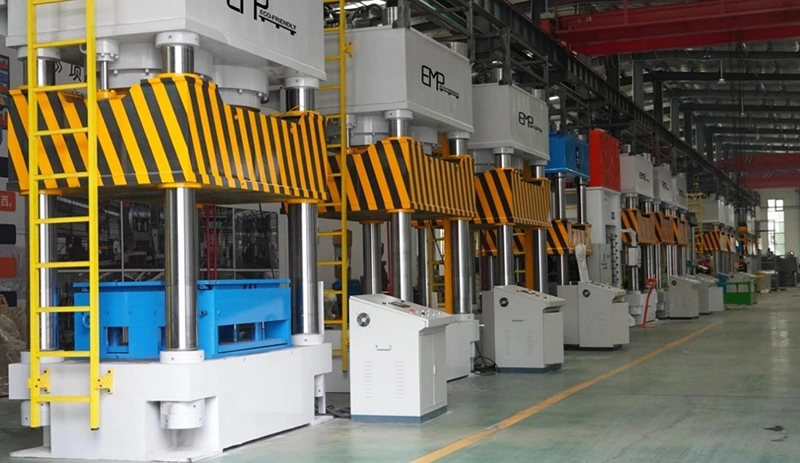
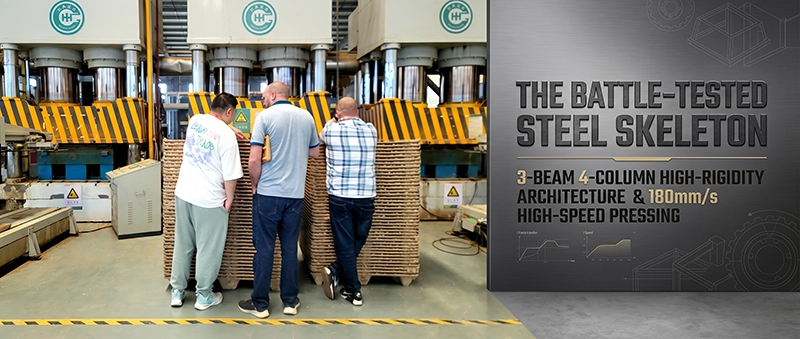
AutoML is not a single press but a sequenced line, and wood waste to pallet conversion starts upstream: crushing, drying, metered glue mixing, rail-mounted weighing and dosing spreading, hot pressing, demolding, then take-out and conveyor stacking. Because every stage is fed by the one before it, the equipment carries the beat. The hydraulic press cycle becomes the fixed interval, and the back-end take-out releases the cured pallet on the press open signal, so the next cycle does not wait for a person to walk to an open mold held at 150 to 180 degrees Celsius. The structure is visible rather than claimed: a row of four-column presses each with its own control cabinet, dosing hoppers standing above the tooling, servo take-out arms and powered roller conveyors. A supplier can walk that flow on an automated pallet manufacturing line, read the rhythm off the equipment and stop reading it off the shift list.
The figures a batch plan is actually built on
The planning values are ordinary engineering references, stated as references and not as guarantees. Press tonnage runs a 1200T to 2200T ladder, with a 1600T class press as the common reference for this build. Hot pressing sits at about 150 to 180 degrees Celsius and 15 to 20 MPa on a cycle of roughly 180 to 240 seconds, at a finished density of about 0.8 to 1.2 grams per cubic centimetre, with MDI commonly around 8 to 10 percent and UF or PF around 10 to 12 percent. One fully automatic press is planned at about 12 pallets an hour for a stated configuration. The recorded pressing force curve next to a stack inspection is the evidence for the argument: the batch is planned on a curve, a cycle count and a weighed fibre charge, not on how fast a crew happened to work that night, which is what separates this from a sawdust pallet making machine fed by hand.
What a supplier can commit, and what still decides the date
With a machine beat, a batch plan can be built from press hours: presses multiplied by cycles per hour, multiplied by shift hours, then reduced by planned stops, mold changes and maintenance windows. That gives the sales team a capacity number it can hold in a call-off meeting and defend when the crew changes. It is deliberately not a delivery promise. Real lead time still has to be counted with unplanned downtime, fibre on hand, moisture and glue trial data, shift pattern and the drying capacity behind the press, and tonnage, mold and cycle for a specific pallet are confirmed per project in the technical agreement. Automation does not remove training, guarding or shop-floor management either, and a fumigation-free reading of a molded pallet stays a destination rule and a forwarder question. What changes is where the uncertainty sits: in an equipment schedule that can be measured, rather than in a roster that cannot.
- The batch date is framed on the press cycle and the back-end take-out, not on crew size or operator experience
- Numeric references are limited to the 1200T to 2200T tonnage ladder, a 1600T class press, 150 to 180 degrees Celsius, 15 to 20 MPa, a 180 to 240 second cycle, 0.8 to 1.2 grams per cubic centimetre and about 12 pallets an hour for a stated configuration
- Lead time is stated as a calculation from press hours, downtime, fibre and shifts rather than as a delivery guarantee
- Both images are drawn from the resolved AutoML designer gallery and the on-page call to action routes to /contact/ for a configuration and capacity review