Molded pallet production line · batch structure repeatability
Where the copy breaks: one structure, several pairs of hands, three shifts
A hand-assembled pallet is a record of the shift that built it: boards graded by eye, runners positioned by hand, feet squared against a jig, fasteners driven one at a time. Run that same structure across three shifts and a thousand units and the copy drifts in mass, deck plane, foot position and fork entry, while the buyer's specification only names one pallet. AutoML is the EMP compressed wood pallet machine line that moves the structure out of the workstation and into a steel mold, hot pressing wood fibre into a one-piece pallet on a 1600T class press at 150 to 180 degrees Celsius. This page follows one structure from a manual assembly bench to a molded pallet production line, and states what the mold fixes and what the plant still has to prove on its own fibre, its own crew and its own samples.
Why a mold, not a faster pair of hands, is what copies a structure
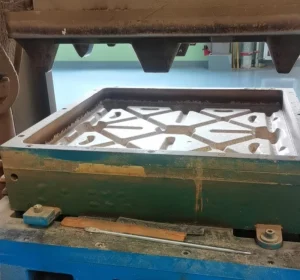
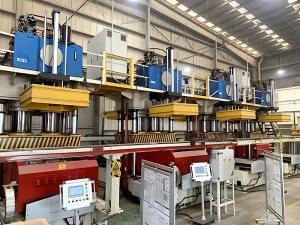
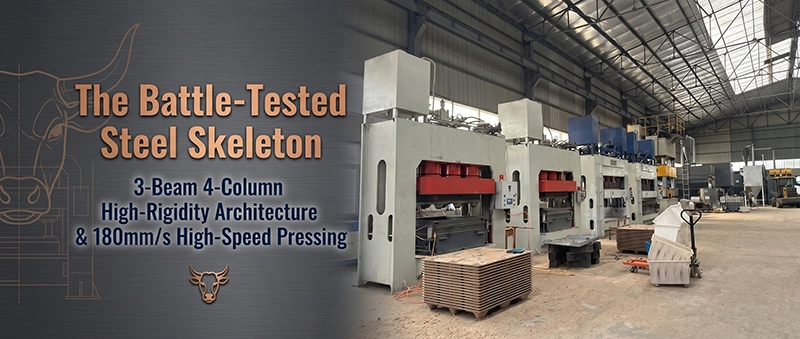
The AutoML answer is to stop copying the pallet with people and start pressing it in a cavity. The deck, the reinforcing ribs, the support feet, the fork entry recesses and the edge chamfers are cut into one steel mold, and a hydraulic hot press closes on a weighed charge of glued wood fibre and forms the entire pallet as a single body in one cycle. Nothing is positioned by an operator during forming, because there is nothing left to position: the geometry of the unit is the geometry of the tool. That is also why the process reads as a nail-free wooden pallet process rather than an assembly process, and why a worn unit is replaced rather than re-boarded. On a semi-automatic line the operator still feeds and supervises; on an automated pallet manufacturing line the weighing and dosing spreader, the glue mixer, the demolding unit and the stacking conveyor carry the handovers. In both configurations the part that decides the structure has moved off the bench and into the mold.
What the press and the mold actually hold, and the numbers to write into a specification
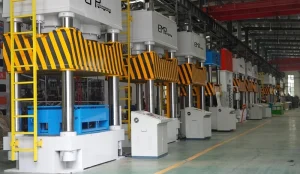
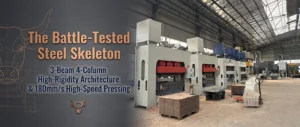
Three things have to be fixed before a structure repeats: the cavity, the pressing window and the material going into it. In the EMP configuration the mold is cut to the customer footprint, with common references across 1000 x 1000, 1100 x 1000, 1200 x 1000 and 1219 x 1016 millimetre sizes and custom tooling beyond them. The press runs a 1600T class machine inside a tonnage ladder that also covers 1200T, 1250T, 1800T and 2200T, with hot pressing at 150 to 180 degrees Celsius, 15 to 20 MPa and a cycle of about 180 to 240 seconds, forming a finished density of roughly 0.8 to 1.2 grams per cubic centimetre. Upstream, fibre is crushed and dried, then metered by a rail-mounted weighing and dosing spreader with belt feeders and blended in a metered glue mixer, with MDI commonly around 8 to 10 percent and UF or PF around 10 to 12 percent. The evidence a buyer can hold is the press force and displacement record for the cycle, and the cured stack itself: deck plane, foot geometry, edge finish and stack registration inspected unit after unit, not sample by sample.
What the plant still has to prove before repeatability becomes a guarantee
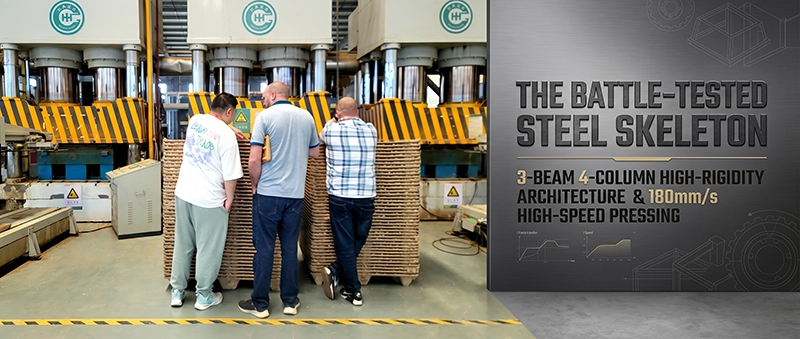
A mold is a starting condition, not a certificate. Structure, size and load performance follow the mold design, and any new footprint, foot pattern or load class is a new tool that has to be validated on samples and on the test method both sides agree, so the repeatability claim belongs to the confirmed specification rather than to the machine in general. Tonnage, mold and cycle are confirmed per project in the technical agreement, because the same press behaves differently on a nine-leg single-face unit and on a cross-base double-face build. Moisture and glue ratio are matched to the glue system from trial data on the customer's own fibre, not copied from a data sheet, and a maintained cavity, a controlled charge and a clean die face are what keep the copy inside its window over a year of shifts. Once those conditions hold, the plant is no longer managing consistency through supervision: the hand assembly steps are gone, the structure is set by tooling, and batch consistency becomes a tool maintenance and process confirmation task with a record behind it. If you are specifying a compressed wood pallet machine around one fixed pallet structure, send the drawing, the load class and the annual volume, and the line configuration, mold scope and pressing window can be worked out against them.
- Structure, size and load performance are confirmed by mold design and by sample validation against an agreed test method
- Tonnage, mold, cycle and station configuration are confirmed per project in the technical agreement
- Moisture content and glue ratio follow trial data for the chosen glue system rather than a universal fixed value
- One-piece bodies are replaced rather than repaired, and fumigation-free use stays a destination rule and forwarder question