
Are your LTL freight bills and warehouse leases being consumed by empty wooden dunnage? Every time you ship or store traditional 48×40 GMA pallets, you are paying to move “air.” For export packaging and bulk goods logistics, the inability to nest empty pallets means your trailers “cube out” long before they weigh out, devastating your reverse logistics ROI and eating up valuable staging space.
The “Before”: The Hidden Costs of Shipping Air
In the high-volume world of corrugated box manufacturing and bagged agricultural exports, logistics managers face a persistent bottleneck: the physical footprint of the delivery vehicle. When supplying packaging materials to your downstream clients, or managing a deadhead run to retrieve empty pallets, traditional solid wood pallets become a massive liability. Because they cannot stack efficiently, a standard 53-foot trailer quickly hits its volumetric limit. You end up deploying three trucks to move a load of empties that should realistically fit into one. Furthermore, those bulky pallets take up prime real estate in your finished goods warehouse—space that should be generating revenue, not storing dunnage.
Beyond the spatial waste, forklift operators constantly battle nail pops and splinters. When loading delicate corrugated boxes or 208L chemical drums, a single protruding nail on a traditional pallet can puncture the bottom layer, leading to rejected loads, chemical spills, and expensive insurance claims. Supply chain directors are aggressively seeking wooden pallet alternatives that eliminate these operational hazards while slashing freight spend.
The Engineering Logic: How 4:1 Nestability Alters Freight Economics
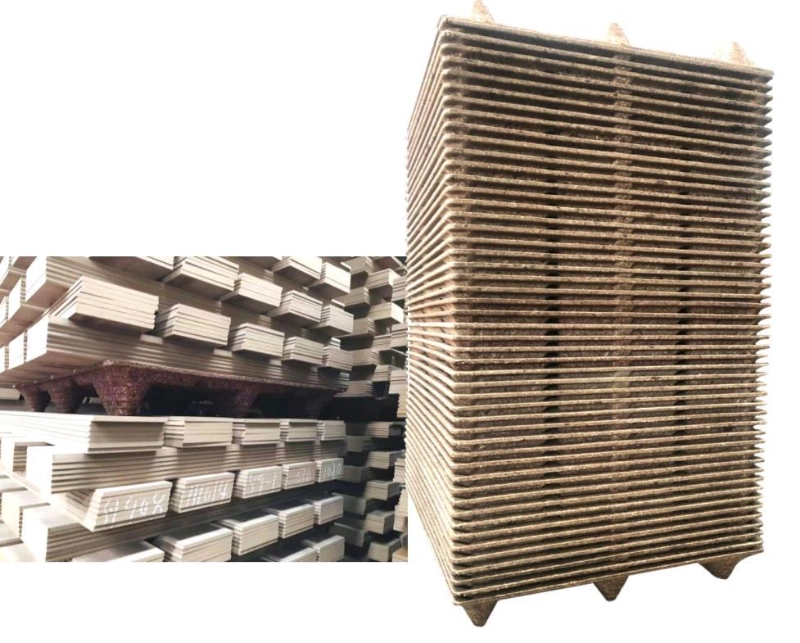
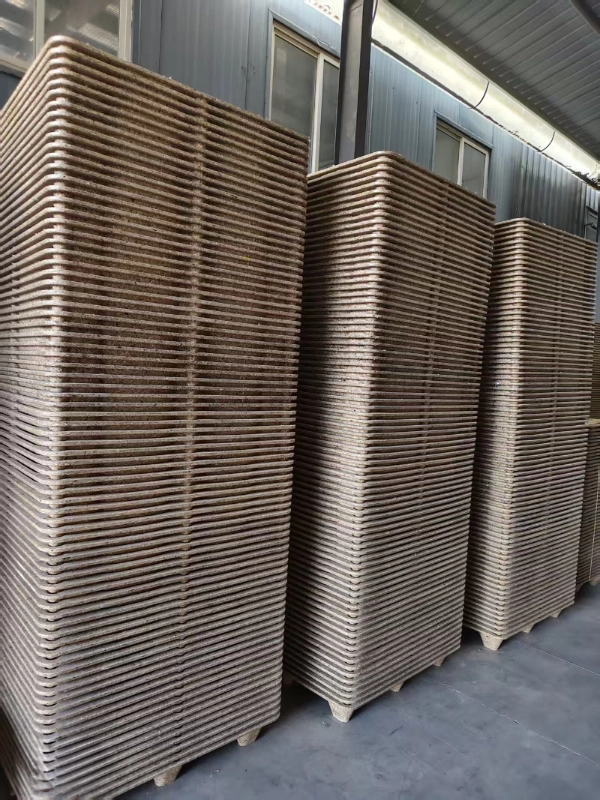
The freight savings generated by a pressed wood pallet are rooted in its geometric design. Utilizing a patented inverted cone design for the pallet legs, the bottom of one pallet perfectly slides into the guide slots of the one below it. This creates a high-density nesting profile.
Let’s look at the hard numbers: a stack of 50 traditional wood pallets towers at roughly 216 inches (18 feet), requiring multiple trips to move and massive rack space to store. In stark contrast, 50 nested presswood pallets compress down to just 82.6 inches (2.1 meters). This 4:1 space-saving ratio means you can increase your warehouse storage density by 250%. For a corrugated box supplier previously dedicating 1,600 sq ft to pallet storage, this footprint shrinks to just over 430 sq ft. When loading delivery trucks, you can slash your LTL (Less Than Truckload) shipment frequency by 60%, directly dropping fuel and labor costs to your bottom line.
The “After”: Shedding Dead Weight in Export Shipping
Weight is the enemy of profit in air freight and transoceanic shipping. A standard solid wood pallet weighs around 48 lbs. The equivalent molded wood pallets weigh in at just 28 lbs (approx. 13kg). When you load a standard 40HQ container with 40 pallets, you are instantly stripping 800 lbs of dead weight from your shipment. In an air freight scenario where volumetric weight penalties are severe, this lightweight profile allows you to pack more actual sellable product onto every flight.
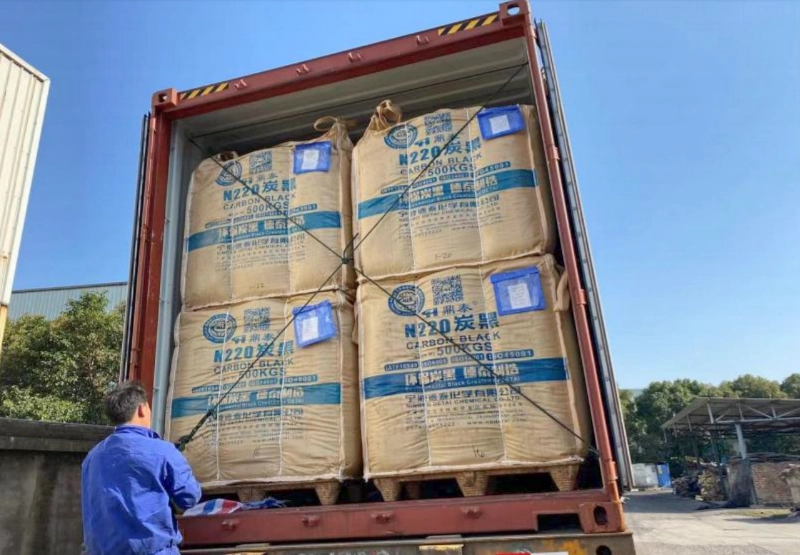
Moreover, for international supply chains, customs holds are a nightmare. Because these units are manufactured under extreme heat and pressure using MDI adhesive, they are globally recognized as “processed wood.” This grants them natural ISPM 15 exemption. As the ideal export pallets, they require no heat treatment stamps or fumigation certificates. Your shipments sail through European and North American ports without the risk of quarantine delays, making them the most reliable one way pallet solution for cross-border logistics.
Seamless Integration with Dock Operations
Beyond freight savings, the operational workflow on the loading dock changes dramatically. The one-piece molded construction means zero nails, zero staples, and zero splinters. When your stretch wrapper secures a load of bagged goods to the pallet, there are no sharp edges to tear the film.
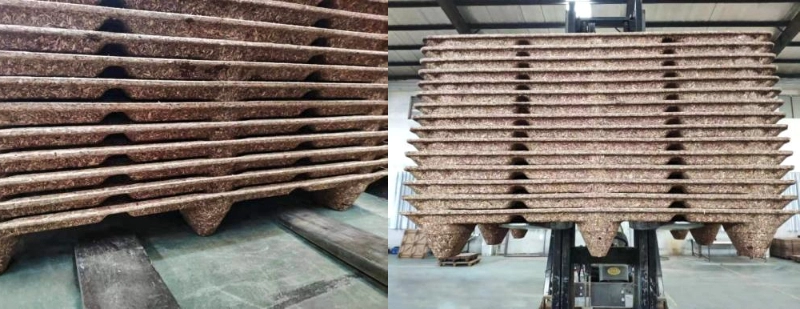
For the forklift operator, the standard 4-way entry and precision-engineered guide slots allow the tines to glide effortlessly into the nested stack. Instead of manually wrestling with heavy, broken wooden boards to separate a stack, the operator can smoothly lift the exact number of pallets needed, increasing container loading speeds by up to 15%. The dimensional consistency (±2mm tolerance) also ensures seamless compatibility with automated palletizing lines, eliminating the sensor faults commonly caused by warped wood.
Frequently Asked Questions (Logistics & Freight)
| How much warehouse space can I actually save with nestable pallets? | Due to the 4:1 nesting ratio, 50 empty presswood pallets stack to just 82.6 inches high. Compared to standard GMA pallets, this frees up approximately 70% of your dedicated pallet storage space, allowing you to store more finished goods. |
| Will these pallets survive heavy double-stacking in sea containers? | Yes. Engineered with a 2.5T dynamic load capacity and flat surface design, they distribute weight evenly. This prevents the “point pressure” that causes bottom-layer corrugated boxes or bagged goods to crush during transoceanic transit. |
| Are there any hidden customs fees for export shipping? | No. Because they are molded under 1600 tons of pressure and high heat, they are classified as “processed wood.” They are naturally ISPM 15 exempt, meaning you completely bypass fumigation costs, certificate fees, and customs hold risks. |
| How does the weight difference affect my LTL or air freight costs? | A presswood pallet weighs roughly 28 lbs, which is about 40% lighter than a standard wooden pallet. This significant reduction in tare weight directly lowers your LTL freight class costs and eliminates heavy volumetric weight penalties in air freight. |
| Can our existing forklifts and pallet jacks handle the nested stacks? | Absolutely. The pallets feature standard 4-way entry with an entry height of 90mm-95mm. The bottom guide slots are specifically designed so standard forklift tines can slide cleanly into the bottom of a nested stack without requiring manual separation. |