CIRCULAR MATERIALS FOR PALLET POOLING AND RECYCLING OPERATORS
Why pooling and conventional recycling do not close the loop
Pallet pooling can extend the useful life of transport assets, but repair and redeployment do not eliminate material loss. Wooden pallets may be repaired, downgraded for less demanding uses, and eventually discarded when damage or quality variation makes further service impractical. AutoML provides a controlled route for qualified wood residues to become new molded, nail-free pallets. The opportunity is not a universal zero-waste promise. It is an operational objective built on suitable feedstock, process control, and traceable material accounting.
How recovered wood residues can enter AutoML production
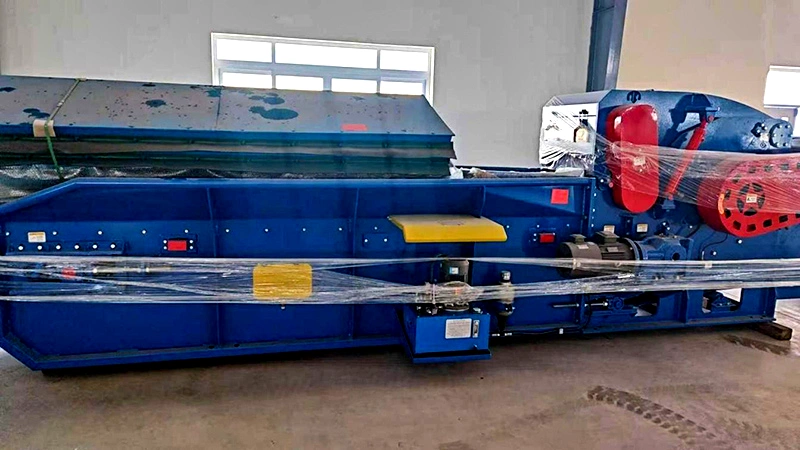
The physical route begins with a controlled feedstock stream. Recovered wood pallets and repair residues, along with sawdust, shavings, wood chips, straw, bamboo powder, bagasse, or other suitable plant-fiber materials, are prepared for the line. The documented process uses a hammer crusher with electromagnetic iron separation, followed by drying and dust collection. Particle size and moisture are not universal settings: the product files reference particle dimensions of approximately 5–30 mm in length and 2–5 mm in thickness, while moisture must be matched to the selected adhesive system and confirmed through trials. After drying, material is conveyed to a buffer and then to the glue mixer. MDI is commonly referenced at about 8–10% dosage, while UF or PF is commonly referenced at about 10–12%, but the actual formulation remains project-dependent. The mixed material is weighed and spread into the mold before hot pressing, demolding, and stacking. Operators should document incoming mass, rejected material, moisture, adhesive consumption, and finished output so that recycled content is measurable rather than assumed.
How end-of-life presswood pallets can re-enter the process
The source documentation identifies a direct recovery step for rejected or end-of-life molded pallets: they can be returned to the front-end crusher, reduced back into feedstock, and used again in the material process. In an operating plant, that step should remain inside the same qualification discipline as other recovered inputs. The operator needs to confirm that the material is compatible with the planned crushing, drying, adhesive, and molding process, and then verify the resulting density, strength, curing behavior, and surface condition through production trials. This is especially important when the adhesive history of returned material is not fully traceable or when the feedstock mix changes. The loop therefore consists of collection, controlled preparation, size and moisture management, adhesive dosing, spreading, pressing, and inspection—not an assumption that every pallet can be repeatedly remade without limits.
How to pursue zero-waste goals without greenwashing
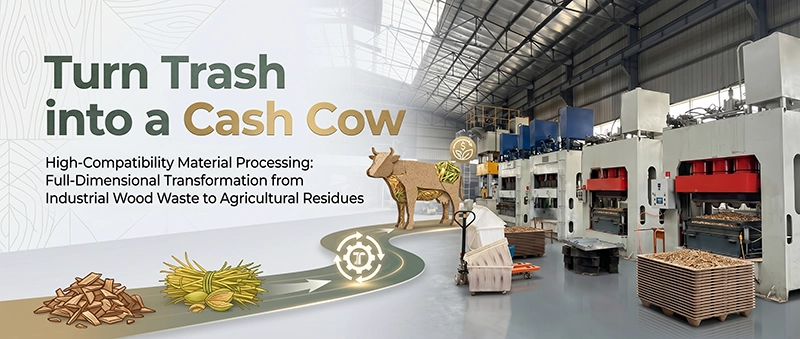
A credible zero-waste program should be stated as a target supported by evidence, not as a blanket product claim. Define which streams are accepted, how they are weighed, where metal and unsuitable contaminants are removed, and how rejected material is recorded. Track the mass balance from recovered input to finished pallets, process losses, and material returned to the crusher. Separate verified process capability from project-specific results: moisture, glue ratio, pressing time, density, output, and payback vary with the adhesive, mold, raw material, and operating conditions. Be transparent about trade-offs. MDI can support demanding applications but is costlier and can increase mold-sticking and cleaning requirements; UF or PF may reduce adhesive cost but may face end-market and environmental constraints. The strongest sustainability statement is therefore specific: AutoML can support a traceable wood-residue recovery loop when inputs are qualified, the line is properly configured, and performance is validated in the customer’s process.
- The article distinguishes pallet reuse, repair, downgrading, and material recovery from a universal zero-waste claim.
- The described recovery route uses documented steps: crushing with iron separation, drying, adhesive mixing, dosing and spreading, hot pressing, demolding, and stacking.
- Moisture, adhesive dosage, performance, and payback are presented as project-dependent rather than guaranteed universal values.
- End-of-life presswood pallet re-entry is framed as a qualified, traceable process that requires input control and production validation.


