DRYR | AIRFLOW SAWDUST DRYER COMPARISON
When an Airflow sawdust dryer search becomes a production decision
Airflow sawdust dryer projects are often considered when a pellet, molded pallet, charcoal briquette, MDF, or organic fertilizer line needs faster moisture reduction. The more important question is whether a small hand welded machine can deliver stable continuous sawdust drying. Dryr is a standardized rotary sawdust dryer with an assembled structure and optional PLC control for repeatable operation, with model capacities from 0.8 to 2 t/h and a documented output moisture target below 10 percent.
Why hand welded and manual drying creates avoidable risk
The low cost alternative is often a small hand welded drum machine or manual and open air drying. Some local machines are built with manual welding and depend on workmanship to keep the drum round. That can mean inconsistent alignment, less predictable rotation, more maintenance exposure, and no automatic operating sequence. Natural sun drying is slower and depends on weather and floor space. A small airflow dryer or sawdust flash dryer may suit fine, low moisture material in a limited duty application, but it should not be treated as a universal replacement for a rotary drum dryer. The correct comparison starts with feed moisture, particle size, target output, fuel, dust control, and required operating hours.
Why Dryr is a better fit for continuous industrial drying
Dryr fits plants that need continuous sawdust drying before pelletizing, molding, briquetting, board production, or organic fertilizer processing. Its role is to reduce moisture before the next process, not to replace an engineering assessment. The assembled structure is manufactured and prepared as a system rather than left for local technicians to recreate the main drum on site. This supports dimensional consistency and makes split shipment assembly more practical for long equipment. Optional PLC control can coordinate continuous feeding and operation, reducing routine manual intervention. For a molded pallet production line, the decision should be based on whether raw material moisture is unstable enough to justify a dedicated sawdust dryer for molded wood pallet production.
Structure and parameter evidence behind the comparison: Airflow sawdust dryer versus rotary drum dryer
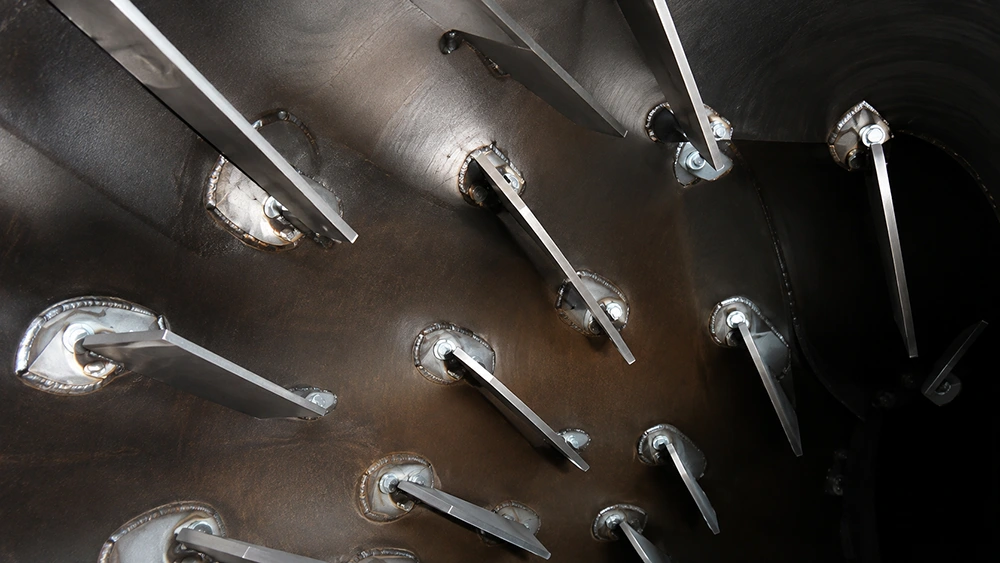
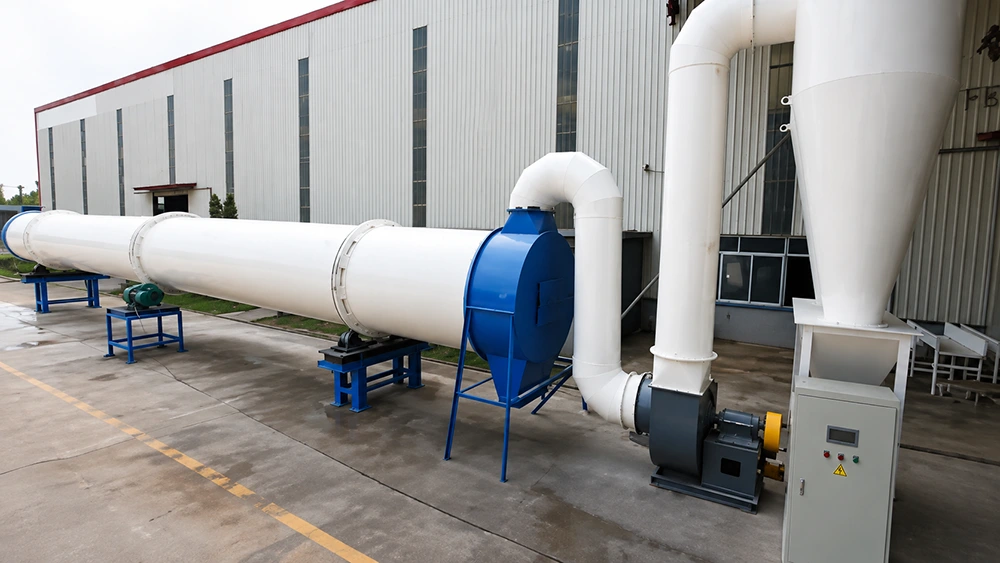
The machine uses a hot air furnace, rotary drum, conveying, and dust control sections as a continuous processing unit. Inside the drum, staggered lifting plates raise and disperse the material so hot air can contact more of the sawdust before the material moves forward. The chamber interior photo shows the metal paddle bars, welded mounting plates, bolted hubs, and continuous weld details that support this working principle. The system overview photo shows a long drum with roller supports, process ducting, a cyclone separator, blower, and control cabinet. External girth gear, pinion, gearbox, and motor drive the drum rotation on the documented equipment configuration. The available models cover approximately 0.8 to 2 t/h: H 1010 at 0.8 to 1 t/h, H 1212 at 1 to 1.2 t/h, H 1512 at 1.2 to 1.5 t/h, and H 1815 at 1.5 to 2 t/h. The standard material brief records output moisture below 10 percent and thermal efficiency above 80 percent; final selection and operating values require project confirmation.
- The exact phrase Airflow sawdust dryer is used in the title, SEO title, slug, H1, first screen summary, and both image alt texts.
- The article follows the required sequence from customer and scene to old solution problems, product fit, structure and parameter evidence, and final results.
- The article uses verified Dryr facts only, including the assembled structure, optional PLC control, 0.8 to 2 t/h model range, lifting plates, dust control options, and output moisture below 10 percent.
- The rendered body must contain the EMP section marker, primary button marker, and contact path required by the EMP Blog route.


