Drum dryer for wood pellet and molded pallet production lines
Why Production Lines Outgrow Manual Drying
A Drum dryer gives pellet plants and molded wood pallet lines a controlled route from high-moisture sawdust to a stable feedstock, replacing uncertain hand-welded equipment with precision-built structure and optional PLC automation.
The Limits of Hand-Welded Drum Machines
A small hand-welded low-end drum machine may appear inexpensive, but its operating result depends heavily on fabrication skill. In some local markets, including examples of manually welded machines, drum roundness and alignment are achieved by workmanship rather than a repeatable manufacturing process. Poor precision can increase vibration, sealing problems, adjustment work, and unplanned stoppages. Without automatic feeding and control, operators must keep correcting the process by hand, and the dryer becomes dependent on local welding technicians when a structural or alignment problem appears.
A Better Fit for Continuous Sawdust Drying
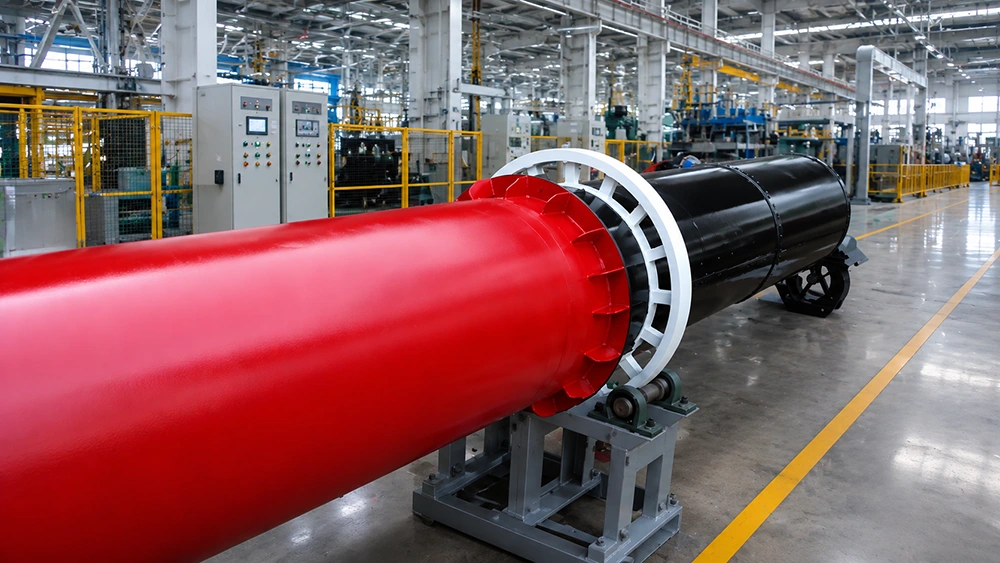
Dryr is built as a standardized rotary drum dryer for continuous sawdust drying. Its assembled structure is produced and fitted before shipment, improving dimensional consistency while allowing the equipment to be split for sea freight and assembled on site. This split shipment assembly dryer reduces dependence on local welding capability during installation. An optional PLC control package coordinates continuous feeding and operation, helping reduce manual intervention and making on-site installation and commissioning easier to organize for a pellet plant or molded pallet production line.
From Fabrication Precision to Process Stability
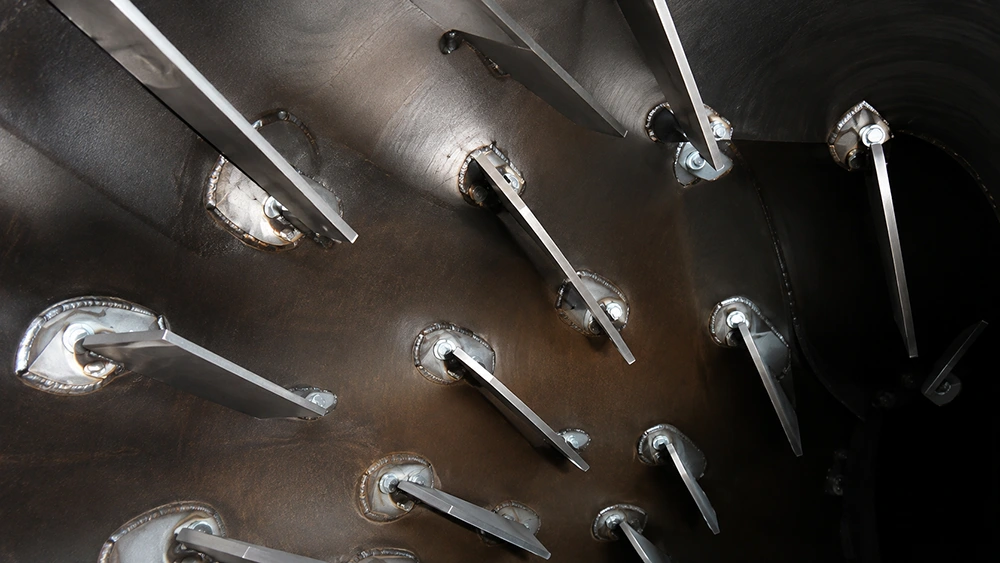
The product evidence is visible in the drum assembly and chamber details: segmented cylindrical sections, bolted ring connections, roller supports, and a defined drive frame provide a serviceable mechanical layout. Inside the chamber, staggered lifting flights turn and distribute the material through the hot air path instead of allowing sawdust to travel as a compact layer. Dryr configurations cover approximately 0.8–2 t/h, with diameter options of 1000, 1200, 1500, and 1800 mm; a properly specified system can target output moisture below 10%, subject to material and process conditions. With optional cyclone or baghouse dust control, the result is steadier feed preparation, fewer operator corrections, and a more repeatable basis for pelletizing or molding.
- emp-section
- emp-btn-primary
- href="/contact/"
- Drum dryer


