Charcoal Briquette Production: How a Rotary Sawdust Dryer Cuts Carbonization Energy and Steam Risk
Start with the Carbonization Feed, Not the Furnace
High-moisture sawdust entering a sealed carbonization process carries both an energy load and a process-safety concern. A continuous rotary sawdust dryer can reduce the feed to below 10 percent moisture before carbonization, so the furnace does not spend its main heat load evaporating water and less feed moisture is available to become trapped steam. Dryr is selected from actual inlet moisture, particle size, heat source, and target throughput rather than from a headline capacity alone.
Why a Rotary Sawdust Dryer Fits the Upstream Step
Natural sun drying and manual open-air drying are difficult to stabilize when weather, floor space, and raw-material supply change. A small airflow dryer or sawdust flash dryer may suit fine, low-moisture feed at a limited rate, but it should not be selected without checking particle size, initial moisture, and required throughput. Dryr is a continuous industrial sawdust dryer built around a rotary drum dryer path. A hot air furnace supplies process air while the rotating drum lifts, disperses, and advances the sawdust, wood shavings, or other validated biomass material. This gives the carbonization line a dedicated moisture-reduction step and keeps the downstream furnace focused on carbonization.
Structure and Parameters That Can Be Checked
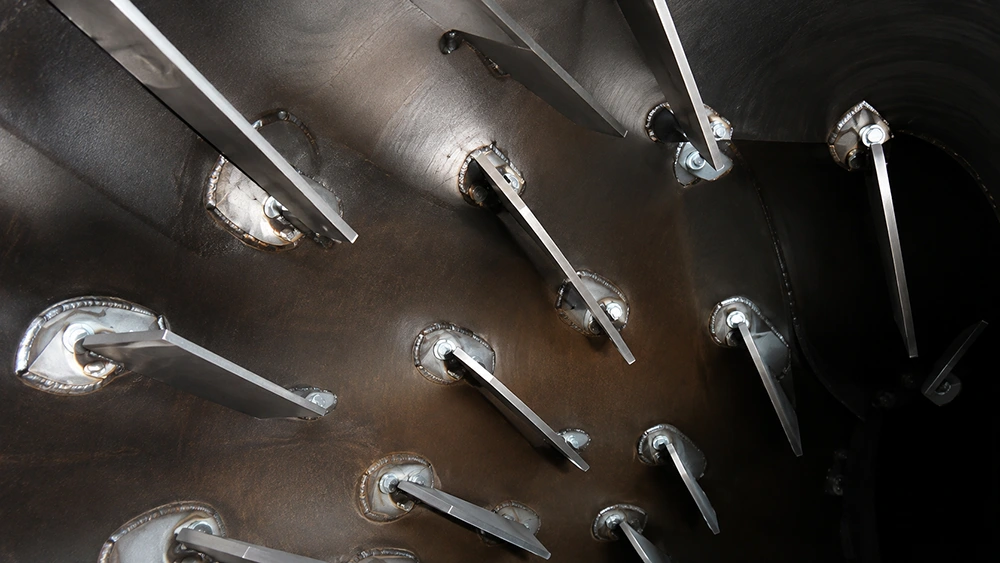
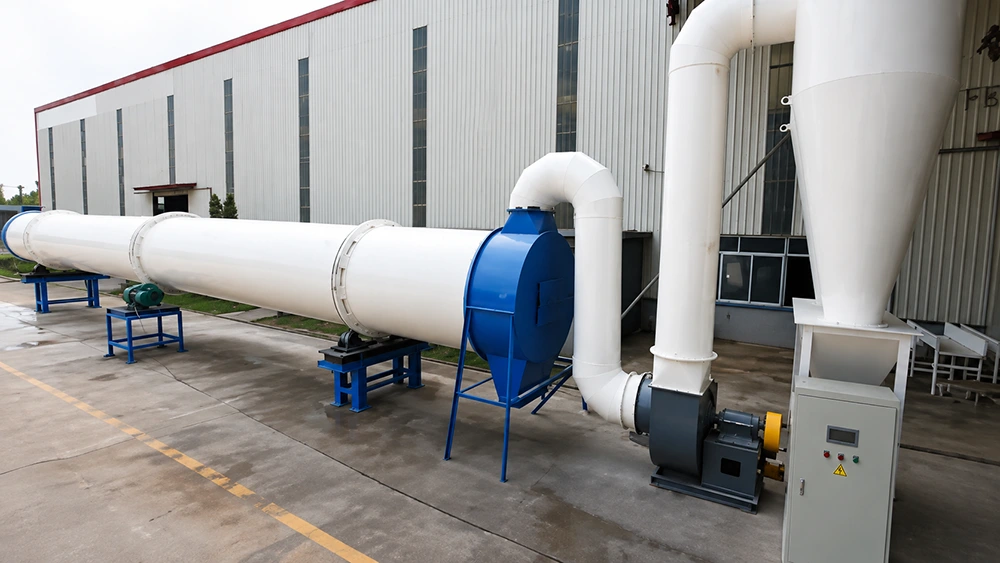
The internal evidence is visible in the Dryr gallery. The chamber image shows staggered metal paddle bars, welded mounting plates, bolted hubs, and continuous weld details; these are the lifting elements that expose more material surface to hot air as the drum rotates. The system image shows the horizontal drum connected to process ducting, a centrifugal blower, a cyclone separator, and steel support frames. The documented range is approximately 0.8–2 t/h: H-1010 uses a 1000 mm drum, 4 kW main motor, and 7.5 kW induced-draft fan for 0.8–1 t/h; H-1212 uses 1200 mm, 5.5 kW, and 7.5 kW for 1–1.2 t/h; H-1512 uses 1500 mm, 7.5 kW, and 11 kW for 1.2–1.5 t/h; H-1815 uses 1800 mm, 11 kW, and 15 kW for 1.5–2 t/h. The stated target outlet moisture is below 10 percent, but the actual result must be confirmed against feed conditions and heat-source selection.
The Result: Less Water Load Before Carbonization
With the moisture target set and verified at the dryer discharge, the carbonization furnace receives a more consistent feed and a lower water load. That can reduce the fuel spent boiling off water and help shorten the carbonization cycle; it also removes the wet-feed moisture source before a sealed carbonization step, reducing the moisture-driven steam accumulation risk. Dryr records a self-insulated design and a stated thermal efficiency above 80 percent, while fuel options can include coal, oil, natural gas, or suitable dry solid, pellet, or powder fuels depending on the project. A cyclone dust collector or baghouse filter, PLC control, screw conveying, and final safety devices should be confirmed in the project scope. The practical result is a pre-drying stage that supports energy and safety decisions without treating the dryer as a substitute for pressure relief, venting, interlocks, or commissioning of the carbonization system.
- Define inlet moisture, particle size, and the required outlet moisture before sizing the sawdust dryer.
- Match the 0.8–2 t/h range and model to the real charcoal briquette or carbonization feed rate.
- Confirm the hot air furnace, fuel, cyclone or baghouse, controls, and discharge conveying scope.
- Validate pressure relief, venting, interlocks, and commissioning for the sealed carbonization process.


