Sawdust Dryer for Charcoal Briquette Production
Why drying becomes the bottleneck during charcoal briquette plant expansion
When a charcoal briquette plant expands, the briquetting presses and carbonization furnaces are often upgraded first. If the front-end sawdust drying capacity stays unchanged, wet material cannot feed the downstream equipment at the planned rate. DRYR is a rotary sawdust dryer for charcoal briquette production, with four configurations covering 0.8–2 t/h and a project option for a 17–18 m drum to increase residence time and evaporation capacity. The sizing basis is the water that must be evaporated across the line, not the nominal feed rate alone.
Why the old drying arrangement leaves new downstream capacity unused
Natural sun drying and manual open-air drying may appear inexpensive at a small scale, but they do not provide a stable continuous drying step for an expanding plant. Weather, yard space, handling, and changing moisture can interrupt material flow before briquetting. A small airflow dryer can also be difficult to match when the required evaporation load rises. Selecting a dryer only by the wet sawdust throughput can leave the line short of the heat and residence time needed for moisture reduction, so the press or carbonization furnace remains underfed even after its nominal capacity is increased.
How to match a rotary sawdust dryer to the whole production line
DRYR uses four sawdust dryer configurations, H-1010, H-1212, H-1512, and H-1815, covering 0.8–2 t/h for small and medium charcoal briquette plants. The selection should start with the required water evaporation load and include a practical buffer for feed variation and planned expansion. When the calculation calls for longer residence time, the rotary drum can be customized to 17–18 m. A longer drum gives the material more time in the drying process and can increase evaporation capacity without treating the dryer as an isolated machine.
What the structure and process layout deliver at the line outlet
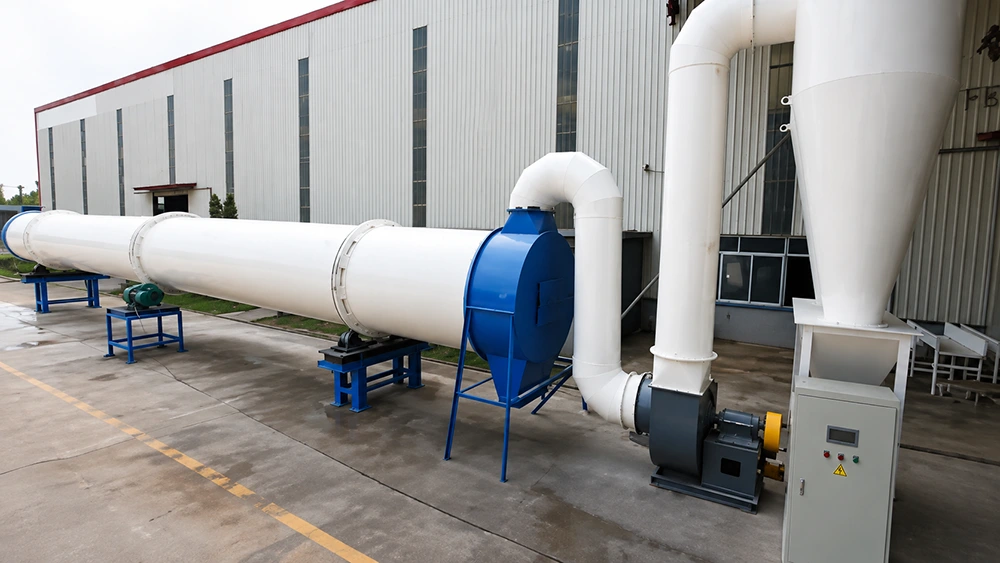
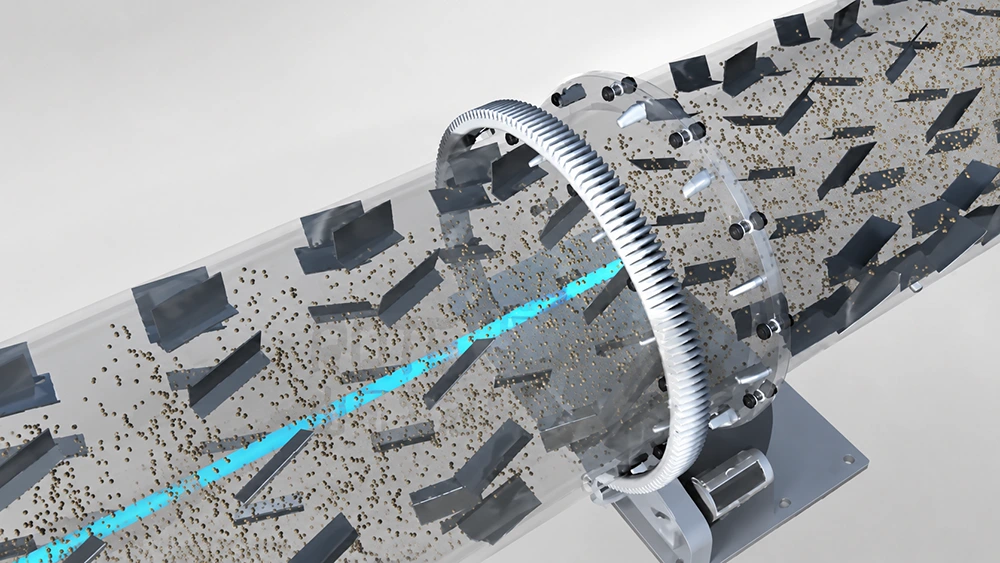
The equipment layout provides visible engineering points for the capacity calculation. The system view shows a horizontal rotary drum, process ducting, blower, cyclone separator, support frames, and a control cabinet. The transparent drum view shows internal lifting flights that raise and disperse granular material as the drum rotates, supporting contact with the hot air stream. These features connect the dryer specification to the production objective: continuous sawdust drying, controlled dust handling, and a moisture condition that supports stable briquetting. With the dryer sized by evaporation demand and commissioned with the complete line, the front end is less likely to become the slowest step as pressing and carbonization capacity grows.
- Match the dryer to the water evaporation load created by the target wet sawdust feed rate.
- Reserve drying capacity before adding briquetting presses or carbonization furnaces.
- Use a longer 17–18 m drum when the project needs more residence time and evaporation capacity.
- Specify moisture control, continuous feeding, dust collection, and commissioning around the complete charcoal briquette line.


