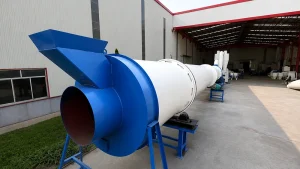
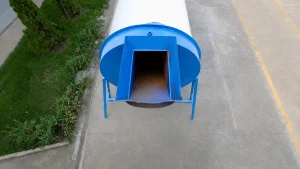
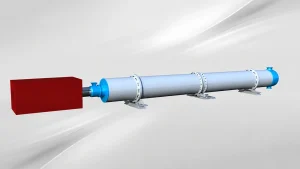
Sawmill Residue • 46% of Log Volume • Drum Wood Chip Making Machine
The Sawmill Residue Problem: 46% of Every Log Becomes a Disposal Line
A wood chip making machine changes the math on sawmill residue. FAO data shows roughly 46% of a log leaves the sawmill as slabs, edgings, trims, sawdust and bark; the same FAO appendix marks that stream as usable raw material for particleboard, MDF, pulp and biomass fuel. A 45 kW drum wood chipper turns the disposal cost line into a saleable chip line, without paying for a 110 kW turnkey system the mill does not yet need.
Why a Drum Wood Chip Making Machine Fits the Residue Flow
Residue is not a uniform feedstock. Slabs arrive flat and wide, edgings arrive as long thin strips, offcuts arrive with nail-free faces, bark arrives wet and stringy. A drum wood chipper handles that mix because the rotor is fed by a hydraulic upper feed roller that floats over thickness changes, with a lower pressing roller underneath to keep thin edgings from skipping past the cut. The fly knives mounted on the knife roller shear against a counter knife at a fixed gap, and the sizing screen underneath lets only correctly sized chips fall through while oversized pieces stay inside for another pass. That is the design difference that matters for residue: a disc chipper wants a square end and a fixed length, which is why it is preferred for clean pulp logs, while a drum wood chip making machine accepts the irregular geometry that a sawmill actually produces and still outputs chips within a tight size band. For a mid-size sawmill running 80,000 to 120,000 cubic metres a year, the 45 kilowatt X-215 tier delivering 4 to 5 tonnes per hour matches the residue stream the headrig and edger discharge across two shifts without forcing the mill into the 110 kilowatt capex of an X-218 sized for a 30 tonne per hour pellet plant.
Inside the X-215: Hydraulic Feed, Drum Rotor, 30-35 mm Chip Screen
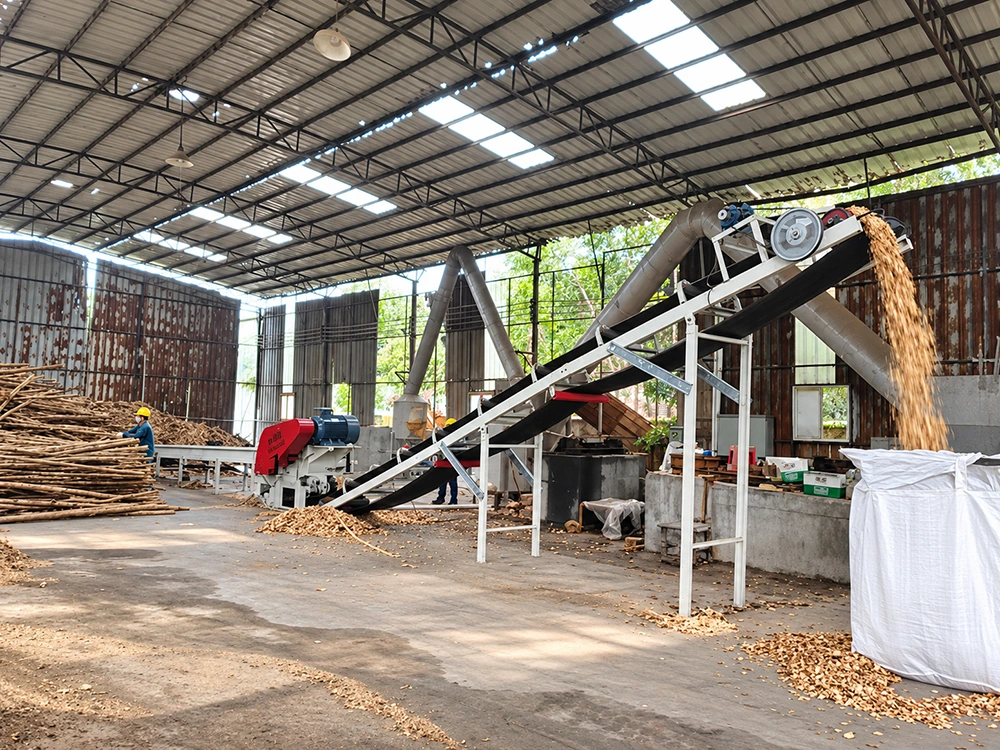
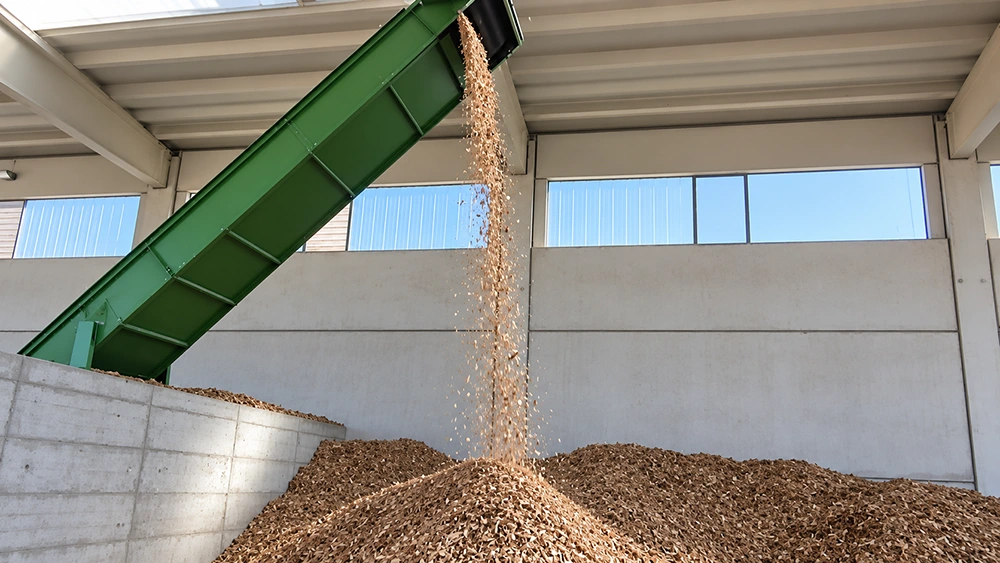
The X-215 drum wood chip making machine is built around a 600 millimetre diameter knife roller turning at 590 rpm, fed through a 400 by 180 millimetre inlet that accepts up to 160 millimetre diameter stock. The upper feed roller is hydraulically loaded so it floats over slab edges and settles back down on thin edgings, which is the practical behaviour sawmill operators ask for when the infeed is mixed. Two fly knives are bolted to the drum and indexed against the counter knife; chips drop through the sizing screen and oversized material recirculates inside the housing until it qualifies. A 380 volt soft starter cabinet with a variable frequency drive meters feed speed and a wireless remote handles start and stop from the loader cab. The line photograph below shows the working layout: inclined belt conveyor lifting chips from the drum chipper discharge into a bulk bag, with the ducting tied into dust control. Output chip size is held at roughly 30 to 35 millimetres, which is the standard input window for downstream pellet plants, particleboard furnish preparation and biomass boiler fuel. Total connected load is 49.4 kilowatts, of which 45 kilowatts is the main motor and the balance is the feed and hydraulic auxiliaries.
From Disposal Cost to Chip Revenue: What Changes at the Mill Gate
Once the drum wood chip making machine is installed at the sawmill gate, the residue stream stops being a cost centre and starts being a controlled raw material line. Uniform 30 to 35 millimetre chips can move into a particleboard or MDF furnish line, into a biomass fuel pile for the mill boiler, or into bulk bags for sale to regional pellet producers, which is the path most CMLU-style mills take because they are already running an export-oriented lumber business and need a defensible sustainability story on the residue side. Capital exposure is contained at the 45 kilowatt X-215 tier, so payback depends on local chip prices rather than on a European turnkey quote sized for throughput the mill will not see for years. For a sawmill that wants to scale later, the same Shred platform steps up to the X-216 at 55 kilowatts and 6 to 8 tonnes per hour, or to the X-218 at 110 kilowatts and 8 to 12 tonnes per hour, on the same drum geometry and the same chip specification. The boundary the mill still has to manage is metal contamination from demolition wood or nail-bearing offcuts: the drum wood chipper ships without a metal detector on the standard configuration, so nailed feedstock needs pre-sorting or an upstream metal control step before it reaches the rotor. Clear that path and the sawmill moves from paying to dispose of 46% of every log to shipping those chips as a second revenue line on the same truck that takes the lumber out.
- Title contains the exact phrase 'wood chip making machine' and is not on the existing published title list for this site.
- Slug uses 'wood-chip-making-machine-sawmill-residue' to match the SEO keyword without repeating any prior sawmill slug.
- Section 1 cites the FAO 46% residue figure with attribution and the sawmill customer scene.
- Section 3 documents X-215 specifications (45 kW, 600 mm rotor, 4 to 5 t/h, 30 to 35 mm chips) that match the official EMP parameter table.