Franchise network | AutoML molded pallet line
The franchise node is selling a product it cannot differentiate
A franchise network earns its position from channel and brand, not from manufacturing. So when the pallet a node sells is a commodity standard item, the price is public, the lumber bill moves on its own, and the only lever left is bidding lower than the node next door. This page is about the practical route a mature network uses to put an own-brand, fumigation-free molded pallet into the same truck lanes it already runs: wood waste to pallet conversion on an automated pallet manufacturing line added inside an existing production node.
Why a molded pallet production line fits a node that already exists
The mistake is to treat a new SKU as a greenfield factory project. AutoML is not a stand-alone press; it is a project-based production line that chains crushing, drying, glue mixing, dosing and spreading, hot pressing, demolding and stacking into one process, and it is configured either as a semi-automatic line or a full automatic pallet manufacturing line depending on local labor cost, power capacity, plant layout and target output. That matters for a network because the node already has the building, the electrical supply and the operating team. Investment references from project costing notes put a full automatic line at around RMB 4 million and a semi-automatic line at around RMB 2 million, which is an asset step a mature production node can underwrite, not a construction program. The automation boundary is flexible: a node can keep the core press and the glue mixing module and trim upstream or downstream automation when the budget is tight, then extend later. And the raw material side is the structural difference. Feedstock is sawdust, wood chips, shavings, straw, bamboo powder and bagasse, so the line runs on residues and recovered fiber rather than on purchased lumber, which is what moves the margin structure away from the lumber curve the nailed pallet business is tied to.
What the press, the dosing station and the parameters actually show
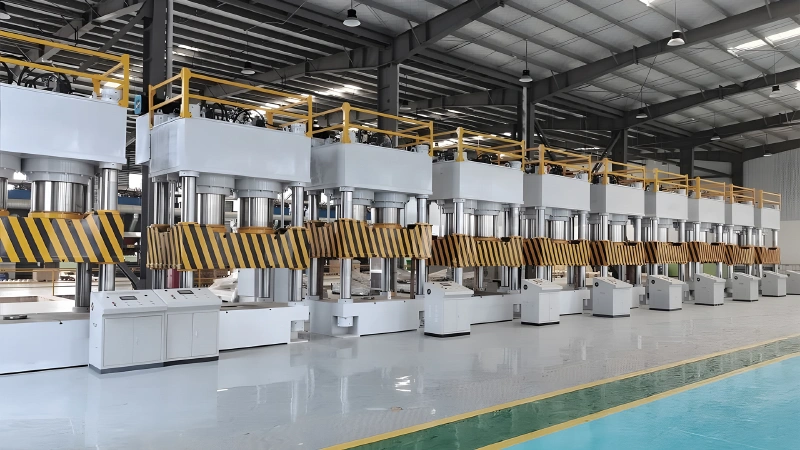
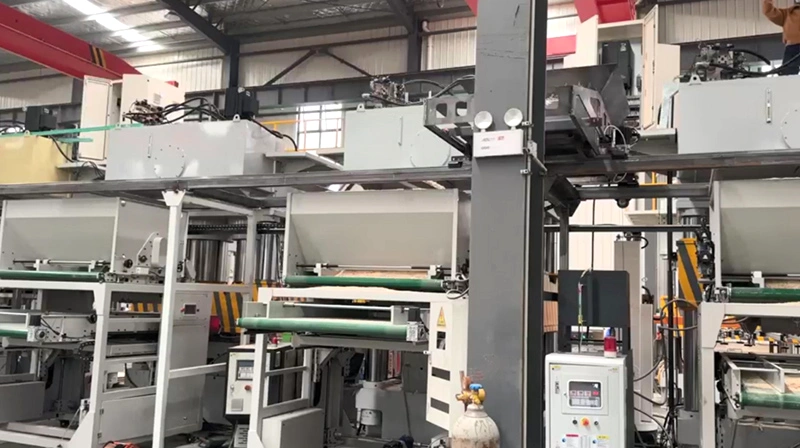
The first image in this article is the press hall: a row of 1600T class three-beam four-column hydraulic hot presses with their own control cabinets on a clean epoxy floor, which is the capacity unit the network node would be adding. The second image is the dosing side of the same line: overhead dosing belt feeders and hoppers metering the glued sawdust mixture into the molding tools, which is where density variation is created or removed. Parameters that come out of the product files for this class of line: pressing temperature 150 to 180 degrees C, pressing pressure 15 to 20 MPa, and a press cycle of roughly 180 to 240 seconds, with slide fast closing referenced at about 10 seconds in some project files. Raw material is prepared to a length of 5 to 30 mm and a thickness of 2 to 5 mm, and finished product density is referenced at 0.8 to 1.2 g per cubic cm. Common mold sizes include 1000×1000, 1100×1000, 1200×1000 and 1219×1016 mm, with 9-leg single-face, flat single-face, cross-base double-layer and three-runner flat structures plus custom molds for special loads. Glue dosage is project dependent, referenced around 8 to 10 percent for MDI and 10 to 12 percent for UF or PF, and moisture has to be matched to the glue system and trial data rather than treated as a fixed number, because the files themselves carry different windows for UF and MDI processes.
What the node ends up selling, and what the network gets back
The output is a one-piece, nail-free molded pallet produced from recovered fiber, which changes three commercial things at once for a franchise network. The product is differentiable: it carries the network's own label as a private-label SKU instead of being an anonymous standard item. The compliance position is cleaner for export and high-end packaging users, because a molded one-piece pallet removes the need for the heat treatment and fumigation queue that solid wood packaging goes through, and nestable pallet manufacturing cuts the space the same pallet occupies in storage and in return freight. And the cost base stops tracking lumber, because the feedstock is waste fiber rather than boards. Distribution is the part the network does not have to rebuild: the new SKU goes into the truck lanes, depots and accounts that already move the existing pallet lines, so there is no channel construction cost behind it. Payback logic follows the usual project variables, with project costing notes referencing a typical static payback of about 1.3 to 1.8 years in favorable cases and worst-case scenarios extending to roughly 3 years, against fuel, labor, glue, utilization and local selling price. For a franchisee, that reads as a second product line inside the same gate. For the network, it reads as a branded, higher-margin layer sitting on top of the commodity business without touching the commodity volume it already runs. The next step is a node-level check on power capacity, plant layout, feedstock access and target output before the line configuration is fixed.
- Route contract: emp_fixed_render owns the body DOM with root section.emp-section.emp-blog-p0.emp-blog-p0–tw-layout, including emp-btn-primary and href="/contact/"; no free-form DOM and no H1.
- Images: only AutoML designer gallery sources were used, 1 (2).webp as the 1600T press row and 1 (13).webp as the dosing belt feeders, each imported once through wp_media_batch.
- Facts: 1600T class three-beam four-column presses, 150-180 C, 15-20 MPa, roughly 180-240 s cycle, 5-30 mm by 2-5 mm feedstock, 0.8-1.2 g per cubic cm density, RMB 4 million full automatic and RMB 2 million semi-automatic line references.
- Transaction fields: post_type=post, category=news, b2b_source_brand=emp, b2b_page_type=blog, b2b_page_lang=en, b2b_canonical_product=AutoML, featured image required, comments and pings closed.