Multi-Country Call-Off Consistency
The Node-by-Node Reality Behind One Call for All
A group that sells packaging as one call for all runs on a promise that a single order covers every node it ships from. Wooden stringer pallets and traditional pallet nailing machines cannot hold that promise: moisture, species and batch drift between countries, and the buyer only finds out at incoming inspection. A presswood pallet machine and a molded pallet production line move the standard into the tooling, so every node presses the same pallet from the same parameters instead of negotiating tolerance after the fact.
What a Traditional Pallet Nailing Machine Cannot Control
Sawn lumber reaches each node with its own moisture content, density and grade, and a traditional pallet nailing machine repeats whatever the operator fed it. Wooden stringer pallet equipment can be perfectly maintained in every plant and still turn out pallets that differ between plants, because the input differs. Groups compensate with drawings, incoming inspection and sampling, and mis-matches are usually settled after the pallets are already in the supply chain, where the cost has moved to the customer line. Heavy duty hardwood pallet makers hit the same structural ceiling, and a used pallet press taken over from an earlier line often cannot repeat a documented parameter set at all. The gap is not effort. A nailed wood pallet simply has no fixed molding parameter holding its geometry in place.
Where the Standard Gets Locked: Weighing-Based Dosing and the Press
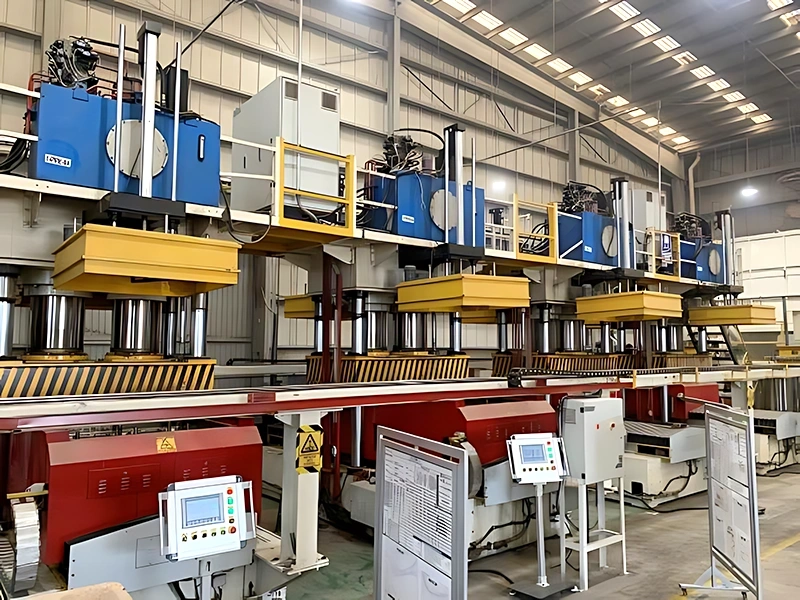
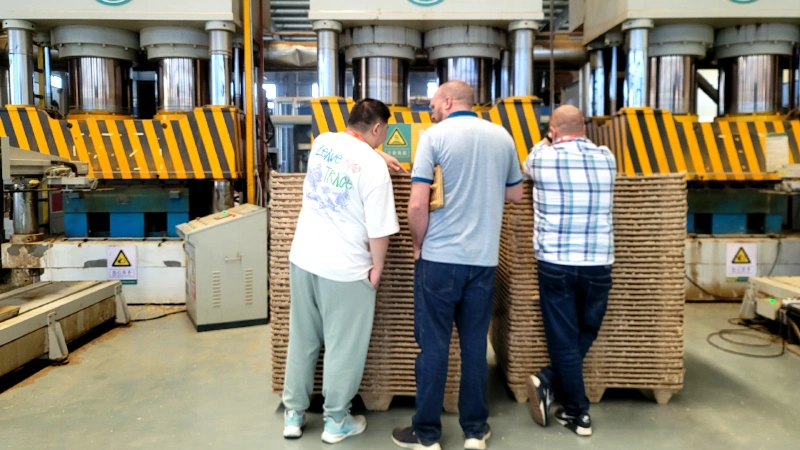
The AutoML molded pallet production line is engineered so the variables that move in a wood shop are fixed by machine settings instead. A rail-mounted spreading system with weighing-based dosing places a measured fiber and adhesive charge into the tooling, so pallet weight and density no longer depend on how much material a hand tipped in, and the same recipe is called up at every node. A 1600T three-beam four-column hot press then molds the pallet in one piece at 150 to 180 degrees Celsius under high pressure, curing the binder and setting the final geometry while the mold is closed. The spreading segment with its rail travel and central PLC screens is where charge weight is recorded and traceable; the finishing stage is where molded pallets are checked as vertical stacks for flatness, entry height and stack fit before they leave the plant. No nails, no stringers, no warping: the nail-free wooden pallet process yields a nestable molded pallet whose footprint and entry heights come off the same tooling at every site.
Result: One Qualification Run, Every Node
For the buyer, the change is that consistency becomes a property of the equipment rather than an outcome of supervision. A pallet qualification run at one node defines the mold, the charge weight, the pressing parameters and the demolding sequence, and those same numbers travel to the other nodes, so a call-off placed in country A and a call-off placed in country B resolve to the same pallet, dimensionally and in load class. Because the pallet is a pressed wood product rather than sawn timber, it also removes the heat treatment and marking step that drives per-shipment paperwork on wooden pallets, which simplifies cross-border call-off under ISPM-15 rules. Groups that already run crushing and wood waste recycling machine capacity upstream can feed the presswood pallet machine from their own recovered fiber, so wood waste to pallet conversion becomes the raw material strategy standing behind the standard. One call for all then rests on a recorded molding parameter, not on a site visit.
- Pallet geometry and load class are set by mold and pressing parameters, so a single specification can be reproduced at every network node.
- Weighing-based dosing fixes charge weight and density by machine setting instead of operator judgment.
- One-piece molded pallets use no nails or stringers and need no heat treatment step, which removes per-shipment fumigation paperwork.
- Repeatable core parameters: 1600T three-beam four-column press class, 150 to 180 degrees Celsius mold temperature, one-piece demolding.